Skip to content
Back to guides
Market moves 9 min read

2026 NFL Schedule Release Primer: Betting and Fantasy Angles to Track Off the Slate

Read the price, role, and market first

The 2026 NFL schedule was released in mid-May. Here is what bettors and fantasy players should track now that the full slate is out.
9 sections
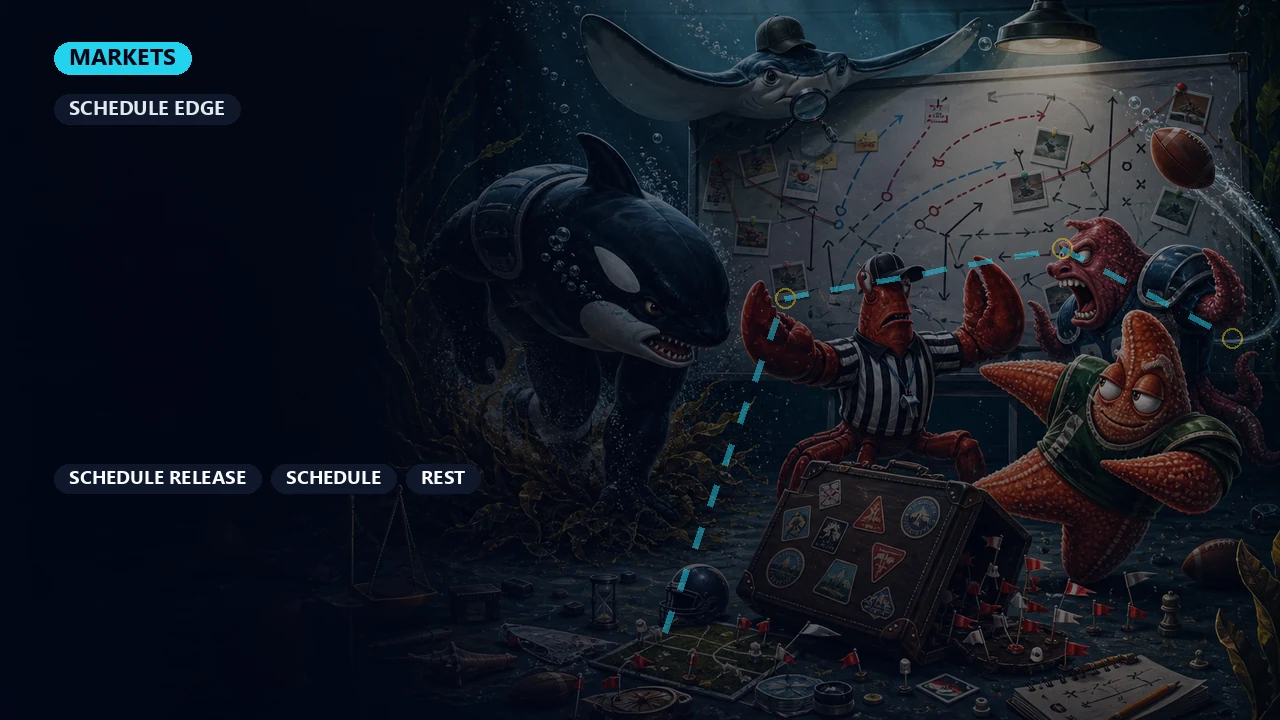
2026 NFL Schedule Release Primer: Betting and Fantasy Angles to Track Off the Slate cover art

The 2026 NFL schedule was released in mid-May. The fantasy and betting mistake is treating it like a wallpaper reveal. The schedule changes rest edges, travel spots, fantasy playoff matchups, weather windows, prime-time tax, and lookahead lines before a ball is snapped.

Prime-time count is a schedule signal, not just a vibe

When the slate drops, count standalone windows per team: Sunday night, Monday night, Thursday night, and the holiday spotlight games. The networks flex toward perceived contenders, so a heavy prime-time allocation for the Chiefs, Bills, Ravens, Eagles, Cowboys, or Lions tells you the league expects them to matter. That visibility feeds award markets and futures liquidity before it changes any single spread.

There is a real edge in the discount, too. A roster the schedule-makers ignored gets fewer national windows, which means fewer sharp eyes hammering its weekly numbers and more soft early lines to attack. The flip side is the short-week tax: every Thursday night appearance shortens a prep cycle on both sides of that game and the one after it, so a team with several Thursday games is carrying a recovery burden that a team with none simply is not.

For fantasy, prime-time count matters less for a target hog like Justin Jefferson or CeeDee Lamb and more for game-script-dependent pieces. A quarterback in many standalone, pass-heavy environments accumulates garbage-time and shootout volume that a run-first team in noon kickoffs will not. Note it, but do not let a Sunday-night logo move a player above his role.

Bye placement is a roster-construction input, not trivia

The bye week is the most underrated line item in the release. An early bye (Weeks 5 through 7) means your fantasy starters play straight through the championship stretch, which is exactly what you want. A late bye stacked into the fantasy playoff window is a quiet trap: drafting two running backs who both rest in Week 14 forces a mid-playoff scramble for replacement touches.

Cross-reference byes across your likely core before you draft. If your plan leans on a Lions or Ravens skill-position cluster, a shared bye concentrates risk on one weekend; staggering byes across your starting lineup is free insurance that costs nothing but attention. The same check applies to streaming positions, where a kicker or defense bye should map cleanly onto a waiver replacement you already like.

On the betting side, a bye is a rest edge only in context. A team off a bye facing an opponent on a short week is the textbook spot, but the bye alone is not a bet. Pair it with the rest, travel, and prior-opponent factors before you move a number, the same discipline this primer applies everywhere else.

What to work through now that the slate is out

Circle short weeks first. Thursday road games after physical divisional matchups are where player props, team totals, and injury-risk assumptions can shift. Then mark long-rest teams, bye-week placement, and whether teams like the Bills, Chiefs, Ravens, Eagles, Cowboys, and 49ers get travel clusters.

For fantasy, Weeks 15 through 17 matter most. If Josh Allen, Lamar Jackson, Jahmyr Gibbs, Amon-Ra St. Brown, or Justin Jefferson gets a clean playoff schedule indoors or against fast-paced opponents, that belongs in projection notes even if it should not override talent.

Early announcements and marquee slots

Ahead of a full release, the NFL and broadcast partners typically reveal selected games, and the marquee slots that drew the early hype are worth revisiting. Treat a flashy prime-time opener or a holiday showcase as puzzle pieces, not full conclusions: those slots tell you about attention, travel, and market liquidity, but not the full fatigue map.

International games deserve their own tab. Long overseas travel changes bye-week assumptions, especially when teams return without immediate rest, so flag each international assignment and the spot that follows it.

Follow-up plan after release

Once the full slate is public, build three lists: teams with rest advantages, teams with brutal travel clusters, and fantasy players with playoff-window matchup upgrades. That follow-up article should be more specific than this primer because every date, kickoff window, and bye week will be known.

The biggest edge is speed plus discipline. You want to react before stale lookahead markets update, but you do not want to overprice a schedule angle that is smaller than quarterback play, offensive line health, or defensive personnel.


Practical checklist for 2026 NFL Schedule Release Primer

Start by writing the decision in plain English: The 2026 NFL schedule was released in mid-May. Here is what bettors and fantasy players should track now that the full slate is out. That keeps the page tied to a concrete betting decision, not a generic 2026 NFL take. Tag the note with nfl-betting, nfl, 2026-nfl, schedule-release so you can find the same angle again when the board, depth chart, or injury report changes.

Checkpoint one is "Prime-time count is a schedule signal, not just a vibe." Do not move past it until the data you are using would have been available before the decision. The supporting evidence should connect to this claim: When the slate drops, count standalone windows per team: Sunday night, Monday night, Thursday night, and the holiday spotlight games. The networks flex toward perceived contenders, so a heavy prime-time allocation for the Chiefs, Bills, Ravens, Eagles, Cowboys, or Lions tells you the league expects them to matter. That visibility feeds award markets and futures liquidity before it changes any single spread.

Checkpoint two is "Bye placement is a roster-construction input, not trivia." Convert that section into one measurable field, whether it is a rest flag, route-share trend, win-total range, projected fantasy points, or market entry price. If the field cannot be written down, the angle is still a story instead of a model input.

Checkpoint three is "What to work through now that the slate is out." Record the opposing case before acting. A useful note says what would make the thesis wrong, what closing-line or ADP movement would confirm that the room already adjusted, and how small the first stake or roster exposure should be.

Build this in your own browser
  • Prime-time count is a schedule signal, not just a vibe
  • Bye placement is a roster-construction input, not trivia
  • What to work through now that the slate is out
  • Early announcements and marquee slots
  • Follow-up plan after release

Take the workflow above and turn it into a model that makes these picks for you: open it in the Workshop with this topic pre-loaded, start a fresh build, or see what the sharpest creators are running on the same theme. Once it is winning, you can chase the leaderboard or scout a squad on the NFL auto-battler.

Building this is concrete. Pick the real reason the edge exists — a usage trend, a schedule spot, a situational tendency, or news timing — and only feed the model what you would have actually known before betting. If a final stat or the closing line sneaks into the inputs, the model looks brilliant in testing and goes broke in real life. Then tell it what to predict: a margin for a spread, an over/under for a player prop, a win probability for a moneyline, or a fantasy point projection for your lineup. Every step stays in plain view so anyone — including you next week — can see exactly why it made a pick.

How it tests matters more than how it looks. Run it on past seasons it has never seen and judge it on the most recent games, not a cherry-picked stretch. Hold it to a simple bar: does it actually beat the closing line? A model that cannot beat "just trust the closing number" is not worth the trouble. Check that its confidence is honest — when it says 60%, those picks should hit around 60% of the time. And only fire a bet when the edge survives the vig, sensible bet sizing, and an honest look at last week's losing tickets, because a few lucky or unlucky weeks can hide both a winning process and a losing one.

To make it real, open the Workshop with the same topic and rebuild the workflow above. A typical model for an article like this pulls in the data that drives the angle (play-by-play, schedule, or player usage), turns it into the one signal that matters, predicts the market you care about, tests itself on past seasons, and sizes the bet for you. When its closing-line value holds up over a real sample, you can publish it and climb the leaderboard.

Keep the rabbit hole useful: rest and travel betting spots, fantasy playoff schedule strategy, closing-line value guide, bet tracking workflow.

Verified stat anchors and 2026 price checks

Use names as evidence, not decoration. The useful SEO win is that Josh Allen, Lamar Jackson, Jahmyr Gibbs, Amon-Ra St. Brown and Justin Jefferson and Chiefs, Bills, Ravens, Eagles and Lions appear inside decisions, thresholds, and internal links instead of being dumped into a keyword list.

Calibrate the fantasy take with real 2025 production before moving to 2026 price. StatMuse season pages list Jonathan Taylor at 1,559 rushing yards, 18 rushing TDs, and 44 receptions; Bijan Robinson at 1,478 rushing yards with 79 catches for 820 receiving yards; Jahmyr Gibbs at 1,223 rushing yards, 77 catches, and 616 receiving yards; Puka Nacua at 166 targets, 129 catches, and 1,715 receiving yards; and Amon-Ra St. Brown at 172 targets, 117 catches, 1,401 yards, and 11 receiving TDs.

  • ADP rule: pay full freight only when role, team total, and contingency value all support the ceiling.
  • FAAB rule: 45-70% for a real lead-RB takeover, 25-45% for a target-share breakout, 10-25% for a stable flex, 1-8% for streamers, and 0-3% for bench stashes.
  • PPR tiebreaker: a Kyren Williams-style rushing profile and a Gibbs or Bijan receiving profile should not be priced the same if catches are worth a full point.
  • QB rushing rule: Josh Allen and Jalen Hurts archetypes deserve separate math from pocket passers because goal-line rushing can change weekly ceiling and late-round replacement value.

Turn those names into decisions: draft, fade, trade, stash, or bid only when the 2026 price leaves room after role risk. Related workflows: fantasy ADP value tiers, target share vs air yards, FAAB strategy.

Research note board

Use this draft-room board before moving a player up or down. It keeps projection, price, and format separate.

DecisionCheck firstExample applicationDo not act if
DraftADP, scoring format, role certaintyJosh Allen at sticker price versus Lamar Jackson at a discountThe room is charging for ceiling while role risk is still unresolved
TradeRest-of-season role, playoff schedule, roster needJahmyr Gibbs as a need-based target instead of a generic upgradeBoth sides depend on the same fragile team environment
Waiver or stashInjury-away upside, first-team reps, FAAB reserveAmon-Ra St. Brown profile compared with a short-term streamerThe move costs flexibility without adding a clear starting path

Use the examples as context, not as a bet recommendation. Markets move, depth charts change, and injury reports matter.

Educational analysis only, not a bet recommendation. Check current lines, injuries, rules, contest terms, and local regulations before acting.

DFS projected ROI vs ownership %

Projected GPP ROI multiplier vs projected ownership across simulated lineups. Sub-10% leverage plays compound when they hit; chalk plays cap your upside even when the projection is dead-on.

Prop OVER hit rate vs line distance from median

Empirical hit rate of OVER bets as the prop line moves away from the player projection median, measured in standard deviations. A line set 1sd below the median hits ~84% of the time — but books price the juice to match.

Frequently asked questions

What is the key takeaway from "2026 NFL Schedule Release Primer"?
The 2026 NFL schedule was released in mid-May. The fantasy and betting mistake is treating it like a wallpaper reveal. The schedule changes rest edges, travel spots, fantasy playoff matchups, weather windows, prime-time tax, and lookahead lines before a ball is snapped. The article is written so you can build a model around it rather than just read another opinion — every claim ties back to a signal, a timing window, or a test you can run yourself on past seasons.
What does the section on "Prime-time count is a schedule signal, not just a vibe" actually cover?
When the slate drops, count standalone windows per team: Sunday night, Monday night, Thursday night, and the holiday spotlight games. The networks flex toward perceived contenders, so a heavy prime-time allocation for the Chiefs, Bills, Ravens, Eagles, Cowboys, or Lions tells you the league expects them to matter. That visibility feeds award markets and futures liquidity before it changes any single spread.
How do you turn this article into a workable model in Shark Snip?
Open the Workshop with the topic pre-loaded, feed it the data the angle relies on, tell it what to predict (a spread cover, a prop over, or fantasy points), and test it on past seasons before you risk real money or move your roster. Everything stays in plain view, so when it wins you can publish it and let other players follow it.
What is the most common mistake when applying "Follow-up plan after release" in practice?
Once the full slate is public, build three lists: teams with rest advantages, teams with brutal travel clusters, and fantasy players with playoff-window matchup upgrades. That follow-up article should be more specific than this primer because every date, kickoff window, and bye week will be known. Validate against the closing line, not just the outcome — a winning bet at a stale number is still a process loss, and a losing bet that beat the close is still a process win over a useful sample.

Build a free model in 60 seconds →

Go →
9m read time
30 players/teams
12 key angles
Angles in this read 6 angles
Target heat fantasy
Tier stack fantasy
Snap meter fantasy
Ownership leverage dfs
Correlation web correlation
Edge meter edge

FantasyPros 2025 PPR anchor plus 2026 role context

Fantasy examples should stay tied to role, usage, format, and price instead of generic labels. For RBs, separate workload security from last season finishes before moving a player up the board.
Jonathan TaylorKyren WilliamsChristian McCaffreyBijan RobinsonJahmyr GibbsJames Cook IIIDerrick HenryDe'Von AchaneColtsRams49ersFalconsLionsBillsclosing line valuetarget shareair yardsred-zone roleroute participation
2026 NFL Schedule Release Primer: Betting and Fantasy Angles to Track Off the Slate data infographic
Chart view of the article's core numbers. Source: inline-lib-dfsOwnershipVsLeverage-nfl-schedule-release-2026-betting-fantasy-primer.

Start free — pick NFL

Go →

We use cookies for essential site functionality. With your consent, we also use cookies for analytics and performance monitoring. See our Privacy Policy.