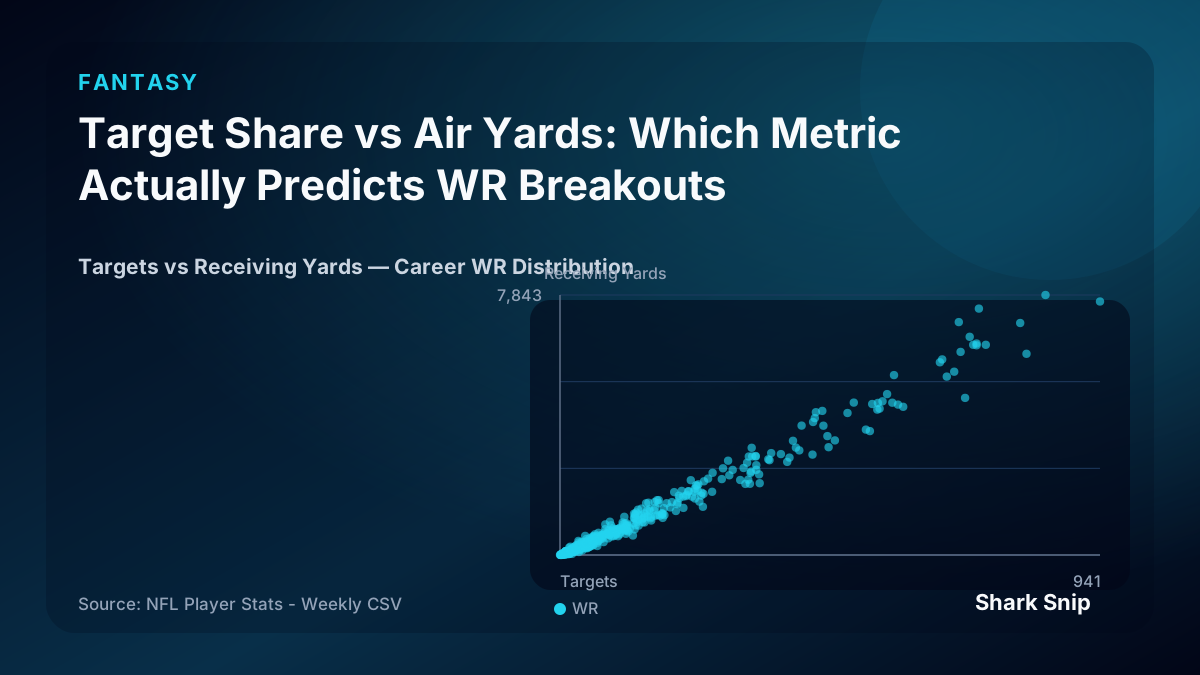
Target share and air yards get lumped together because both describe receiver opportunity. That is where the similarity ends. Target share tells you how often the offense chooses a player. Air yards tells you how much downfield work those choices carry. One is a volume signal; the other is a role signal. The same distinction matters on /desk and /dfs because those surfaces solve different lineup problems.
Definitions, briefly
- Target share — the share of a team's passing attempts directed toward a player.
- Air yards — the cumulative downfield distance of a receiver's targets, whether or not they are caught.
Both numbers measure usage. They measure very different kinds of usage, which is why they predict different fantasy futures. You can recompute either from the play-by-play inside Studio if you want to build your own version of the projection with your own read on snap counts or matchup.
What target share predicts: floor
Target share answers the first question: when the offense throws, does it keep choosing this receiver? That makes it the cleaner starting point for redraft decisions. It speaks to involvement, and involvement creates more paths to a usable week.
- A large share in a slow offense can matter more than a larger raw target count in a shootout.
- A stable share can survive one bad box score when the route role remains intact.
- A rising share matters most when playing time and quarterback context support it.
If you are picking between two receivers in the same tier, start with the player whose role creates more repeatable opportunity. That is not the same as declaring a guaranteed floor. Catchability, injuries, game environment, and touchdowns still move the outcome. The model should show which current inputs support its ranking on /picks.
What air yards predicts: ceiling
Air yards describes where the targets are happening. Deep work can create a huge week on a small number of catches, but it can also produce an empty line when the connection misses. Underneath work usually needs more receptions to reach the same ceiling, yet it can offer a steadier path when the offense is functioning.
Air yards can change quickly with route concepts, quarterback play, and coaching. Treat it as a current role description rather than a permanent player trait. Within a season, it helps explain which receivers can swing a lineup on one completion; it does not guarantee that the completion arrives.
The "WR1 of the future" trap
Headlines love a league-leading air-yards total as a breakout signal. Be careful. Downfield opportunity without enough targets, routes, or catchable passes can describe a frustrating role rather than an emerging star. The model should treat air yards alongside target share and route participation, not as a standalone badge.
The combined view: aDOT
The cleanest synthesis is average depth of target (aDOT) — air yards divided by targets. aDOT tells you what the offense is asking the receiver to do. Our projection model layers three questions:
- Target share sets the volume baseline.
- aDOT describes the route depth and likely volatility.
- Red-zone target share adds scoring context.
A strong breakout case has agreement across the role: the receiver is running routes, earning attention, and being used in a way that can produce the kind of points the format rewards. That is the type of model-vs-consensus delta covered in where our model disagrees with consensus.
How to use this in practice
Drafting
If you are deciding between two receivers at the same ADP, prioritize target share for the safer volume case and air yards for the wider outcome range. League scoring and roster construction decide which profile is useful. The ADP value tiers framework keeps the opportunity cost visible.
Trading
An air-yards-heavy receiver can become a buy-low candidate after quiet stat lines, but the role still needs to survive review. Check routes, targets, quarterback play, and price before assuming a ceiling game is due. The trade-analyzer guide explains how to override a verdict only when you can name the missing input.
Start-sit
For weekly DFS or start-sit calls, layer the matchup onto the role. A defense that limits deep throws can narrow a vertical receiver's path, while a vulnerable secondary can widen it. The tool should explain that interaction instead of turning one coverage split into an automatic start or fade.
What about WR2s and WR3s?
Target share and air yards get noisier lower on a depth chart because the samples are smaller. For secondary receivers, route participation becomes the first filter. A player running a full route tree with a quiet target week is more interesting than a part-time receiver whose limited routes happened to draw the ball. The role has to exist before the breakout can.
Position-adjacent: how RBs and TEs use the same signals
The model applies similar logic to tight ends and pass-catching running backs, but the role questions differ:
- Tight ends: target share matters only after route participation separates receiving work from blocking snaps. See the TE premium piece for how reception scoring changes that value.
- Pass-catching running backs: routes and targets often reveal receiving value better than total touches alone.
The model's biggest current target-share calls
A current disagreement should be published with the role evidence that created it, not as a frozen list of player percentages. Look for:
- New routes. A player is on the field for more passing snaps.
- New first-read work. Targets rise because the offense is choosing him earlier.
- New target depth. The same volume is being used differently.
- New competition. Injuries or personnel changes alter the route tree.
Refresh the inputs weekly and preserve the timestamp. A projection that moves should be able to say which role field changed.
How to read the metrics together on a single player card
A useful player card surfaces target share, aDOT, and route participation with their window and source. The combination helps distinguish a stable volume role, a volatile downfield role, and a player waiting for opportunity. When the signals diverge, the correct output is a review case, not false confidence.
Build the WR projection yourself
The cleanest way to internalize the distinction is to build a receiver projection that exposes the weights. The Shark Snip workshop lets you inspect the available inputs and test the projection chronologically. Use the build surface to see which fields drive a number, then change one assumption at a time.
Receiver projection models live on the Shark Snip marketplace. Read each model card for its data cutoff, validation window, and receipts before trusting a ranking. The sibling read worth bookmarking is the RB regression piece, which applies the same opportunity-versus-efficiency distinction to backs.
Bottom line
Target share describes the floor of opportunity. Air yards describes the shape of that opportunity. Route participation tells you whether the role is real. Put the three together and the breakout case becomes something you can inspect instead of a headline you have to trust.
The Shark Snip fantasy rankings can put those fields beside the projection. Cross-check the public leaderboards only when the record keeps its window, sample, and provenance.
Test the model before you bet it
Train on earlier weeks, evaluate on later weeks, and preserve every eligible recommendation. If the apparent edge disappears on games the model never saw, the projection was chasing noise. The NFL auto-battler can be a low-stakes place to practice reading role inputs, but game performance does not prove a betting edge.
Average NFL total points by recorded weather bucket
Average combined score is grouped only from completed NFL schedule rows with a recorded indoor roof state or numeric wind value.
NFL ATS cover-margin distribution
Bars count completed NFL schedule rows by closing-spread cover margin using the repository canonical home-margin grading convention.