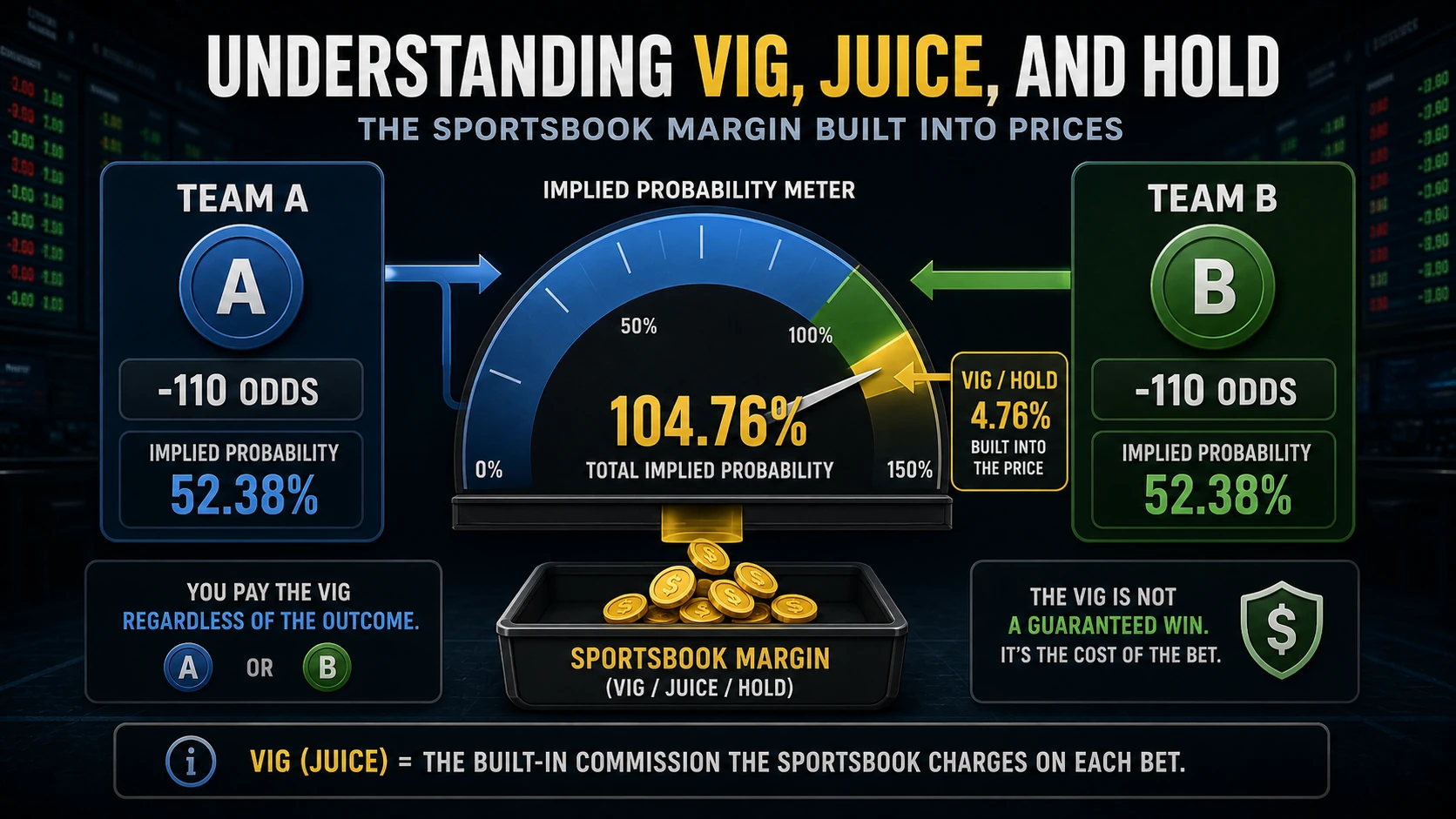
A betting price tells you what your ticket needs to earn back its cost. A complete set of prices also tells you how much the offered probabilities exceed a full market. Neither calculation tells you how much money a sportsbook actually kept.
That distinction is the useful part of vig, juice and hold. Learn to name the quantity you are measuring, calculate it from the right inputs, and compare the ticket you can actually take. A low-margin board can still contain an overpriced selection, and a no-vig estimate does not change the payout on your slip.
Keep the terms separate
Vig, short for vigorish, and juice are betting terms for the price cost or markup. They are often used loosely in conversation. For a calculation, say whether you mean a selection's break-even probability, the whole market's overround, or the operator's realized hold.
Overround is the sum of the offered implied probabilities minus one. It describes a complete set of quoted prices. Realized hold compares gross betting revenue with the amount wagered over a stated period. Revenue and prices are different inputs, so those percentages must not be substituted for one another.
You may also see “theoretical hold” used for a normalized price-based margin. That requires an explicit formula and assumptions about liabilities or probabilities. When a site labels any percentage simply “hold,” look for the denominator. An attractive label is not enough information to reproduce the calculation.
Start with the price on the actual ticket
For a win-or-lose cash back bet without an extra fee, decimal odds d imply a break-even probability of q = 1 / d. Convert American or fractional prices to decimal first if that is easier. The odds-reading guide explains each format and the difference between profit and total return.
This threshold belongs to the selection and price you can buy. It does not become lower because you calculate a no-vig probability later. A bettor must still clear the offered payout's break-even requirement, allowing for any additional cost and the actual settlement rules.
Check the event, market, line, side and time before comparing prices. A full-game moneyline is not a regulation-only result. A different spread or player threshold is a different selection. A better payout on a harder condition cannot be judged by price alone.
A historical quote set, not a live recommendation
The Smarkets implied-probability guide gives a price table for the 2016 Australian Open final: Novak Djokovic at 1.20 decimal and Andy Murray at 5.50. We use that named source so the calculation is reproducible. These are historical teaching quotes, not current market access, a suggested ticket or evidence of our model's performance.
| Selection | Decimal price | Calculation | Implied probability |
|---|---|---|---|
| Novak Djokovic | 1.20 | 1 / 1.20 | 83.33% |
| Andy Murray | 5.50 | 1 / 5.50 | 18.18% |
Keep the unrounded values for the next step. Adding the rounded display cells can change the final hundredth of a percentage point. A transparent calculation uses the original prices and rounds only the displayed answer.
Calculate overround from every outcome
Call the sum of raw implied probabilities S. Then overround = S - 1. For the historical prices, S = 1 / 1.20 + 1 / 5.50 = 67 / 66. Expressed as a percentage, the total is 101.52% and the price-only overround is 1.52%, each rounded from the full-precision calculation.
The excess does not mean that mutually exclusive outcomes can actually have a combined probability above certainty. It means the prices cannot be used unchanged as a normalized forecast. The conversion is measuring payouts, not discovering the true outcome distribution.
This calculation assumes the outcomes form the complete win-or-lose market under review and ignores commission. It is not a reconstruction of the exchange's actual revenue on that match. A retirement rule, refund or commission treatment would need its own settlement-aware analysis.
For a market with more outcomes, the arithmetic is the same but the completeness check matters even more. Include a draw when a draw can win. Include any “other” selection when it covers part of the field. Do not add overlapping outcomes and call their total a market margin.
Why overround is not the share of stakes retained
There is a denominator change hiding in this comparison. Overround measures excess implied probability relative to one complete probability mass. A retained share measures revenue relative to the total amount staked. The same numerator-like idea does not make those denominators interchangeable.
Consider the algebra of an equal-payout book, without claiming that any real customers placed those stakes. If the payout on every winning outcome would be C, the stake on outcome i would be C / dᵢ. Total stakes would be C × S; paying the winning liability leaves C × (S - 1). Dividing the latter by total stakes gives (S - 1) / S, equivalently 1 - 1 / S.
Applied to the historical quote set, that normalized fraction is 1 / 67, or 1.49% rounded. It differs from the 1.52% overround because it uses a different denominator. This is a mathematical equal-payout construction, not a claim that the operator balanced that market or retained that percentage.
Realized hold instead needs actual stakes, payouts, adjustments and a stated reporting window. Those records are not in the historical odds table. A sportsbook's operating profit also includes costs beyond gross betting revenue, so neither a price calculation nor gross hold is a net-profit figure.
The reporting window matters too. Stakes on unsettled events and payouts on previously placed bets may fall in different periods. Before comparing revenue figures, check the report's treatment of settlements, refunds and promotional credits. For your own price study, keep the pre-event quote set separate from the later accounting result. A winning or losing outcome does not retrospectively change the overround that was present in the captured prices.
What proportional devigging does
A proportional no-vig calculation divides every raw implied probability by their total: pᵢ = qᵢ / S. The resulting probabilities sum to one. That gives a consistent market-relative reference, under the assumption that scaling all raw probabilities by the same factor is an appropriate way to remove the overround.
For the historical quotes, the normalized values are 55 / 67 for Djokovic and 12 / 67 for Murray: 82.09% and 17.91% when rounded. These are derived estimates from a declared method. They are not measured winning frequencies or a recovery of the exchange's private beliefs.
Other methods distribute margin differently. That matters when comparing a favorite with a long-priced outcome, or when tracking a market over time. A comparison that silently switches methods can show an apparent change even when the underlying odds did not change. Keep the method beside the estimate.
Do not use a normalized probability as the ticket's cost threshold. The quoted price is still the quoted price. Devigging helps you describe the market; it does not refund the margin or make a forecast more accurate.
A one-sided quote cannot reveal the whole margin
From one available quote you can calculate that selection's break-even probability. You cannot calculate the complete market's overround without the other outcomes. The missing selection is not permission to assume a familiar opposite price or copy a price from yesterday.
Record the limitation plainly: “Opposing quote unavailable; market margin not calculated.” Keep the available selection and its timestamp if they are useful, but separate those facts from the unavailable comparison. An empty field is more informative than a precise-looking number built from an invented price.
Check the scope of a source that claims complete coverage. All outcomes at one book, best available prices across several books, and an average price across a panel are different objects. Each can answer a useful question, but only the first describes that book's posted board at the recorded time.
Compare identical markets at comparable times
Shopping for a better price is distinct from estimating whether a selection is mispriced. For an identical available bet with the same settlement, a higher decimal payout lowers its break-even requirement. That is a mathematical improvement in the transaction; it does not establish a predictive edge.
Do not combine a favorite from one operator with an underdog from another and label the result either operator's hold. A cross-book set can be a comparison view, but it has a different source and meaning. If the prices were captured at different times, it may not even represent a set that could have been accepted together.
An unusually small or negative calculated overround is a prompt to verify inputs, not a guarantee. Check for missing outcomes, stale quotes, mismatched lines, different settlement rules, limits and fees. A displayed price that cannot be accepted does not belong in the available opportunity set.
Account for fees and promotion rules separately
Exchange commission can change the effective return, but its application depends on the operator's terms. A fee on net market winnings is not automatically the same as a charge on every winning ticket. A stake-based fee is another structure again. Do not assume a commission rate or calculation basis from a generic odds guide.
A boosted selection likewise does not repair the rest of the market. Read the eligible payout, maximum eligible amount, exclusions and settlement treatment. A return paid as restricted credit is not automatically equivalent to withdrawable cash. Keep those conditions visible rather than reducing the whole offer to an advertising percentage.
The price-only calculations here intentionally omit current commissions and promotions. To evaluate an actual offer, start with its current documented terms. Where those terms are unavailable or ambiguous, stop at the comparison you can support.
Use the calculation without overstating it
A low-overround market is not proof that every selection is fairly priced. Margin can be distributed unevenly, and a normalized market view can still be wrong. Nor does a model's disagreement prove the model has found value. Check calibration, input timing, sample quality and whether the prediction answers the same market question.
Keep a bet record with the accepted quote and relevant comparison prices. Preserve the forecast made before the event and the result after settlement. The closing-line-value guide explains one later price comparison, not a substitute for outcome evidence or a guarantee of future results.
The practical decision is smaller than the terminology makes it sound. Identify the available ticket, translate its payout, collect the complete comparison market, and name exactly what you calculated. When an input is missing, say what is missing. When a percentage is derived from prices, do not report it as measured revenue.
Where these numbers come from
The price inputs are the historical table in the Smarkets implied-probability guide. Every displayed probability, overround and normalized fraction follows from the equations shown here. They are not a live quote archive, a backtest or an operator revenue report.
The Smarkets margin guide explains complete-market price conversion and the need to account for commission. The Gambling Commission's gross gambling yield definition distinguishes stakes and other receipts from prizes or winnings paid. Neither source supplies an actual hold result for the historical match.
Observed market vig versus no-vig fair probability
Each bar is derived from a recorded two-sided moneyline snapshot and removes the paired market overround before comparing fair probability.
Breakeven win rate at recorded American prices
Breakeven probability is calculated only from American prices that were actually captured in the odds-history table.