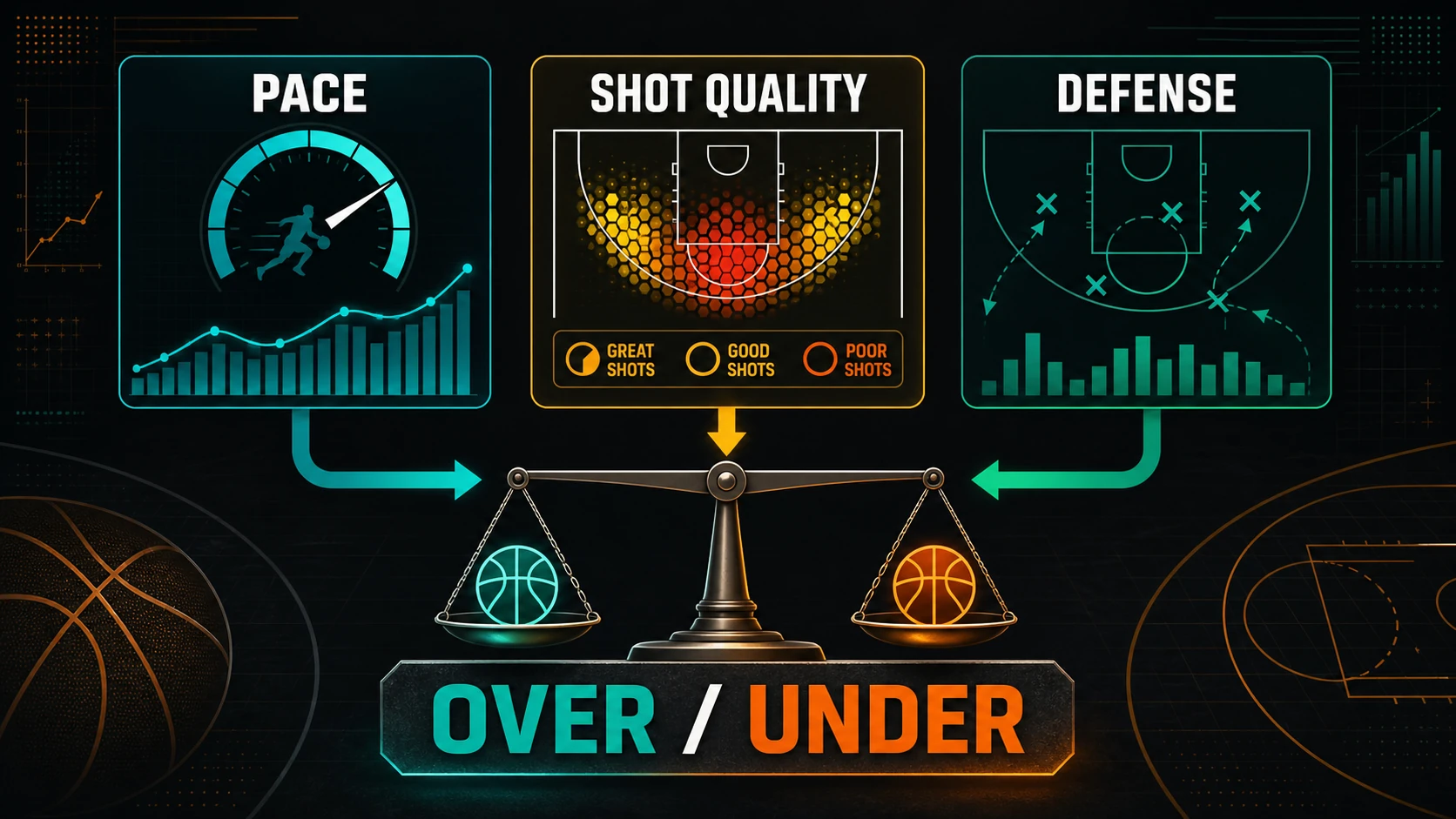
An NBA total is not a prediction of which team feels hot. It is a price on possessions and scoring efficiency, wrapped in uncertainty about lineups, rest, officiating, and game state. The cleanest totals work starts by separating those pieces. The fastest way to get lost is to blend them into one story about pace.
Good NBA over under betting is less about declaring that fast teams go over and more about asking whether the market's possession and efficiency assumptions match the available evidence. A projection can be directionally sound and still be a bad bet because the number already moved.
Build possessions and efficiency separately
Estimate how many possessions each team is likely to create, then estimate what each offense can score per possession against the expected defense and lineup. This structure makes the forecast interpretable. It also keeps a fast game with poor offense from being mislabeled as an automatic over.
Pace should be calculated from comparable regulation possessions, with garbage time and unusual overtime handled explicitly. Efficiency should use pregame information and opponent adjustment. The two parts meet only after each has been built honestly.
Lineups change both sides of the equation
A missing ball handler can slow initiation and damage shot quality. A reserve guard may push faster but turn the ball over more. A rim protector's absence can raise opponent efficiency while changing rebounding and transition opportunities. Injury news rarely moves only one input.
Use expected lineup minutes and preserve the status timestamp. If the starting group is uncertain, model scenarios or widen the interval. A single precise total based on an invented rotation is not useful precision.
Defense is more than a ranking
Team defensive efficiency summarizes outcomes but not how those outcomes were produced. Shot-location control, transition defense, foul avoidance, rebounding, turnover creation, and opponent quality all matter. A matchup can attack the exact part of a defense that the aggregate ranking hides.
Ask how each offense creates shots and how the opponent tries to remove them. A switching defense, a drop defense, and an aggressive trapping defense can produce different pace and efficiency paths even when their season ratings look similar.
Rest can pull totals in opposite directions
Compressed schedules may reduce offensive execution and shooting legs. They may also damage transition defense, closeouts, and rebounding. Which effect dominates depends on lineup depth, travel, prior workload, and the opponent's style.
Do not attach a fixed under adjustment to every tired team. Let rest affect possessions and efficiency through tested interactions. When the current availability picture is incomplete, the honest conclusion is that the total range is too wide.
The market number belongs in the analysis
A totals model produces a distribution. The bet decision compares that distribution with the actual threshold and price available at the forecast time. An opening number and a later number are different bets. Store both rather than describing the move from memory.
Line movement is information, not proof. It may reflect injuries, limits, weather for an outdoor event, or ordinary trading. Rebuild the projection when new facts arrive. Do not chase the move merely because someone else moved first.
Derivative totals need their own model
First-half, second-half, quarter, and team totals emphasize different rotations and game states. A full-game projection cannot simply be divided into equal pieces. Starters play different shares, coaches stagger creators, and late fouling or bench-heavy minutes can reshape the closing period.
Team totals isolate one offense against one defense but still depend on pace generated by both clubs. A derivative market deserves a target and validation set of its own. Lower volume does not automatically mean lower quality; it often means wider uncertainty.
The registered view below describes scoring already recorded by regulation quarter. It does not forecast a derivative total or establish a betting rule.
Live totals are vulnerable to scoreboard storytelling
A burst of made shots can send the live number higher without changing the possession outlook. A slow scoring start can come from missed open looks rather than a genuine pace change. The live model should update possessions, shot quality, fouls, rotation, and injuries—not merely extrapolate points already scored.
Keep the pregame forecast visible. That anchor makes it possible to identify which assumptions changed and which outcomes were simply noisy. A live re-entry should come from a new price against an updated model, not from the desire to get even with the first bet.
Validation should expose the failure mode
Train on earlier games and test forward. Compare possession error, efficiency error, total error, and probability calibration. A single average miss can hide a model that is good at pace and bad at shooting or vice versa.
If publishing an over-under record, show the window, number of graded decisions, and win rate. ATS-style reporting should use wins, losses, percentage, window, and sample. Do not publish return claims without the actual prices and fills. When the evidence is incomplete, report the projection test and stop there.
The totals workflow
- Estimate possessions from both teams and the expected lineups.
- Estimate offensive efficiency against the specific defensive mechanisms.
- Add rest, travel, and officiating only from timestamped, tested data.
- Compare the full distribution with the available threshold and price.
- Rebuild when the lineup or market information changes.
- Pass when uncertainty is wider than the apparent edge.
Totals are not mysterious. They are simply unforgiving when the model hides its assumptions. Count the opportunities, price the efficiency, and respect the number on the board. The over or under comes last.
Average NFL total points by recorded weather bucket
Average combined score is grouped only from completed NFL schedule rows with a recorded indoor roof state or numeric wind value.
NFL ATS cover-margin distribution
Bars count completed NFL schedule rows by closing-spread cover margin using the repository canonical home-margin grading convention.