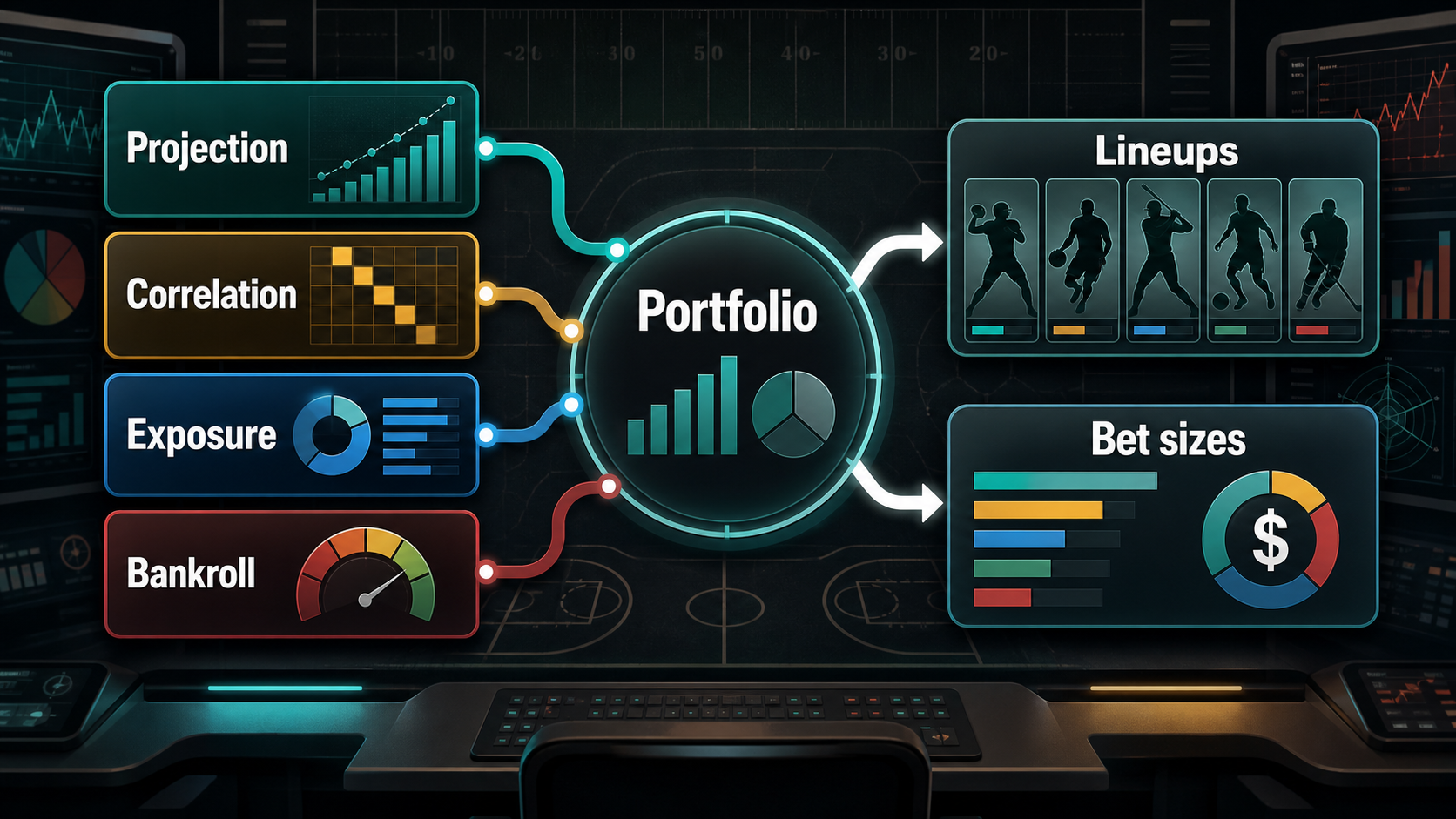

Once projections exist, how much should be bet, which DFS lineups should be built, and how should correlation and bankroll risk be controlled? That is the practical question behind this method family. Model output is not the final decision. Betting and DFS both require portfolio construction: sizing edges, limiting exposure, handling correlation, and deciding whether a slate or contest is worth attacking.
The plain-English version
Model output is not the final decision. Betting and DFS both require portfolio construction: sizing edges, limiting exposure, handling correlation, and deciding whether a slate or contest is worth attacking.
The novice trap is to treat the method name as magic. The useful move is to ask what information the method can learn, what it cannot learn, and what kind of sports question it is actually built to answer. A method that is excellent for ranking team strength can be poor for a single player prop, and a method that wins a backtest can still be unbettable if the edge appears only after the market has moved.
Start with the target. A spread model, moneyline model, player prop projection, DFS lineup optimizer, and fantasy ranking all answer different questions. Then check the timestamp of every feature. If the feature would not have been known before the bet, contest lock, or lineup decision, it does not belong in the model. Finally, compare the output to the right benchmark: the closing line, the posted prop, the field ownership, or the best available projection.
Method-by-method guide
fixed-unit
Fixed-unit staking risks the same unit on every approved bet, regardless of edge size. In sports terms, this is the part of the model that decides how to translate noisy pre-game inputs into a usable betting, fantasy, or DFS signal instead of a loose opinion.
Where it helps: It keeps bankroll decisions simple when model probabilities are useful but not precise enough for dynamic sizing. The practical test is whether the block improves decisions on games it has not seen, not whether it explains last night's box score after the answer is known.
Where it fails: It leaves value on the table for large true edges and can still lose badly if the approval gate is weak. The fix is usually cleaner targets, stricter time cuts, a smaller feature set, or a calibration layer before the output reaches a staking or lineup workflow.
flat-with-gate
Flat-with-gate staking uses a fixed size only when the edge clears a required threshold. In sports terms, this is the part of the model that decides how to translate noisy pre-game inputs into a usable betting, fantasy, or DFS signal instead of a loose opinion.
Where it helps: It helps avoid tiny DFS or betting edges that do not survive vig, fees, or projection error. The practical test is whether the block improves decisions on games it has not seen, not whether it explains last night's box score after the answer is known.
Where it fails: It depends heavily on the gate threshold and can miss moderate edges if the threshold is arbitrary. The fix is usually cleaner targets, stricter time cuts, a smaller feature set, or a calibration layer before the output reaches a staking or lineup workflow.
edge-weighted-linear
Edge-weighted linear sizing increases stake gradually as the estimated edge grows. In sports terms, this is the part of the model that decides how to translate noisy pre-game inputs into a usable betting, fantasy, or DFS signal instead of a loose opinion.
Where it helps: It helps when larger edges deserve more exposure but the builder wants smoother behavior than full Kelly. The practical test is whether the block improves decisions on games it has not seen, not whether it explains last night's box score after the answer is known.
Where it fails: It can oversize if the edge estimate is biased high or if correlated bets are treated independently. The fix is usually cleaner targets, stricter time cuts, a smaller feature set, or a calibration layer before the output reaches a staking or lineup workflow.
confidence-weighted
Confidence-weighted sizing scales decisions by the model confidence attached to the edge. In sports terms, this is the part of the model that decides how to translate noisy pre-game inputs into a usable betting, fantasy, or DFS signal instead of a loose opinion.
Where it helps: It helps when confidence buckets have proven that stronger signals deserve more bankroll or DFS exposure. The practical test is whether the block improves decisions on games it has not seen, not whether it explains last night's box score after the answer is known.
Where it fails: It is dangerous when confidence is just model loudness rather than calibrated reliability. The fix is usually cleaner targets, stricter time cuts, a smaller feature set, or a calibration layer before the output reaches a staking or lineup workflow.
full-kelly
Full Kelly sizes a bet to maximize long-run logarithmic bankroll growth under perfect edge estimates. In sports terms, this is the part of the model that decides how to translate noisy pre-game inputs into a usable betting, fantasy, or DFS signal instead of a loose opinion.
Where it helps: It is a useful theoretical ceiling for how aggressive a bankroll-aware strategy could be. The practical test is whether the block improves decisions on games it has not seen, not whether it explains last night's box score after the answer is known.
Where it fails: It is usually too aggressive for sports models because probabilities are noisy and markets change. The fix is usually cleaner targets, stricter time cuts, a smaller feature set, or a calibration layer before the output reaches a staking or lineup workflow.
half-kelly
Half Kelly uses half of the full Kelly recommendation to reduce volatility and model-error risk. In sports terms, this is the part of the model that decides how to translate noisy pre-game inputs into a usable betting, fantasy, or DFS signal instead of a loose opinion.
Where it helps: It can balance growth and drawdown when edges are calibrated but still uncertain. The practical test is whether the block improves decisions on games it has not seen, not whether it explains last night's box score after the answer is known.
Where it fails: It can still be too large if the model is overconfident or bets are correlated. The fix is usually cleaner targets, stricter time cuts, a smaller feature set, or a calibration layer before the output reaches a staking or lineup workflow.
fractional-kelly
Fractional Kelly generalizes the idea by using a chosen fraction of the Kelly stake. In sports terms, this is the part of the model that decides how to translate noisy pre-game inputs into a usable betting, fantasy, or DFS signal instead of a loose opinion.
Where it helps: It lets a user pick a risk posture that matches bankroll tolerance and model trust. The practical test is whether the block improves decisions on games it has not seen, not whether it explains last night's box score after the answer is known.
Where it fails: It can create false precision if the fraction is tuned to a favorable backtest. The fix is usually cleaner targets, stricter time cuts, a smaller feature set, or a calibration layer before the output reaches a staking or lineup workflow.
bankroll-aware-kelly
Bankroll-aware Kelly adjusts sizing with bankroll state, limits, and practical risk controls. In sports terms, this is the part of the model that decides how to translate noisy pre-game inputs into a usable betting, fantasy, or DFS signal instead of a loose opinion.
Where it helps: It helps keep stakes realistic when bankroll changes, limits bind, or exposure is already high. The practical test is whether the block improves decisions on games it has not seen, not whether it explains last night's box score after the answer is known.
Where it fails: It can become overly complex and hide the core question of whether the probability edge is real. The fix is usually cleaner targets, stricter time cuts, a smaller feature set, or a calibration layer before the output reaches a staking or lineup workflow.
variance-capped-kelly
Variance-capped Kelly limits Kelly-style sizing so drawdown and volatility stay within defined bounds. In sports terms, this is the part of the model that decides how to translate noisy pre-game inputs into a usable betting, fantasy, or DFS signal instead of a loose opinion.
Where it helps: It helps when a model has positive expected value but unacceptable short-term variance. The practical test is whether the block improves decisions on games it has not seen, not whether it explains last night's box score after the answer is known.
Where it fails: It depends on variance estimates that can be wrong when bets or DFS lineups are correlated. The fix is usually cleaner targets, stricter time cuts, a smaller feature set, or a calibration layer before the output reaches a staking or lineup workflow.
MILP optimizer
A MILP optimizer solves lineup or portfolio selection with linear objectives and integer roster decisions under constraints. In sports terms, this is the part of the model that decides how to translate noisy pre-game inputs into a usable betting, fantasy, or DFS signal instead of a loose opinion.
Where it helps: It can build DFS lineups that maximize projection while respecting salary, roster slots, teams, and contest rules. The practical test is whether the block improves decisions on games it has not seen, not whether it explains last night's box score after the answer is known.
Where it fails: It optimizes exactly what it is told, so bad projections or missing constraints produce polished bad lineups. The fix is usually cleaner targets, stricter time cuts, a smaller feature set, or a calibration layer before the output reaches a staking or lineup workflow.
exposure caps
Exposure caps limit how often a player, team, stack, or bet can appear across a portfolio. In sports terms, this is the part of the model that decides how to translate noisy pre-game inputs into a usable betting, fantasy, or DFS signal instead of a loose opinion.
Where it helps: They keep one fragile projection from dominating all DFS entries or one correlated angle from dominating bankroll. The practical test is whether the block improves decisions on games it has not seen, not whether it explains last night's box score after the answer is known.
Where it fails: They can block the best play too aggressively if caps are copied from rules of thumb instead of slate context. The fix is usually cleaner targets, stricter time cuts, a smaller feature set, or a calibration layer before the output reaches a staking or lineup workflow.
stacking rules
Stacking rules intentionally combine correlated players or outcomes that can succeed together. In sports terms, this is the part of the model that decides how to translate noisy pre-game inputs into a usable betting, fantasy, or DFS signal instead of a loose opinion.
Where it helps: They help NFL DFS lineups capture quarterback, receiver, bring-back, and game environment upside. The practical test is whether the block improves decisions on games it has not seen, not whether it explains last night's box score after the answer is known.
Where it fails: They can over-correlate lineups and reduce diversification if every entry tells the same story. The fix is usually cleaner targets, stricter time cuts, a smaller feature set, or a calibration layer before the output reaches a staking or lineup workflow.
Cholesky/correlated sampling
Cholesky/correlated sampling simulates player outcomes with relationships preserved instead of independent random draws. In sports terms, this is the part of the model that decides how to translate noisy pre-game inputs into a usable betting, fantasy, or DFS signal instead of a loose opinion.
Where it helps: It helps model DFS slates where teammates, opponents, pace, and game environment move outcomes together. The practical test is whether the block improves decisions on games it has not seen, not whether it explains last night's box score after the answer is known.
Where it fails: It can misstate portfolio risk if the correlation matrix is estimated from small or stale samples. The fix is usually cleaner targets, stricter time cuts, a smaller feature set, or a calibration layer before the output reaches a staking or lineup workflow.
ownership
Ownership estimates how popular a player or lineup construction will be in a DFS contest. In sports terms, this is the part of the model that decides how to translate noisy pre-game inputs into a usable betting, fantasy, or DFS signal instead of a loose opinion.
Where it helps: It helps decide whether a strong projection is still useful after the field also sees it. The practical test is whether the block improves decisions on games it has not seen, not whether it explains last night's box score after the answer is known.
Where it fails: It can be noisy, especially on slates where late news changes field behavior quickly. The fix is usually cleaner targets, stricter time cuts, a smaller feature set, or a calibration layer before the output reaches a staking or lineup workflow.
leverage
Leverage measures the payoff of being right when the field is underexposed to a player, stack, or game script. In sports terms, this is the part of the model that decides how to translate noisy pre-game inputs into a usable betting, fantasy, or DFS signal instead of a loose opinion.
Where it helps: It helps tournaments where beating duplicated popular builds matters as much as raw median projection. The practical test is whether the block improves decisions on games it has not seen, not whether it explains last night's box score after the answer is known.
Where it fails: It can become contrarian for its own sake if the projection gap is too large. The fix is usually cleaner targets, stricter time cuts, a smaller feature set, or a calibration layer before the output reaches a staking or lineup workflow.
contest recommendation
Contest recommendation maps lineup style and portfolio risk to cash games, small fields, large tournaments, or no-play decisions. In sports terms, this is the part of the model that decides how to translate noisy pre-game inputs into a usable betting, fantasy, or DFS signal instead of a loose opinion.
Where it helps: It helps avoid using a fragile high-variance lineup in the wrong DFS contest type. The practical test is whether the block improves decisions on games it has not seen, not whether it explains last night's box score after the answer is known.
Where it fails: It can mislead if payout structure, field strength, and entry limits are not part of the recommendation. The fix is usually cleaner targets, stricter time cuts, a smaller feature set, or a calibration layer before the output reaches a staking or lineup workflow.
slate difficulty
Slate difficulty estimates how hard it is to create differentiated, high-upside lineups on a given DFS slate. In sports terms, this is the part of the model that decides how to translate noisy pre-game inputs into a usable betting, fantasy, or DFS signal instead of a loose opinion.
Where it helps: It helps decide whether to attack a slate heavily, play smaller, or wait for a better contest environment. The practical test is whether the block improves decisions on games it has not seen, not whether it explains last night's box score after the answer is known.
Where it fails: It can be wrong when late injury news opens value or when ownership concentrates differently than projected. The fix is usually cleaner targets, stricter time cuts, a smaller feature set, or a calibration layer before the output reaches a staking or lineup workflow.
Sports walkthrough
A betting workflow may turn probabilities into fixed-unit, confidence-weighted, or Kelly-style sizes. A DFS workflow may use a MILP optimizer with exposure caps, stacking rules, Cholesky/correlated sampling, ownership, leverage, contest recommendation, and slate difficulty to create lineups that fit both projection and risk constraints.
Concrete names keep the model honest: Christian McCaffrey can dominate exposure decisions, Amon-Ra St. Brown can anchor stacking rules, and Josh Allen can change both bankroll risk and DFS leverage when his rushing projection rises. Those examples are not there to imply a pick; they force the workflow to deal with real role changes, injury context, usage shifts, opponent quality, and market reaction instead of abstract rows in a table.
The workflow is deliberately boring. Define the event, gather only pre-decision information, produce a projection or probability, compare it with the market or contest environment, size the action conservatively, and then record what happened. When the number closes, the closing price becomes the first audit. When the game finishes, the outcome becomes the second audit. Over a useful sample, both audits matter more than whether one bet won.
Validation workflow
Validate this method family in the same shape it will be used live. Train on older games, tune on a later slice, and reserve the newest window for the final check. If the method uses player props, keep player identity, team context, injury status, and market number aligned to the timestamp when the decision would have been made. If it uses DFS simulations, lock the slate, salary, ownership, and injury assumptions before grading lineups.
Compare against a plain benchmark before celebrating lift. A model should beat a naive average, a market-only view, and a smaller interpretable version before the extra complexity deserves product space. The important comparison is not whether the method can explain the past; it is whether it improves decisions after fees, vig, contest rake, stale lines, and real lineup constraints are included.
Review failures as carefully as wins. A losing pick that beat the close can still be a useful process signal, while a winning pick that took a bad number can be a warning. Group errors by sport, market, player role, team, confidence bucket, and price range so the builder can tell the difference between normal variance and a broken assumption.
Expert notes
Sizing depends on probability quality. Kelly variants punish miscalibration because overconfident edges become oversized bets.
DFS optimization is a portfolio problem, not a best-lineup problem. The top median lineup can be poor for tournaments if ownership, leverage, and correlation are ignored.
Correlation cuts both ways. Stacking can raise ceiling, but too much correlated exposure can make an entire entry set fail together.
Contest recommendation should reflect slate difficulty. A thin edge in a sharp contest is different from the same projection edge in a softer contest with different payout structure.
When not to use this family
Do not use a method just because it is more advanced than a baseline. If the data is thin, the target is unstable, the sport context changed, or the market already absorbs the signal, a simpler model with better validation is usually the better tool. The warning sign is a model that needs a long explanation for why its live results should be ignored.
Watch for leakage, repeated samples, and hidden correlation. A player prop model can accidentally learn same-game information through closing lines, a DFS optimizer can double count teammate correlations, and a ratings model can overstate certainty after one noisy result. If a method cannot survive a walk-forward split, a holdout season, and a calibration check, keep it in research.
Decision checklist
| Modeling question | Useful block | Risk check |
|---|---|---|
| What is the cleanest baseline for this sports decision? | fixed-unit | Confirm the target, feature timestamp, and market comparison are all aligned before training. |
| Which block adds lift without turning noise into confidence? | slate difficulty | Compare walk-forward performance, calibration, and closing-line value before trusting the output. |
How Shark Snip uses it
Shark Snip uses fixed-unit, flat-with-gate, edge-weighted-linear, confidence-weighted, full-kelly, half-kelly, fractional-kelly, bankroll-aware-kelly, variance-capped-kelly, MILP optimizer, exposure caps, stacking rules, Cholesky/correlated sampling, ownership, leverage, contest recommendation, and slate difficulty in betting and DFS portfolio workflows.
The block names above are intentionally visible in this article so model builders can connect the concept to the actual building blocks in Tinker, DFS simulation, and the model marketplace. Shark Snip treats these methods as components in a workflow: feature preparation, model fit, probability repair, portfolio construction, and post-game evaluation. No block is allowed to skip validation because every sport has small samples, changing incentives, and noisy injury information.
The most useful model is not the one with the most intimidating name. It is the one whose assumptions match the sport question, whose inputs were available at decision time, whose output is calibrated enough to compare with a price, and whose failures are visible before real bankroll or contest exposure is increased.
Related reading and tools
Keep going with building your first model with Tinker, closing-line value, bet tracking, Kelly Criterion basics. These links connect the method family to the betting, DFS, and model-building workflows readers already use.
Props and DFS example board
For props, DFS, and PrizePicks-style decisions, the names should reveal the input. Jokic assists, Shai points, Wembanyama blocks, Josh Allen rushing, Ja'Marr Chase receptions, and Christian McCaffrey touchdown equity all require different checks. Treat each player as a role-and-price puzzle rather than a logo on a pick card.
- Fixed-line check: compare the app line to sportsbook consensus before calling it an edge.
- Correlation check: do not pair legs that require opposite game scripts.
- DFS check: salary, ownership, and late-swap flexibility can matter as much as median projection.
- Tracking check: grade closing value and result separately so a lucky hit does not hide a bad line.
Props workflow links
Use PrizePicks basics, NFL player props, and correlation math as the internal loop from projection to price to risk control.
Prop, DFS, and contest examples
Use names as evidence, not decoration. The useful SEO win is that Josh Allen, Christian McCaffrey, Amon-Ra St. Brown, Ja'Marr Chase and Bijan Robinson and Chiefs, Bills, Eagles and Lions appear inside decisions, thresholds, and internal links instead of being dumped into a keyword list.
- Prop EV example: if Amon-Ra St. Brown receptions are 6.5 at -120, a model median of 7.1 with a 56% over probability creates a fair threshold near -127; pass if the market jumps to 7.5 without a projection change.
- DFS value example: projection divided by salary times 1,000 keeps the slate honest. A 20.4-point projection at $7,200 is 2.83x median value; tournaments need ceiling, leverage, and correlation on top of that.
- Stack example: Patrick Mahomes with Travis Kelce and Xavier Worthy needs a bring-back plan from the opponent; Josh Allen with Keon Coleman and Dalton Kincaid needs rushing-TD cannibalization in the script notes.
- PrizePicks example: Nikola Jokic rebounds, Devin Booker points, and Stephen Curry threes should not be treated as one generic “More” card; legs need hit rate, payout, and correlation checks.
The next step should be a tool, not another opinion: compare the line on NFL player props, pressure-test salary in DFS tools, and log the close with bet tracking.
Educational analysis only, not a bet recommendation. Model outputs can be wrong, markets move, and sports data can contain injuries, role changes, reporting gaps, and contest-specific constraints.