
Updated Sep 8, 2026 · Week 1 board.
What “sit” really means, and the rule that covers it
PrizePicks calls it a DNP: did not play. If a player you picked leaves the game in the first half and does not return, that leg does not just vanish. PrizePicks' own Reboot policy drops your entry down one size instead. A 6-pick Flex becomes a 5-pick Flex.
A 5-pick becomes a 4-pick. A 4-pick becomes a 3-pick. A 3-pick Power becomes a 2-pick Power, and a 3-pick Flex also becomes a 2-pick Power, not a 2-pick Flex. A 2-pick Power becomes a refund.
Every remaining leg still has to grade the normal way; only the size of the entry changes.
The rule has real edges. For NFL, it only applies to full-game player props. The player must exit in the first half and not return in the second. Defensive players and most special teamers are not eligible.
Kickers and punters are the exception, if they are listed active but never record a kick or punt. If you picked “Less” on a player who gets Rebooted, that pick still wins, because the player finishing under the line is exactly what you bet. None of this requires signing up for anything extra; it applies to every entry automatically. PrizePicks lays out every sport's exact version of the rule on its own Reboots policy page.
How the payout math actually works
PrizePicks is a daily fantasy contest, not a sportsbook. You build an entry of 2 to 6 player legs, and for each leg you pick “More” or “Less” against a line. There is no separate price per leg the way a sportsbook posts -110 on a spread; the cost of the bet is baked into the multiplier for the whole entry. Power Play requires every leg to hit.
Flex Play pays out on a sliding scale even when one or two legs miss, but the win-everything payout on Flex is smaller than the win-everything payout on Power for the same entry size.
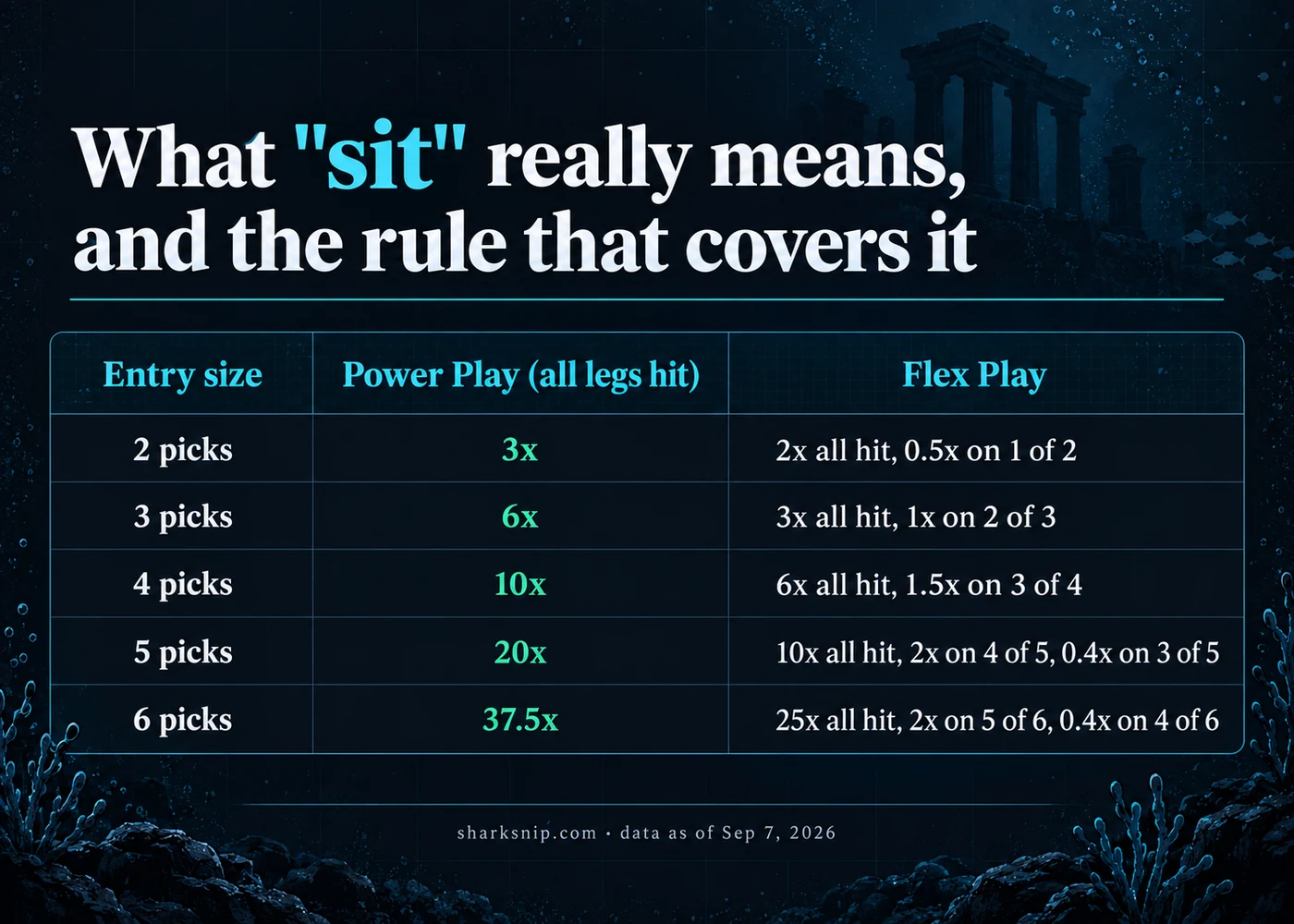
| Entry size | Power Play (all legs hit) | Flex Play |
|---|---|---|
| 2 picks | 3x | 2x all hit, 0.5x on 1 of 2 |
| 3 picks | 6x | 3x all hit, 1x on 2 of 3 |
| 4 picks | 10x | 6x all hit, 1.5x on 3 of 4 |
| 5 picks | 20x | 10x all hit, 2x on 4 of 5, 0.4x on 3 of 5 |
| 6 picks | 37.5x | 25x all hit, 2x on 5 of 6, 0.4x on 4 of 6 |
Put a number on that: a $10 stake on a 4-pick Power play returns $100 if all four legs hit and $0 if any leg misses. The same $10 on a 4-pick Flex play returns $50 on a clean sweep, $15 if three of four hit, and $0 if two or more miss. Flex feels safer because a single miss does not zero you out. It is also a lower payout on the outcome you are actually chasing, a full sweep.
The break-even hit rate you actually need
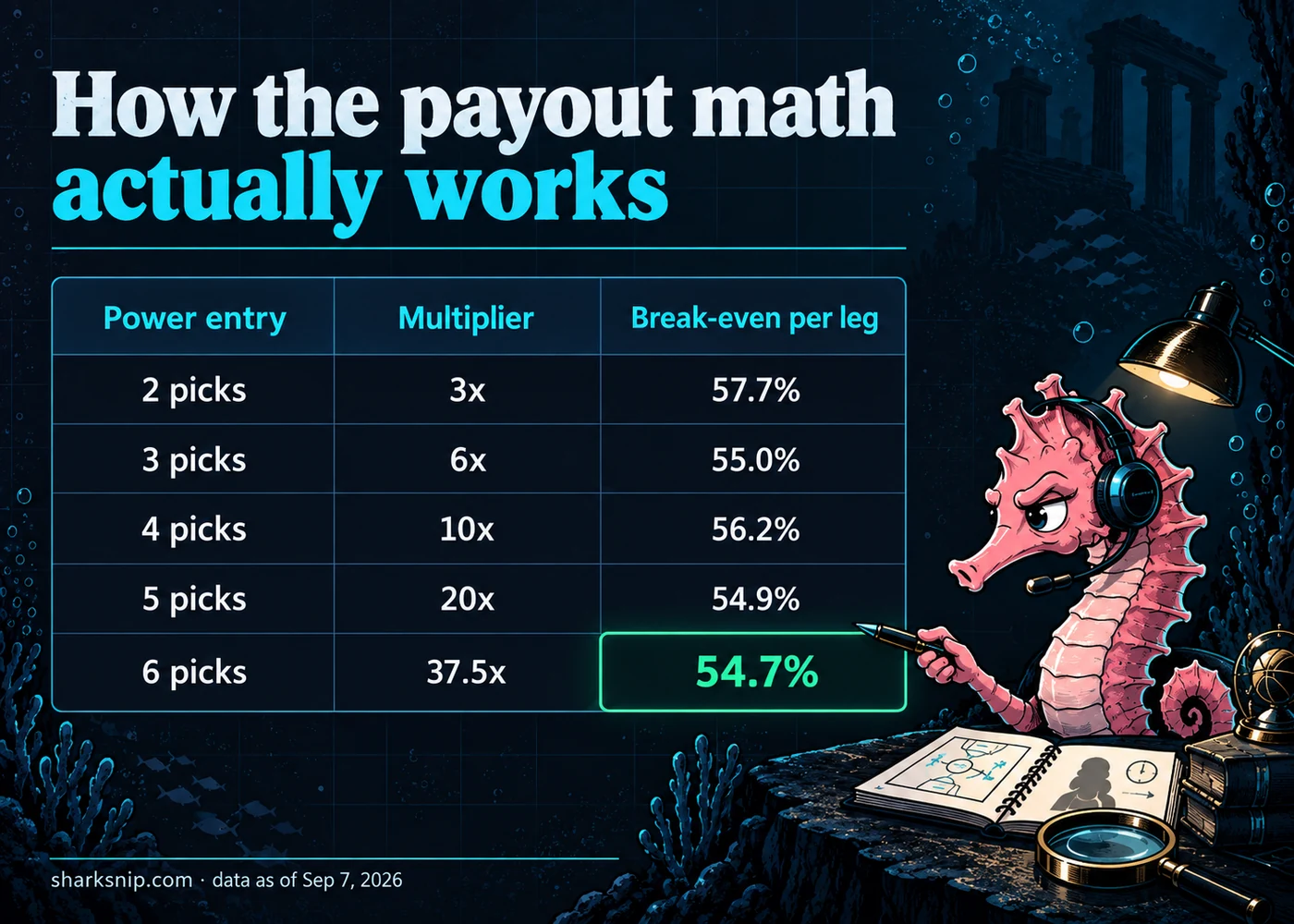
Each entry size has its own break-even win rate per leg, the rate you would need across a large sample of entries just to come out even. Solve it from the payout multiplier: for an n-leg Power play at multiplier M, the required per-leg hit rate is the nth root of 1 divided by M.
| Power entry | Multiplier | Break-even per leg |
|---|---|---|
| 2 picks | 3x | 57.7% |
| 3 picks | 6x | 55.0% |
| 4 picks | 10x | 56.2% |
| 5 picks | 20x | 54.9% |
| 6 picks | 37.5x | 54.7% |
A standard -110 sportsbook spread breaks even at 52.4% (the difference between that and a true coin flip is the book's edge). PrizePicks asks for roughly 55 to 58 percent per leg depending on entry size, a meaningfully higher bar. The 6-pick Power play at 37.5x has the lowest break-even of the group, 54.7%. The 5-pick at 20x sits right behind it at 54.9%.
Those two are the structural sweet spot on paper. They also demand a clean sweep on every leg, so the swings around that number are large.
That math assumes each leg is independent, and legs rarely are. Stack three props from the same blowout game and a tight final score can sink all three together. Correlation is not automatically bad; deliberately stacking a quarterback's passing yards with his top receiver's receiving yards is a positive correlation that can lift both legs in a shootout. It just means the clean math above is a starting estimate, not proof of your real odds.
A worked example: four legs, one stake
Take a 4-pick Power play for $25. If every leg hits, the entry pays 10x, or $250. If even one leg misses, the $25 is gone. Suppose your real per-leg hit rate is 58%: the chance all four hit is 0.58 to the fourth power, which is 11.3%.
Multiply that by the $250 payout and the expected return is $28.29 against a $25 stake, an edge of about 13%. That only holds if 58% is a genuine number over a large sample, not four picks you feel good about tonight.
Now run the same play at a 53% true hit rate, closer to an average bettor's actual accuracy. The chance all four hit is 0.53 to the fourth power, 7.9%. Multiply by $250 and the expected return drops to $19.73, a loss of $5.27 on every $25 entry over time. The multiplier chart looks the same in both cases.
The gap between 58% and 53% is the entire difference between a real edge and losing money slowly while it feels close.
The disciplined way to actually beat it
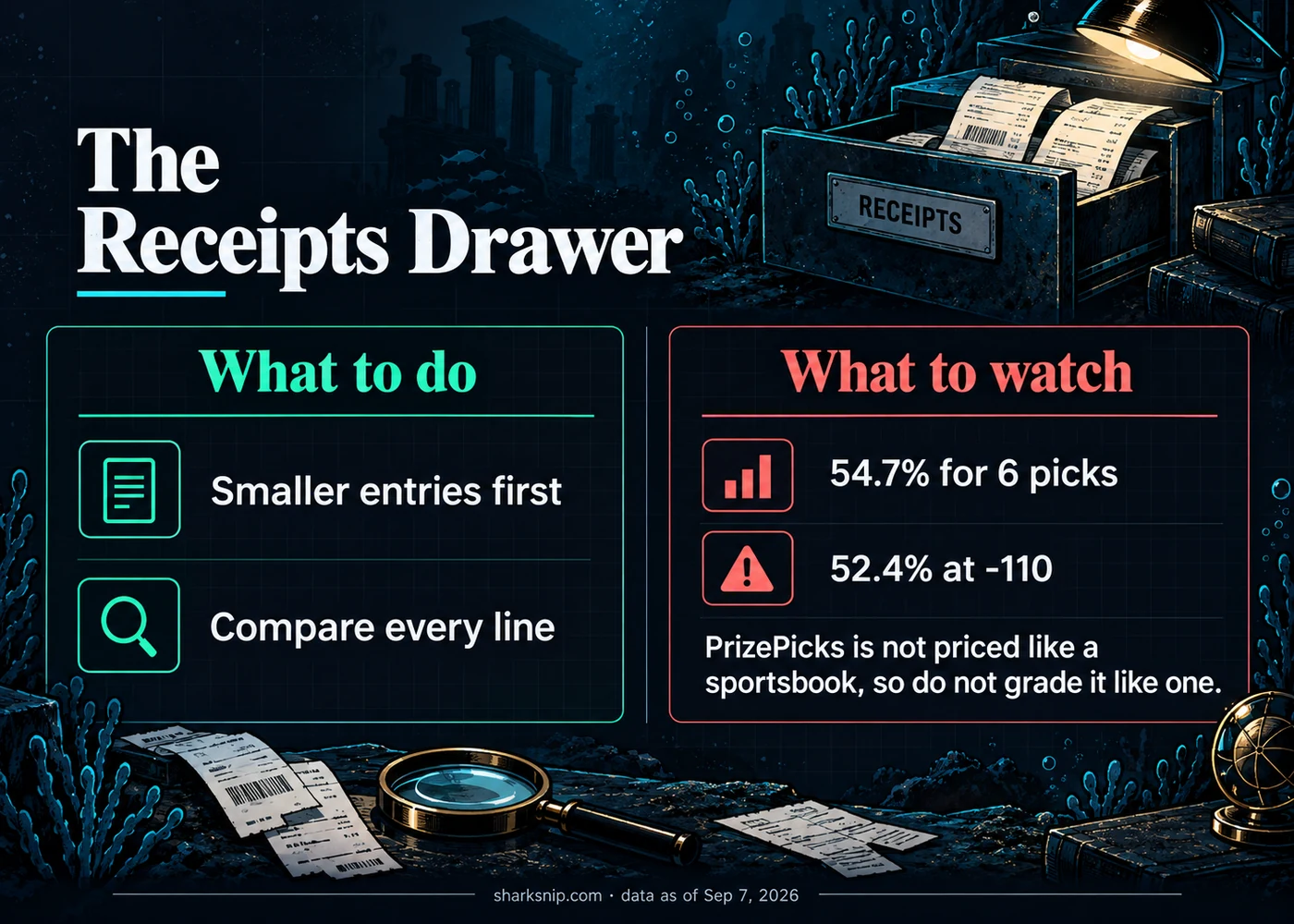
Smaller entries first: a 2 or 3-pick Power play has less variance than a 6-pick lottery ticket, and the break-even bar (57.7% and 55.0%) is honest about what it takes. Compare every line to a sportsbook before submitting; PrizePicks numbers for less-followed stat types (rebounds, receptions, longest reception) drift further from the sharp market than headline stats like points or passing yards. Log every entry, including the line, your call and the result, because the only way to know your real hit rate is a record kept over 50 or more entries, not a gut feeling after a good week. Treat Flex as a variance tool, not a safety net; it pays less on the outcome you actually want.
And do not chase a loss with a bigger parlay the same night. That is the fastest way to turn one bad entry into three.
Check your own numbers before every submit. The full player-props board is at /player-props. Build your own number instead of trusting a hunch at /build. For the deeper Flex-versus-Power math on exactly when each structure wins, see /blog/prizepicks-flex-vs-power-math.
Our wider daily fantasy hub is at /dfs. Who is actually beating the market over time gets tracked separately at /insights?tab=leaderboard.

The Receipts Drawer
PrizePicks is not priced like a sportsbook, so do not grade it like one. A -110 spread clears at 52.4%. The tightest PrizePicks entry, the 6-pick Power play at 37.5x, still needs 54.7% per leg, and the rest ask for 55 to 58%. That gap is real and it is the whole game.
Anyone telling you PrizePicks is “basically the same as betting spreads” has not run the multiplier math. Anyone telling you a 6-pick Flex is the safe play has not compared its per-leg payout to a 2-pick Power play. The DNP rule protects you from one bad break in a game. It does not protect you from a per-leg hit rate that sits under the break-even line above, so track it before you scale up entry size.
Watch the payout chart itself too; PrizePicks can update a multiplier, and the break-even math above only holds for the numbers actually live when you submit.