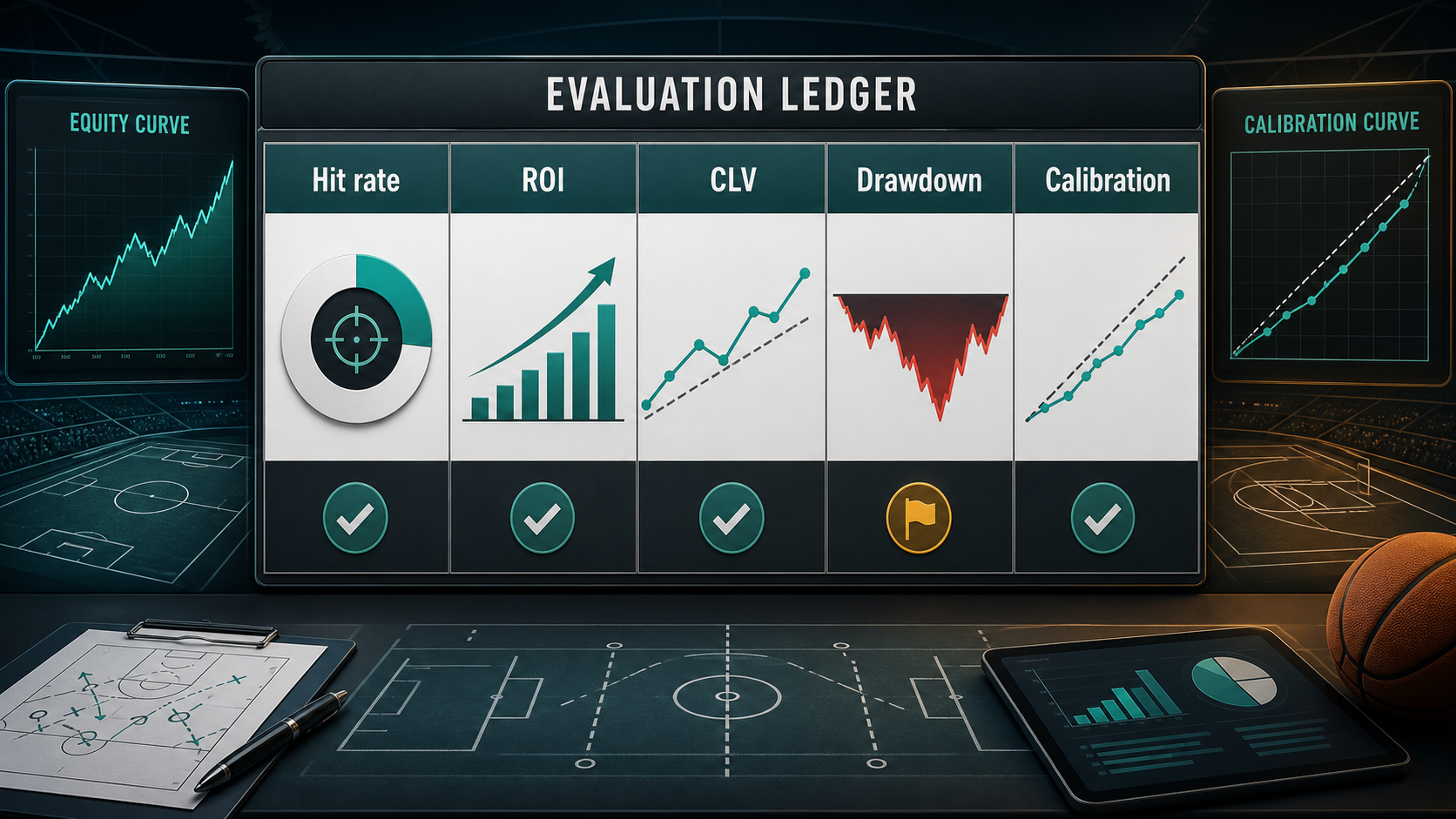

Can a model show positive CLV while posting an ugly short-term betting record, and should we still trust it? That is the practical question behind this method family. Backtesting is the audit trail. A model should be judged by more than hit rate because sports betting has prices, market movement, variance, and bankroll risk. Good evaluation separates process quality from short-term results.
The plain-English version
Backtesting is the audit trail. A model should be judged by more than hit rate because sports betting has prices, market movement, variance, and bankroll risk. Good evaluation separates process quality from short-term results.
The novice trap is to treat the method name as magic. The useful move is to ask what information the method can learn, what it cannot learn, and what kind of sports question it is actually built to answer. A method that is excellent for ranking team strength can be poor for a single player prop, and a method that wins a backtest can still be unbettable if the edge appears only after the market has moved.
Start with the target. A spread model, moneyline model, player prop projection, DFS lineup optimizer, and fantasy ranking all answer different questions. Then check the timestamp of every feature. If the feature would not have been known before the bet, contest lock, or lineup decision, it does not belong in the model. Finally, compare the output to the right benchmark: the closing line, the posted prop, the field ownership, or the best available projection.
Method-by-method guide
ats-pct
ATS percentage measures how often a side covers the spread against the number being evaluated. In sports terms, this is the part of the model that decides how to translate noisy pre-game inputs into a usable betting, fantasy, or DFS signal instead of a loose opinion.
Where it helps: It quickly describes whether an NFL spread model is clearing the basic cover threshold over a sample. The practical test is whether the block improves decisions on games it has not seen, not whether it explains last night's box score after the answer is known.
Where it fails: It ignores price, push rules, closing movement, and whether the sample is large enough to matter. The fix is usually cleaner targets, stricter time cuts, a smaller feature set, or a calibration layer before the output reaches a staking or lineup workflow.
avg-edge
Average edge measures the typical gap between model view and market price or probability. In sports terms, this is the part of the model that decides how to translate noisy pre-game inputs into a usable betting, fantasy, or DFS signal instead of a loose opinion.
Where it helps: It helps separate a model with many tiny opinions from one that finds meaningful discrepancies. The practical test is whether the block improves decisions on games it has not seen, not whether it explains last night's box score after the answer is known.
Where it fails: It can be inflated by miscalibrated probabilities or stale market numbers. The fix is usually cleaner targets, stricter time cuts, a smaller feature set, or a calibration layer before the output reaches a staking or lineup workflow.
brier-score
Brier score measures squared error for probabilistic predictions, rewarding accurate and calibrated probabilities. In sports terms, this is the part of the model that decides how to translate noisy pre-game inputs into a usable betting, fantasy, or DFS signal instead of a loose opinion.
Where it helps: It helps evaluate moneyline or cover probabilities beyond simple win-loss grading. The practical test is whether the block improves decisions on games it has not seen, not whether it explains last night's box score after the answer is known.
Where it fails: It can be hard to interpret without a baseline, and rare outcomes can dominate small samples. The fix is usually cleaner targets, stricter time cuts, a smaller feature set, or a calibration layer before the output reaches a staking or lineup workflow.
log-loss
Log loss strongly penalizes confident wrong probabilities. In sports terms, this is the part of the model that decides how to translate noisy pre-game inputs into a usable betting, fantasy, or DFS signal instead of a loose opinion.
Where it helps: It exposes models that make aggressive probability claims on NFL sides and totals. The practical test is whether the block improves decisions on games it has not seen, not whether it explains last night's box score after the answer is known.
Where it fails: It can punish one extreme miss heavily, so it should be read with calibration and sample context. The fix is usually cleaner targets, stricter time cuts, a smaller feature set, or a calibration layer before the output reaches a staking or lineup workflow.
expected-calibration-error
Expected calibration error summarizes how far predicted probability buckets are from actual outcomes. In sports terms, this is the part of the model that decides how to translate noisy pre-game inputs into a usable betting, fantasy, or DFS signal instead of a loose opinion.
Where it helps: It shows whether a 60% bucket is behaving like 60% over time. The practical test is whether the block improves decisions on games it has not seen, not whether it explains last night's box score after the answer is known.
Where it fails: It depends on bucket choices and can hide problems in smaller segments. The fix is usually cleaner targets, stricter time cuts, a smaller feature set, or a calibration layer before the output reaches a staking or lineup workflow.
maximum-calibration-error
Maximum calibration error reports the worst bucket-level calibration miss. In sports terms, this is the part of the model that decides how to translate noisy pre-game inputs into a usable betting, fantasy, or DFS signal instead of a loose opinion.
Where it helps: It catches a model that is mostly fine but dangerously wrong in one confidence bucket. The practical test is whether the block improves decisions on games it has not seen, not whether it explains last night's box score after the answer is known.
Where it fails: It can be noisy when one bucket has few examples. The fix is usually cleaner targets, stricter time cuts, a smaller feature set, or a calibration layer before the output reaches a staking or lineup workflow.
closing-line-value
Closing-line value measures whether the bet beat the final market price. In sports terms, this is the part of the model that decides how to translate noisy pre-game inputs into a usable betting, fantasy, or DFS signal instead of a loose opinion.
Where it helps: It helps judge process when a bet loses but the model consistently captured better numbers than the close. The practical test is whether the block improves decisions on games it has not seen, not whether it explains last night's box score after the answer is known.
Where it fails: It is not profit by itself and can be distorted if the close is unreliable or unavailable. The fix is usually cleaner targets, stricter time cuts, a smaller feature set, or a calibration layer before the output reaches a staking or lineup workflow.
closing-line-cents
Closing-line cents converts line movement into a price-difference unit that can be averaged across bets. In sports terms, this is the part of the model that decides how to translate noisy pre-game inputs into a usable betting, fantasy, or DFS signal instead of a loose opinion.
Where it helps: It helps compare CLV across markets where spreads, totals, and moneylines use different scales. The practical test is whether the block improves decisions on games it has not seen, not whether it explains last night's box score after the answer is known.
Where it fails: It can obscure key-number effects if the conversion treats every cent or point as equally valuable. The fix is usually cleaner targets, stricter time cuts, a smaller feature set, or a calibration layer before the output reaches a staking or lineup workflow.
roi-at-minus-110
ROI at minus 110 evaluates spread or total results under the common -110 price assumption. In sports terms, this is the part of the model that decides how to translate noisy pre-game inputs into a usable betting, fantasy, or DFS signal instead of a loose opinion.
Where it helps: It tells whether an ATS record clears the 52.38% break-even threshold after vig. The practical test is whether the block improves decisions on games it has not seen, not whether it explains last night's box score after the answer is known.
Where it fails: It is wrong when actual prices differ, especially in prop and alternate markets. The fix is usually cleaner targets, stricter time cuts, a smaller feature set, or a calibration layer before the output reaches a staking or lineup workflow.
kelly-roi
Kelly ROI evaluates returns under Kelly-style bet sizing rather than flat stakes. In sports terms, this is the part of the model that decides how to translate noisy pre-game inputs into a usable betting, fantasy, or DFS signal instead of a loose opinion.
Where it helps: It helps test whether probability edges are strong enough to support dynamic sizing. The practical test is whether the block improves decisions on games it has not seen, not whether it explains last night's box score after the answer is known.
Where it fails: It can look excellent in backtests when probabilities are overconfident, then draw down sharply live. The fix is usually cleaner targets, stricter time cuts, a smaller feature set, or a calibration layer before the output reaches a staking or lineup workflow.
sharpe
Sharpe measures return per unit of volatility, giving a risk-adjusted view of results. In sports terms, this is the part of the model that decides how to translate noisy pre-game inputs into a usable betting, fantasy, or DFS signal instead of a loose opinion.
Where it helps: It helps compare a steady small-edge model with a volatile high-upside model. The practical test is whether the block improves decisions on games it has not seen, not whether it explains last night's box score after the answer is known.
Where it fails: It assumes a return structure that may not fully match betting streaks and discrete outcomes. The fix is usually cleaner targets, stricter time cuts, a smaller feature set, or a calibration layer before the output reaches a staking or lineup workflow.
max-drawdown
Max drawdown measures the worst peak-to-trough bankroll decline in the test. In sports terms, this is the part of the model that decides how to translate noisy pre-game inputs into a usable betting, fantasy, or DFS signal instead of a loose opinion.
Where it helps: It tells whether a model can survive normal losing streaks without exceeding risk tolerance. The practical test is whether the block improves decisions on games it has not seen, not whether it explains last night's box score after the answer is known.
Where it fails: It is sample-dependent and can understate future pain if the backtest window was unusually friendly. The fix is usually cleaner targets, stricter time cuts, a smaller feature set, or a calibration layer before the output reaches a staking or lineup workflow.
profit-factor
Profit factor compares gross wins to gross losses. In sports terms, this is the part of the model that decides how to translate noisy pre-game inputs into a usable betting, fantasy, or DFS signal instead of a loose opinion.
Where it helps: It summarizes whether winning bets produce enough to cover losing bets after price and stake. The practical test is whether the block improves decisions on games it has not seen, not whether it explains last night's box score after the answer is known.
Where it fails: It can look strong in small samples with one or two unusually large wins. The fix is usually cleaner targets, stricter time cuts, a smaller feature set, or a calibration layer before the output reaches a staking or lineup workflow.
win-streak
Win streak records the longest run of winning graded decisions. In sports terms, this is the part of the model that decides how to translate noisy pre-game inputs into a usable betting, fantasy, or DFS signal instead of a loose opinion.
Where it helps: It helps users understand variance and avoid overreacting to a temporary heater. The practical test is whether the block improves decisions on games it has not seen, not whether it explains last night's box score after the answer is known.
Where it fails: It can create false confidence if read without sample size and drawdown. The fix is usually cleaner targets, stricter time cuts, a smaller feature set, or a calibration layer before the output reaches a staking or lineup workflow.
loss-streak
Loss streak records the longest run of losing graded decisions. In sports terms, this is the part of the model that decides how to translate noisy pre-game inputs into a usable betting, fantasy, or DFS signal instead of a loose opinion.
Where it helps: It prepares bankroll expectations for normal cold runs even in positive models. The practical test is whether the block improves decisions on games it has not seen, not whether it explains last night's box score after the answer is known.
Where it fails: It can be worse live than in backtest if market regime changes. The fix is usually cleaner targets, stricter time cuts, a smaller feature set, or a calibration layer before the output reaches a staking or lineup workflow.
hit-rate-by-confidence
Hit rate by confidence groups picks by model confidence and checks whether higher confidence really wins more often. In sports terms, this is the part of the model that decides how to translate noisy pre-game inputs into a usable betting, fantasy, or DFS signal instead of a loose opinion.
Where it helps: It validates whether a model should size larger on high-confidence edges. The practical test is whether the block improves decisions on games it has not seen, not whether it explains last night's box score after the answer is known.
Where it fails: It fails when confidence buckets are too small or are tuned after seeing results. The fix is usually cleaner targets, stricter time cuts, a smaller feature set, or a calibration layer before the output reaches a staking or lineup workflow.
edge-persistence
Edge persistence measures whether model edges remain useful across time, teams, seasons, or market states. In sports terms, this is the part of the model that decides how to translate noisy pre-game inputs into a usable betting, fantasy, or DFS signal instead of a loose opinion.
Where it helps: It helps decide whether a signal should be trusted live or treated as a historical artifact. The practical test is whether the block improves decisions on games it has not seen, not whether it explains last night's box score after the answer is known.
Where it fails: It can be slow to detect decay because true edges and random variance are difficult to separate. The fix is usually cleaner targets, stricter time cuts, a smaller feature set, or a calibration layer before the output reaches a staking or lineup workflow.
Sports walkthrough
Imagine a model beats the closing line on average but starts 18-24 ATS. The short-term record looks bad, yet the CLV signal may say the model is regularly getting better prices than the close. Evaluation metrics split the ledger into accuracy, calibration, price quality, ROI, risk, drawdown, and edge persistence so the builder does not panic or celebrate too early.
Concrete names keep the model honest: The Chiefs can win but fail ATS, the Bills can create strong CLV that still loses on a late turnover, and the Eagles can produce hit rate noise when closing numbers move through key prices. Those examples are not there to imply a pick; they force the workflow to deal with real role changes, injury context, usage shifts, opponent quality, and market reaction instead of abstract rows in a table.
The workflow is deliberately boring. Define the event, gather only pre-decision information, produce a projection or probability, compare it with the market or contest environment, size the action conservatively, and then record what happened. When the number closes, the closing price becomes the first audit. When the game finishes, the outcome becomes the second audit. Over a useful sample, both audits matter more than whether one bet won.
Validation workflow
Validate this method family in the same shape it will be used live. Train on older games, tune on a later slice, and reserve the newest window for the final check. If the method uses player props, keep player identity, team context, injury status, and market number aligned to the timestamp when the decision would have been made. If it uses DFS simulations, lock the slate, salary, ownership, and injury assumptions before grading lineups.
Compare against a plain benchmark before celebrating lift. A model should beat a naive average, a market-only view, and a smaller interpretable version before the extra complexity deserves product space. The important comparison is not whether the method can explain the past; it is whether it improves decisions after fees, vig, contest rake, stale lines, and real lineup constraints are included.
Review failures as carefully as wins. A losing pick that beat the close can still be a useful process signal, while a winning pick that took a bad number can be a warning. Group errors by sport, market, player role, team, confidence bucket, and price range so the builder can tell the difference between normal variance and a broken assumption.
Expert notes
Use walk-forward testing. Random splits leak season context, market regime, and team strength. Sports models should prove they work forward in time.
Profit is noisy. ROI matters, but it should be read with CLV, sample size, drawdown, and calibration. A profitable 40-bet stretch can be luck.
Calibration metrics matter for probability models. A model can pick winners while still assigning probabilities that are too high for bet sizing.
Track persistence. If edges vanish after one market adapts or one season changes, the model may have found a historical quirk rather than a durable signal.
When not to use this family
Do not use a method just because it is more advanced than a baseline. If the data is thin, the target is unstable, the sport context changed, or the market already absorbs the signal, a simpler model with better validation is usually the better tool. The warning sign is a model that needs a long explanation for why its live results should be ignored.
Watch for leakage, repeated samples, and hidden correlation. A player prop model can accidentally learn same-game information through closing lines, a DFS optimizer can double count teammate correlations, and a ratings model can overstate certainty after one noisy result. If a method cannot survive a walk-forward split, a holdout season, and a calibration check, keep it in research.
Decision checklist
| Modeling question | Useful block | Risk check |
|---|---|---|
| What is the cleanest baseline for this sports decision? | ats-pct | Confirm the target, feature timestamp, and market comparison are all aligned before training. |
| Which block adds lift without turning noise into confidence? | edge-persistence | Compare walk-forward performance, calibration, and closing-line value before trusting the output. |
How Shark Snip uses it
Shark Snip uses ats-pct, avg-edge, brier-score, log-loss, expected-calibration-error, maximum-calibration-error, closing-line-value, closing-line-cents, roi-at-minus-110, kelly-roi, sharpe, max-drawdown, profit-factor, win-streak, loss-streak, hit-rate-by-confidence, and edge-persistence to audit model trust.
The block names above are intentionally visible in this article so model builders can connect the concept to the actual building blocks in Tinker, DFS simulation, and the model marketplace. Shark Snip treats these methods as components in a workflow: feature preparation, model fit, probability repair, portfolio construction, and post-game evaluation. No block is allowed to skip validation because every sport has small samples, changing incentives, and noisy injury information.
The most useful model is not the one with the most intimidating name. It is the one whose assumptions match the sport question, whose inputs were available at decision time, whose output is calibrated enough to compare with a price, and whose failures are visible before real bankroll or contest exposure is increased.
Related reading and tools
Keep going with building your first model with Tinker, closing-line value, bet tracking. These links connect the method family to the betting, DFS, and model-building workflows readers already use.
Named modeling examples
A model page is more useful when the feature examples are concrete. Josh Allen rushing attempts, Ja'Marr Chase target share, Nikola Jokic assist rate, Tarik Skubal strikeout projection, Igor Shesterkin starter confirmation, and Islam Makhachev control time are all different prediction problems. A single “player form” feature cannot explain them all, so the model needs sport-specific inputs and review notes.
- NFL: separate route participation, pressure rate, and red-zone role from box-score volume.
- NBA: separate usage, minute projection, pace, and back-to-back fatigue.
- MLB: separate starter skill, handedness, park, weather, and lineup confirmation.
- NHL and UFC: late confirmations and fight-week news can matter more than a season average.
Model inputs worth naming
Use names as evidence, not decoration. The useful SEO win is that Josh Allen, Ja'Marr Chase, Bijan Robinson and Puka Nacua and Chiefs, Bills, Eagles and Lions appear inside decisions, thresholds, and internal links instead of being dumped into a keyword list.
- NFL model: route participation for Ja'Marr Chase, rushing attempts for Josh Allen, pressure rate allowed by the Bengals, and red-zone carry share for Jonathan Taylor should be separate features.
- NBA model: usage, projected minutes, rest, and pace should move Nikola Jokic or Shai Gilgeous-Alexander props differently than a one-number power rating.
- MLB model: Tarik Skubal strikeout projection, Coors Field park factor, lineup confirmation, and bullpen rest need their own columns.
- Review loop: grade entry price, closing price, bet result, and model error separately so lucky results do not hide bad forecasts.
Build or audit the workflow in Tinker and review it with CLV.
Educational analysis only, not a bet recommendation. Model outputs can be wrong, markets move, and sports data can contain injuries, role changes, reporting gaps, and contest-specific constraints.