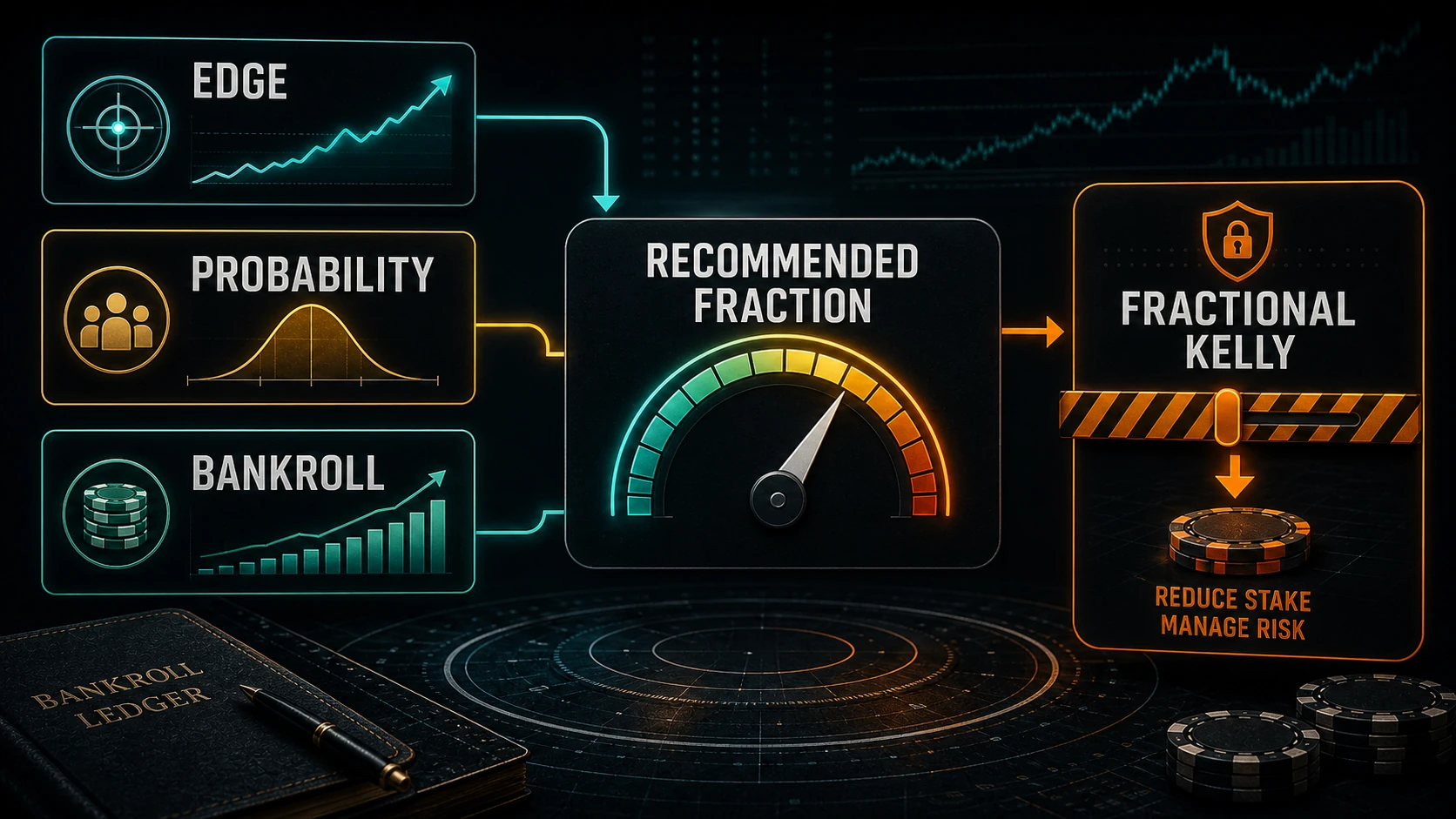
Kelly is often sold as the answer to “How much should I bet?” That is already too generous. Kelly answers a narrower question: given a payoff and a correct probability, what bankroll fraction maximizes expected logarithmic growth? Sports betting rarely supplies the word correct. It supplies an estimate with blind spots.
The formula is the easy part
For a binary wager, write the net profit per amount staked as b, your estimated win probability as p, and the loss probability as q. The Kelly fraction is:
f* = (bp - q) / b
The result is a fraction of bankroll, not a confidence score. If it is positive, the inputs imply a favorable price. If it is zero or negative, the price does not clear the estimate and the correct Kelly stake is no stake.
The algebra is not proprietary and it is not the edge. The edge lives in p. A bettor can calculate the formula perfectly and still make a reckless decision because the probability was guessed, trained on leaked data, or applied to the wrong market.
Probability error is the central risk
Kelly is asymmetric around bad inputs. Understating a real edge leaves growth on the table. Overstating an edge can turn a modest wager into an oversized one, or turn a negative-price decision into a bet. Sports models are especially vulnerable because rosters, roles, injuries, market rules, and data quality change.
Before using Kelly, test calibration. Group historical forecasts by probability range and compare the forecast with the realized ATS win rate over a named window and graded sample size. The result should be reported as wins, losses, win rate, window, and sample size. A chart without those fields cannot establish that the probability is fit for staking.
The testing workflow in the model builder can help organize that review, while the bet-tracking guide explains the audit trail needed after execution.
Fractional Kelly is a control, not a cure
Fractional Kelly scales the formula’s output downward. That is sensible when the estimated probability carries uncertainty, which is nearly always. It reduces the damage from an overconfident input and smooths the relationship between a small model change and the stake.
But the phrase “fractional Kelly” can become a ritual that hides the same flaw. Multiplying a bad recommendation by a smaller number does not make the model calibrated. It only makes the error less aggressive. The bettor still needs a reason for the chosen fraction and a separate rule for maximum exposure.
The related loss-floor guide treats that cap as an explicit policy rather than pretending the formula will discover your risk tolerance.
Price and market definition must match the forecast
The probability belongs to a specific contract. A full-game win forecast does not price a spread cover. A regulation-only forecast does not price an overtime-inclusive market. A model trained on closing lines cannot be evaluated honestly against a stale opening quote without preserving the time relationship.
Use the executable price, including the actual line and settlement rule. If the quote moves, recompute. If the market definition changes, the old probability is not portable. If several outcomes are mutually exclusive, make sure the probabilities are coherent before sizing any side.
This is where the odds translation in the betting-odds guide matters. Kelly expects a payoff input; feeding it a mislabeled price is a clean calculation of the wrong wager.
Portfolio risk breaks ticket-by-ticket sizing
Several bets can share the same underlying event: a team side, a quarterback prop, a receiver prop, and a game total may all lose together when one assumption fails. Running Kelly on each ticket as though it were independent stacks the same confidence repeatedly.
A proper portfolio treatment models joint outcomes. When that is unavailable, aggregate caps and conservative grouping are more honest than false precision. Label correlated positions, sum their downside under the same game states, and decide whether the combined exposure fits the bankroll policy.
The live view on the desk should be read as exposure, not as a collection of isolated green lights.
Bankroll is not disposable model fuel
Kelly assumes the bankroll is the capital base for a repeated process. Money needed for rent, debt service, taxes, or ordinary life is not betting bankroll. Nor is a credit limit. The formula has no field for personal distress, so the operator must impose that boundary before any calculation.
Bankroll management basics sets the accounting frame: one defined pool, tracked changes, no chasing, and no retrospective resizing after a loss. Kelly belongs inside that frame, not above it.
The honest output is often “pass”
A useful Kelly workflow can end in several ways: the price is unfavorable, the estimate is uncalibrated, the market does not match the target, the position is too correlated, or the exposure cap binds. Those are not calculation failures. They are the guardrails doing their job.
The sharp reading is simple. Kelly can translate a defensible edge into a stake policy. It cannot manufacture the edge, certify the model, or decide how much financial pain a person should tolerate. When the inputs are weak, the most sophisticated answer remains no bet.
Bankroll growth from recorded Kelly outcomes
Growth paths are shown only when a verified source supplies recorded bankroll observations for the requested Kelly strategy.
Drawdown by recorded Kelly fraction
Drawdown comparisons are shown only when a verified source supplies observed outcomes for each Kelly sizing strategy.