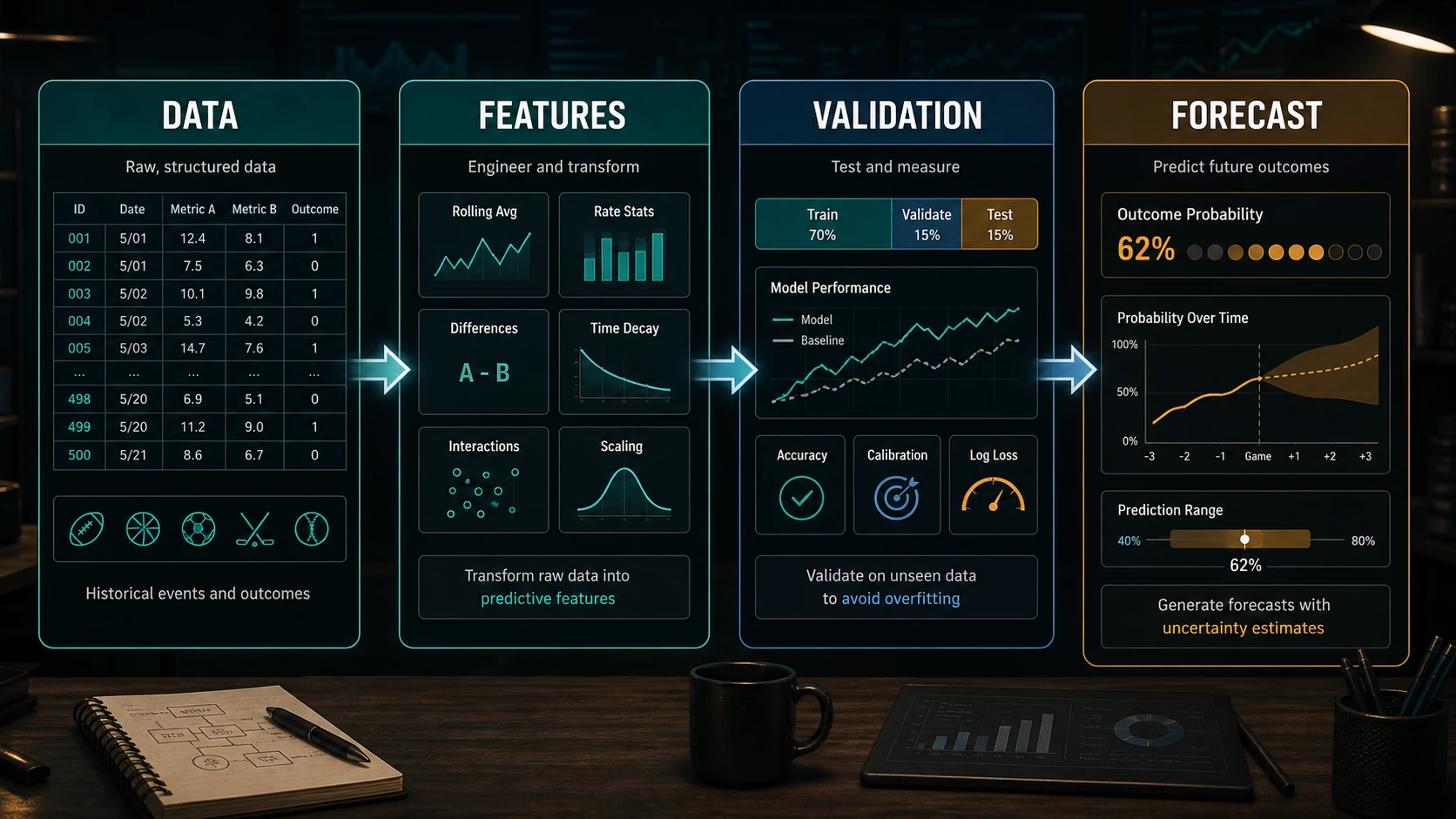
Your first betting model does not need a clever algorithm. It needs a clean question and a replay you cannot accidentally cheat. Most first builds fail before training begins: the target is vague, the feature timestamps are missing, or the test set has already influenced the design. Fix those problems and a simple model can teach you something. Ignore them and a beautiful chart can teach you nothing.
Studio is the relevant build surface, but the workflow matters more than the interface. The same sequence applies anywhere: define the target, define what was knowable, split forward in time, train, compare with the market, and lock a live shadow sample before trusting the result.
Choose one target the ledger can grade
A target should correspond to one observable outcome. Game margin, total score, win probability, and a player statistic are different jobs. Do not ask one model to blur them together and then choose whichever metric looks strongest.
Write the label in operational language. Which event key identifies the row? When is the result final? How are pushes, voids, overtime, corrections, and missing settlements handled? A target without those rules creates grading debates after the answer is known.
For a first build, prefer a target with a reliable schedule, clear settlement, and enough historical coverage to support a forward split. Familiarity with the sport helps you catch nonsense, but it is not a substitute for a data contract.
Choose features by availability, not by storytelling
Every feature needs a source and an “available at” rule. A rolling efficiency measure must exclude the game it predicts. An injury field must reflect the report available before the decision. A market feature must identify the book or consensus and capture time. If the timestamp cannot be defended, the feature stays out.
Start small. Add a feature because it represents information the current set does not already contain, not because its name sounds predictive. Highly related inputs can create a complicated model that is still making one bet. A short feature list is easier to audit when the result changes.
Keep the market in the comparison even when it is not a model input. The closing line is a strong baseline. Beating a naive average while losing to the market is not an edge; it is a forecasting exercise that has not cleared the opponent.
Split the history forward
Train on older events, tune on the next untouched window, and reserve the final window for one decision after the design is settled. Do not shuffle the full history and call the random remainder “out of sample.” Sports data carries time: rosters, coaching, rules, and market behavior move together.
Every time you inspect the final window and change the build, that window becomes part of development. Mark the experiment exploratory and promote a newer untouched period. This rule feels expensive because it limits how often you can look. That expense is what protects the result.
Use the same exclusions across the model and baseline. If a closing line is missing, exclude the event from both and report it. If a feature is missing, return an error with a cure rather than filling it with information from the future.
Read training output like a diagnosis
Training fit tells you whether the model can represent patterns in the data it saw. Validation fit tells you whether those patterns travel to later events. A large gap is a warning that the model learned details of the training window. A small gap is not proof of usefulness; both scores can be poor.
Inspect feature behavior, residuals, and slice stability. Does the model fail on a particular market source, season phase, or probability band? Does one feature dominate because it contains the answer? Does removing the market input erase every apparent advantage? Those questions are more valuable than celebrating a single aggregate metric.
Run a shuffled-label control. The model should lose its apparent skill. If it does not, the pipeline may be leaking or the metric may be computed incorrectly.
Backtest the decision rule, not just the forecast
A prediction and a bet are not the same object. Define the rule that turns a forecast into a pass, watch, or play before reading the held-out outcomes. Then grade every eligible decision under the same rule.
For spread results, report ATS wins, losses, win rate, window, sample, closing-line source, and Do not replace that receipt with return language built from assumed prices. If actual ticket prices and stakes are not in the ledger, the backtest is a forecast-and-selection test, not an account statement.
Keep every drawdown interval. Deleting a bad stretch because the league “changed” is only legitimate when the regime rule was defined without using those outcomes and is tested again on untouched data.
Compare changes one at a time
A useful model-building loop makes one controlled change, reruns the same validation contract, and records the result. Add one feature family. Change one regularization choice. Adjust one preprocessing rule. When several things change together, the experiment cannot tell you what helped.
Save the rejected versions. Failed experiments establish boundaries and stop the same idea from being rediscovered later with a new name. The model card should show the dataset version, feature set, split, baseline, exclusions, and reason the version was accepted or rejected.
Move to live shadow mode before publishing confidence
Generate predictions before events, lock them with timestamps, capture the live market, and grade after settlement. Do not allow manual backfill. This creates a live-pregame ledger that can reveal data latency, source drift, and behavior the historical replay missed.
A live record must state the window and sample. The graded-at value is a batch stamp, not a time axis; the event timestamps define the evaluation order. A model that cannot preserve that distinction is not ready for a public record.
Use the model leaderboard as a comparison surface only when the models share clear grading and provenance. Use Workshop to continue the build context already named by this article, and keep the evidence attached when a model is published.
The watchpoint
The first model is ready to advance when its pregame-safe result beats the relevant baseline on an untouched window, the conclusion survives simple slice and leakage checks, and the live shadow ledger behaves within the uncertainty you declared. Until then, keep it in the lab. The point of the first build is not to prove you are a modeler. It is to establish a process that can tell you when the model is wrong.