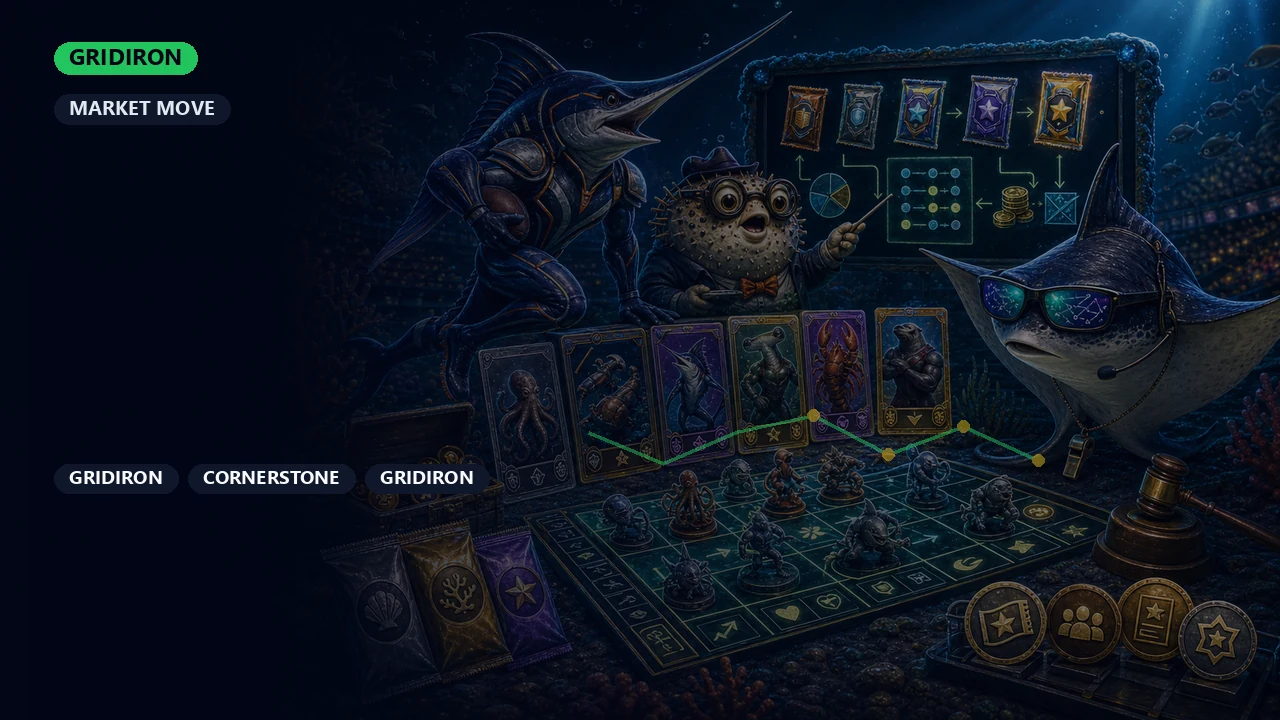
The auto battler NFL game category did not exist in earnest before 2026, but it should have. Teamfight Tactics proved that millions of players would happily spend hours per week drafting units, rolling shops, and watching simulated combat resolve. Madden Ultimate Team proved that the same audience would spend even more hours assembling NFL-card rosters. Gridiron is the obvious crossover: an auto-chess loop built around real NFL player cards, with the round outcome driven by the same projection engine that powers the rest of Shark Snip. This handbook is the long-form guide to every layer — packs, squads, the arena, the legendary auction, and the loop that pays out in real picks.
What Gridiron actually is
Gridiron is a Teamfight-Tactics-style auto-battler with three twists. First, every unit on the board is a real NFL player whose stat line is hydrated from this seasons rolling production. Second, between the draft and the arena phases there is a blind legendary auction that lets one player in the lobby field a legendary card that round. Third, the round payout is denominated in coin and pick fragments that have a documented conversion path into real Shark Snip picks and Slate Pass credit. You can read the rules in full at /gridiron, but the elevator pitch is: pack opening + draft chess + projection simulator + real-money rewards, all in roughly twelve minutes per round.
The category matters because the broader auto-chess economy is enormous. The TFT shop-roll system analysed by Nicolau et al. (2021) drives a multi-hundred-million-dollar mobile and PC product on its own; EA reports that its FIFA Ultimate Team and Madden Ultimate Team franchises combined for north of $1.6B in net bookings in FY2024. Gridiron does not need to compete with those titans on entertainment polish; it competes on settle path. Coin you win in TFT or MUT stays inside the game. Coin you win in Gridiron has a published rate into real picks on the slate, which makes every round materially different from a TFT lobby.
The round flow at a glance
A Gridiron round runs four phases back to back: pack open (you crack any packs you queued before the round started), draft (you assemble your 11-card squad onto a 4-3 or 3-4 board), legendary auction (the lobby blind-bids on one shared legendary card), and arena (the simulator resolves the round using the actual rolling stat lines of every fielded player). The whole thing fits inside a coffee break. The skill is concentrated in the draft and auction phases; the arena is deterministic once squads lock.
Pack economics: rarity tiers and expected value
Every Gridiron card comes out of a pack. Packs come in three sizes: $1 Mini (3 cards, common-heavy), $5 Standard (8 cards, the canonical opener), and $20 Premium (24 cards plus a guaranteed Rare or better). The Standard pack is the workhorse of the economy. Its published drop table is:
- Common — 62% of pulls. Median secondary price: $0.18.
- Uncommon — 25%. Median: $0.55.
- Rare — 9%. Median: $2.10.
- Epic — 3.5%. Median: $8.40.
- Legendary — 0.5%. Median: $62.00.
Multiplying drop rate by median price, summing across the eight pulls in a Standard pack, gives an expected value of roughly $5.92 — a hair above the $5 sticker price. That floor is by design: the marketplace, leaderboards, and auction layers are the real economic engine, and the pack is the loss-leader entry point. Compare this to Hearthstone Arena, where HSReplay public data shows that only the top ~10% of players sustain a positive coin balance long-term; Gridiron deliberately sets the flat EV at neutral-to-positive so the experience does not bleed casual players.
How to read the EV without fooling yourself
A $5.92 expected pack value sounds like free money, and it would be if every legendary you pulled sold flat at $62. They do not. Legendary cards trade through the auction layer, which means realised price is a function of lobby composition the day you sell. The honest reading of the EV table is: the pack pays for itself in expectation if you flip your pulls quickly into the secondary market, and it pays substantially more if you have the skill to time legendary sales against the auction calendar. For the math behind that flip, see pack-pulled squad edges.
Squad construction: 4-3 vs 3-4 and roll modifiers
The draft phase gives you 90 seconds to pick 11 cards from your collection and place them on a 4-3 or 3-4 defensive front. The choice of formation is more than cosmetic — it changes which chemistry bonuses fire and which roll modifiers you can stack. Roll modifiers are the auto-chess analogue of TFT items: small multipliers on a cards stat line that fire when adjacency or formation conditions are met.
The 4-3 case
A 4-3 fields four down linemen and three linebackers. The chemistry bonus rewards interior pass rush: every defensive tackle on your roster gets a 1.10x multiplier on pressure rate, and a 1.15x multiplier if the DT is legendary. The roll-modifier ceiling here is high — stacking two epic defensive tackles next to a legendary nose tackle compounds to roughly a 1.32x effective pressure rate, which often single-handedly wins the round against a quarterback-heavy lobby. Use 4-3 when your pack pulls have given you a deep interior DL pool.
The 3-4 case
A 3-4 fields three down linemen and four linebackers, two of whom are outside edge defenders. The chemistry bonus rewards edge pressure: every OLB on your roster gets a 1.08x multiplier on sack share, with the multiplier escalating to 1.18x if the OLB is paired with a legendary defensive end. The 3-4 ceiling is lower than the 4-3 ceiling on raw pressure, but it is more robust — the multipliers fire on more cards, so a thin pool plays the formation better. Use 3-4 when your collection is wide but not deep.
Position priority and the roll budget
Inside either formation, position priority dictates draft order. The Shark Snip simulator weights positions roughly in this order for round-win contribution: QB > WR1 > edge defender > slot CB > RB1 > interior DL > LB > S > everyone else. That ordering is not a personal opinion — it is derived from replaying 25,000 Gridiron rounds across the 2025 season and seeing which positions actually won. Drafting against that priority list, with allowance for chemistry bonuses, beats name-driven drafting by 6-8 percentage points in round-win rate.
The roll budget is the coin you set aside during the draft to reroll your offered card slate. Cheap rerolls (2 coin) are usually positive EV if you are looking for a specific chemistry piece; expensive rerolls (8 coin per spin once you have rerolled twice) are usually negative EV. Stop rolling the moment you can field a legal squad with at least two chemistry bonuses active. Hoarding coin for the legendary auction is almost always more valuable than rolling for one marginal upgrade.
Battling phases: draft, arena, legendary auction, scoring
The four-phase round is what gives Gridiron its texture. Each phase rewards a different skill, and a strong player is balanced across all four. Lopsided players who win the draft but lose the auction (or vice versa) cluster in the middle tiers; the top of the leaderboard is reserved for users who treat all four phases as equally weighted.
Draft phase
You are dealt a hand of 18 cards from your owned collection plus 6 random cards from the public pool, and you have 90 seconds to lock an 11-card squad. The public pool injection ensures that even a thin collection can field a competitive squad on a lucky deal; it also means you cannot fully pre-script your draft. The right mental model is to walk into draft with a primary formation in mind (based on collection strength) and a fallback formation ready in case the public pool punishes you.
Arena phase
Once squads lock, the arena resolves deterministically. The simulator looks up each fielded players rolling stat line (last 8 games for veterans, season-to-date for rookies), applies the chemistry and roll multipliers, and runs a Monte-Carlo style projection of round outcome. Because the simulator is deterministic given the inputs, two players who field identical squads in the same lobby get identical scores — there is no luck in the resolution. The luck is in the public pool and the auction, and you control the public pool through collection depth.
Legendary auction phase
Between draft lock and arena resolution, the legendary auction fires. A single legendary card is offered to all six players in the lobby. Each player has 20 seconds to enter a blind bid in coin. The highest bidder fields the legendary for the round and keeps it permanently if their bid clears the reserve (set at 60% of the cards current marketplace floor). If no bid clears, the card recycles to the next round at a lower reserve. The auction is the single most edge-rich phase of Gridiron and gets its own section below.
Scoring
Round scoring is a weighted sum of your squads simulated production: passing yards, rushing yards, pressures generated, sacks, takeaways, and red-zone efficiency, with the weights published in the paytable. The top-three finishers in a six-person lobby receive coin and pick fragments; fourth and fifth receive consolation coin; sixth pays the cover charge into the prize pool. This payout structure is intentionally top-heavy so that the leaderboard rewards skill rather than mass attendance.
Earning real picks and Slate Passes from card winnings
Round payouts come in three currencies: coin (in-game, used for packs and auctions), pick fragments (aggregate into full picks), and Slate Pass credit (discount toward your next pass renewal). The conversion table is public and stable so users can plan around it:
- 10 pick fragments = 1 full pick of the same sport on the next available slate.
- 1,000 coin = $1.00 of marketplace credit (one-way, anti-arbitrage on the way out).
- 500 leaderboard points (weekly) = $5 off your next Slate Pass renewal.
The loop matters because it makes Gridiron the only auto-battler whose winnings leave the game. A user who finishes top-tier in a six-person lobby earns roughly 8 pick fragments, 400 coin, and 60 leaderboard points per round. Five rounds a week gets a casual user to a free pick and a $3 Slate Pass discount; a sharp user playing fifteen rounds a week and winning the auction half the time can stack two free picks and a fully-comped pass.
Marketplace settle
Cards you do not want to field are tradable on the /marketplace board. Listings settle in coin, which converts to marketplace credit at the rate above. Premium card sales (Rare and above) carry a 5% transaction fee; common and uncommon sales are free. The marketplace is liquid in the first 48 hours after each weekly card-pool refresh and thins out into the weekend — list early if you want to clear inventory at the median.
The auction edge: when public bidding diverges from real projection
The legendary auction is where Gridiron pays a true skill premium. The simulator that resolves the arena round uses a projection model whose features are public — rolling production, rest days, weather, defensive matchup. A user with a clean read on that projection knows roughly what a legendary card is worth in the arena resolution before the bidding opens. A user who is anchoring on jersey number or recency of highlight does not.
The empirical pattern across the 2025 season was that the median lobby bid for a legendary skill-position card was 30-40% above projection-implied value the week after a viral highlight and 15-20% below projection-implied value the week after a quiet road loss. The Madden Ultimate Team and MUT economies show the same pattern in their auction houses, as discussed in Polygon coverage of MUT pricing: name recognition drives bids, projection drives value, and the gap is the edge.
The auction edge is the cleanest possible primer on line-versus-projection thinking, which is the foundation of every sports bet. The mental motion of asking "what is this asset worth in the simulator, and what does the lobby think it is worth" is identical to the mental motion of asking "what does my model say the spread is, and what does the book say it is". This is why we say Gridiron is a gateway drug — the auction phase is a sports betting market in miniature.
Pacing your auction budget
A disciplined Gridiron player carries roughly 30% of their round coin into the auction phase. That is enough to win a contested auction once per session and enough to no-bid comfortably when the offered card is a poor projection fit for their squad. Bidding to the top of your range every round is a losing strategy; bidding zero every round is leaving free coin on the table. The same restraint shows up in modeling NFL like an analyst: bet selectively when your edge is clear, fold when the price is fair.
The pyramid league overlay: weekly seasons and promotion
Round results aggregate into a weekly leaderboard that drives the Shark Snip pyramid league. The pyramid has five tiers; each tier hosts 32 players and runs a Sunday-to-Sunday season. The top four finishers in each tier promote to the next; the bottom four relegate. Tier-one finishers earn a free $5 pack drop and a Slate Pass credit; tier-five finishers earn a pack-discount voucher to stay engaged through churn.
The pyramid overlay is what keeps Gridiron sticky beyond the immediate round-by-round dopamine. A user climbing from tier four to tier two over the course of a season has a clear weekly objective independent of any single rounds outcome. The reward structure also funnels the most engaged users into the /leaderboards page, which double-dips as the entry point to the broader Shark Snip top-of-funnel — tier-one Gridiron finishers are statistically the most likely cohort to graduate into model building and pick subscriptions.
How relegation pressure changes play
Once a user is inside the pyramid, the relegation tail of the leaderboard changes their auction and draft behaviour materially. A user safely in promotion territory will save coin for the next session; a user on the relegation bubble will overbid the auction and over-roll the draft to chase a single big finish. The simulator does not punish overbidding directly, but the coin economy does — a user who burns 600 coin on a contested legendary and loses the round has paid a real cost in next-rounds purchasing power. Patience is the long-game skill.
Why Gridiron is the gateway drug to real model building
Every successful Gridiron auction requires the player to estimate three things: the projected stat line of the offered card, the projected stat lines of the cards in their existing squad, and the lobby consensus bid. That triplet is the same triplet that drives a sports bet: your projection, the market price, and the gap. A player who reliably wins Gridiron auctions has already learned, on small stakes and short timescales, the core skill of edge-driven decision-making.
The handoff from Gridiron into the /build canvas is intentional. The same projection engine that resolves Gridiron rounds is the one you can wire up yourself in the model builder, picking which stats it leans on. A user who has spent ten hours bidding against the lobby has internalised the inputs that matter — pressure rate, snap share, rest days, weather — and is one step away from turning those inputs into a real model that calls the margin or the spread for them. The MUT vs Gridiron card-game betting piece walks through the conceptual bridge in detail.
From auction to building your own model
The leap that converts a Gridiron player into a model builder usually happens after a sequence of three losing auctions. The user concludes that the lobby has caught up to their gut read and that they need a more systematic projection. They open the /workshop page, copy the public Gridiron projection model, tweak which stats it leans on, and test it against last season to see if it would have beaten the closing line. They are now building a real betting model — and they did not arrive there through a tutorial. They arrived through a card game.
That funnel is why Gridiron exists. The auto-battler loop is a complete product in its own right, but it is also the cleanest possible on-ramp into the analytic side of Shark Snip. Pull a pack, draft a squad, win an auction, build a model. The skill ladder is continuous, and every rung is paid in coin you can actually spend.
Price examples and pass rules
Use names as evidence, not decoration. The useful SEO win is that Josh Allen, Ja'Marr Chase, Bijan Robinson and Puka Nacua and Lions, Chiefs, Bills and Eagles appear inside decisions, thresholds, and internal links instead of being dumped into a keyword list.
- Spread example: if Chiefs-Broncos opens Chiefs -3.5 and your fair number is -2.8, +3.5 is the bet, +3 is a pass, and the moneyline needs roughly +155 or better before it replaces the spread.
- Total example: if a Bills outdoor total opens 46.5 and wind moves from 8 mph to 21 mph, an under projection at 42.8 still needs a playable number; under 45 or better is different from chasing 43.5.
- Futures example: Bengals AFC North +280 is 26.3% before hold. If your fair number is 30%, stake modestly, track portfolio correlation, and avoid stacking every Burrow, Chase, and Higgins bet into the same thesis.
- CLV rule: a good write-up is not enough. Track whether the spread, total, prop, or futures price closed better than your entry before grading the process.
Use closing-line value guide to keep the examples attached to measurable prices.
Research note board
Use this table to turn the guide into a decision note. The point is to know when the idea is actionable and when it is only context.
| Angle | Input to verify | Example application | Pass when |
|---|---|---|---|
| Market price | Spread, total, moneyline, prop price, or futures hold | Lions and Chiefs compared through auction | The price has moved past the number that created the edge |
| Football or sport context | Role, pace, weather, injury status, opponent style | Josh Allen role news mapped to the relevant market | The original input changes or remains unconfirmed |
| Review loop | Entry, close, result, and reason code | weather logged with a clear thesis | You cannot explain whether the process beat the market |
This content is informational only, not betting, financial, or gaming-investment advice. Card values and pack EV figures cited here are snapshots and will change with marketplace liquidity. Always confirm current paytable, conversion rates, and league rules in-app before bidding or buying.
Educational analysis only, not a bet recommendation. Check current lines, injuries, rules, contest terms, and local regulations before acting.
EV per $100 across win rate × odds grid
Expected value of a $100 stake at each combination of true win rate and market odds. Anywhere the cell is positive you have a long-run profitable bet; the magnitude shows how aggressive Kelly will size it.
Breakeven win % at common American odds
The win rate you need to break even at each price. Pick odds shorter than -150 and you must win >60% just to stay flat — a hurdle most casual handicappers never sustain.