An NFL spread is not the sportsbook’s final-score prediction. It is a handicap attached to a price. The favorite has to clear the number. The underdog gets the number added to its result. Most bad spread bets begin when the bettor picks the better team and forgets to price the margin.
What a spread actually is
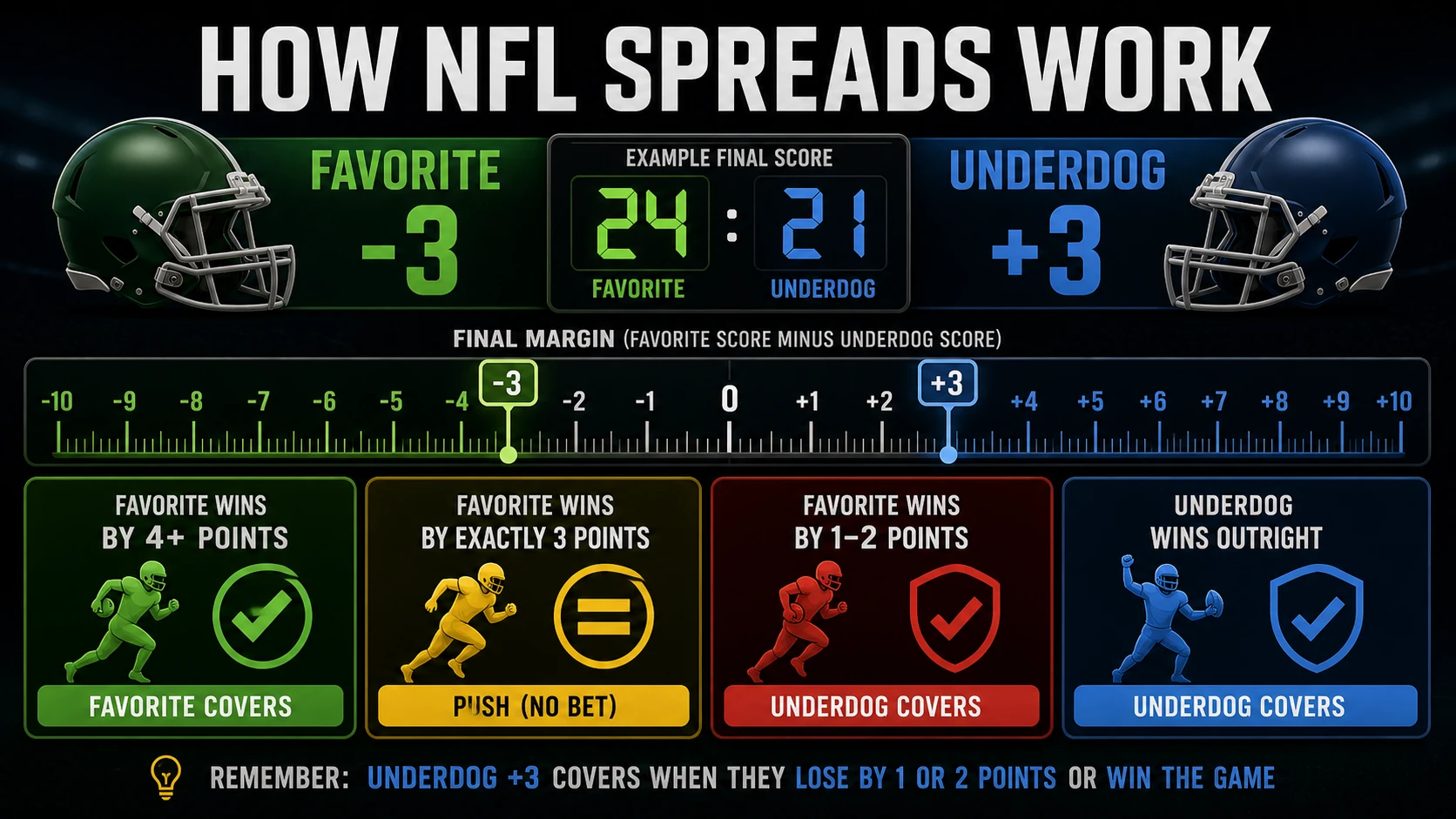
A point spread is a handicap. The sportsbook is not asking only who will win; it is asking by how much. The favorite is given a negative number. The underdog gets the matching positive number. To win a bet on the favorite, that team must win by more than the spread. To win a bet on the underdog, that team can lose by less than the spread or win outright.
The whole point is to turn a lopsided matchup into a priceable margin. It does not mean the book has predicted one exact score or perfectly balanced action. It means each side has a settlement condition and a price.
How NFL spreads are set
A book begins with team strength and matchup information, then accounts for venue, injuries, rest, weather, and expected demand. The posted line can move when new information arrives or when the market forces a price change. The movement does not explain itself.
- Injuries matter when availability changes how the offense or defense functions.
- Weather matters when wind, precipitation, or field conditions alter likely play calling.
- Market information matters when credible action or reporting changes the available price.
- Demand can move an offer even when the football facts stay the same.
By kickoff, the closing line reflects information and demand that reached the market. Beating it is useful only when the wager and reference describe the same market. The closing-line-value guide covers that comparison, while the Workshop is useful for testing a fair-line process.
Reading the number
A favorite at -3 must win by more than three points to cover. A win by exactly three is a push under standard grading. The opposing underdog at +3 covers by winning outright or losing by fewer than three points.
Move either side to a half-point and the push disappears. The hook changes a settlement branch; that is why a tiny-looking move can matter.
What about a pick'em?
When a game has no spread favorite, the board may show PK or zero. The straight-up winner covers. A tie follows the sportsbook’s posted settlement rules.
What does the half-point cost?
The answer is whatever price the book attaches to the improved number. Do not evaluate the spread and price separately. A half-point can protect one margin while raising the break-even rate enough to erase the value.
What ATS means
ATS means against the spread. It grades the result after applying the handicap. Straight-up records answer who won; ATS records answer who covered. A team can win and fail to cover or lose and still cover.
Any numeric ATS record needs its wins, losses, percentage, window, and graded sample. Pushes stay separate. A naked record without those fields is not evidence. The ATS betting guide expands the grading mechanics.
The price is part of the bet
At a posted -110, the bettor risks 110 for a potential profit of 100. The break-even rate is:
110 / (110 + 100) = 52.38%That result comes from deterministic price arithmetic. It does not promise that either side covers at that rate. A better spread at a worse price can demand more successful bets than the protection is worth.
Key numbers: why 3 and 7 dominate the board
In public.schedules, absolute margins of 3 occurred in 453 of 3,140 non-tied regular-season games (14.4%) and margins of 7 in 267 (8.5%) from 2014-2025. Provenance tier: historical results. Football scoring explains why those margins deserve attention; the query shows how often they appeared in the declared window.
Moving a favorite from -3 to -3.5 turns a three-point win from a push into a loss. Moving an underdog from +3 to +3.5 turns that result from a push into a win. The settlement difference is certain; the fair price for it still depends on the market.
How a hook move should be evaluated
Write the result at both numbers. Then calculate the break-even rate at both prices. If the protection matters only in a narrow branch and the price rises sharply, pass. If the new number fixes a settlement risk at a tolerable price, it may be worth taking.
How to read line moves
Lines can move because new information arrived, because money came in unevenly, or because another book changed first. Those are different stories. The movement alone does not identify the cause.
- Fast moves can reflect coordinated action or breaking information.
- Slow drifts can reflect accumulated demand without a new football fact.
- Injury moves should be checked against the actual status report and role change.
Record the number and timestamp you accepted. The bet-tracking guide explains why a later screenshot cannot replace the execution receipt.
Where models help
A model can force the bettor to state a fair margin before reading the board. Team strength, rest, travel, weather, and confirmed availability can enter the estimate when their timing and provenance are clean. The model earns trust by exposing which component created the gap.
Do not chase precision the inputs cannot support. If a small assumption change erases the disagreement, the correct decision may be no bet. The marketplace is useful only when creator models expose the same evidence.
Live betting and the moving spread
In-game spreads react to score, time, possession, and new information. A pregame fair line is useful context, but the live state is a different market. Do not pretend one early play contains no information, and do not pretend it contains all of it.
Before making a live decision, name which input changed and whether the model can update it. A wager made because the number “looks too big” is not analysis.
Practice without staking money
Paper-track spreads before risking cash. Write a fair line, capture the available price, record the close, and grade the ATS result. The point is not to manufacture a hot record. It is to learn whether the reasoning survives an auditable timeline.
Frequently asked questions
How do I read a -7.5 spread in NFL betting?
The favorite must win by 8 or more points to cover. The underdog covers by winning outright or losing by 7 or fewer. The half-point removes the push.
What is a key number in NFL betting?
It is a final margin frequent enough to change the value of a half-point. The sourced regular-season distribution above shows why 3 and 7 receive special attention.
What does ATS mean?
ATS means against the spread. It grades the handicap rather than the straight-up winner.
Why does -110 imply a 52.38% break-even rate?
The bettor risks 110 for a potential profit of 100, so the deterministic rate is 110 divided by 210.
Should I buy a half-point?
Compare the settlement change with the new price. A better number can still be a worse wager when the added cost is too high.
How is a spread different from a moneyline?
A spread settles on margin after the handicap. A moneyline settles on the straight-up winner.
Bottom line
An NFL spread asks whether your side beats the handicap at the price you accepted. Read the sign, know the margin required, respect the hook, and keep the price attached. The team name gets the television graphic. The number decides the ticket.
Watch how lines move from open to close, read injury reports, and track every ATS decision with the framework in the betting-log guide. The spread is the ground floor of NFL handicapping; the receipt is what keeps the lesson honest.
NFL ATS cover-margin distribution
Bars count completed NFL schedule rows by closing-spread cover margin using the repository canonical home-margin grading convention.
Model calibration from graded predictions
Calibration points render only when a verified source binds prediction probabilities to settled outcomes for the same observations.