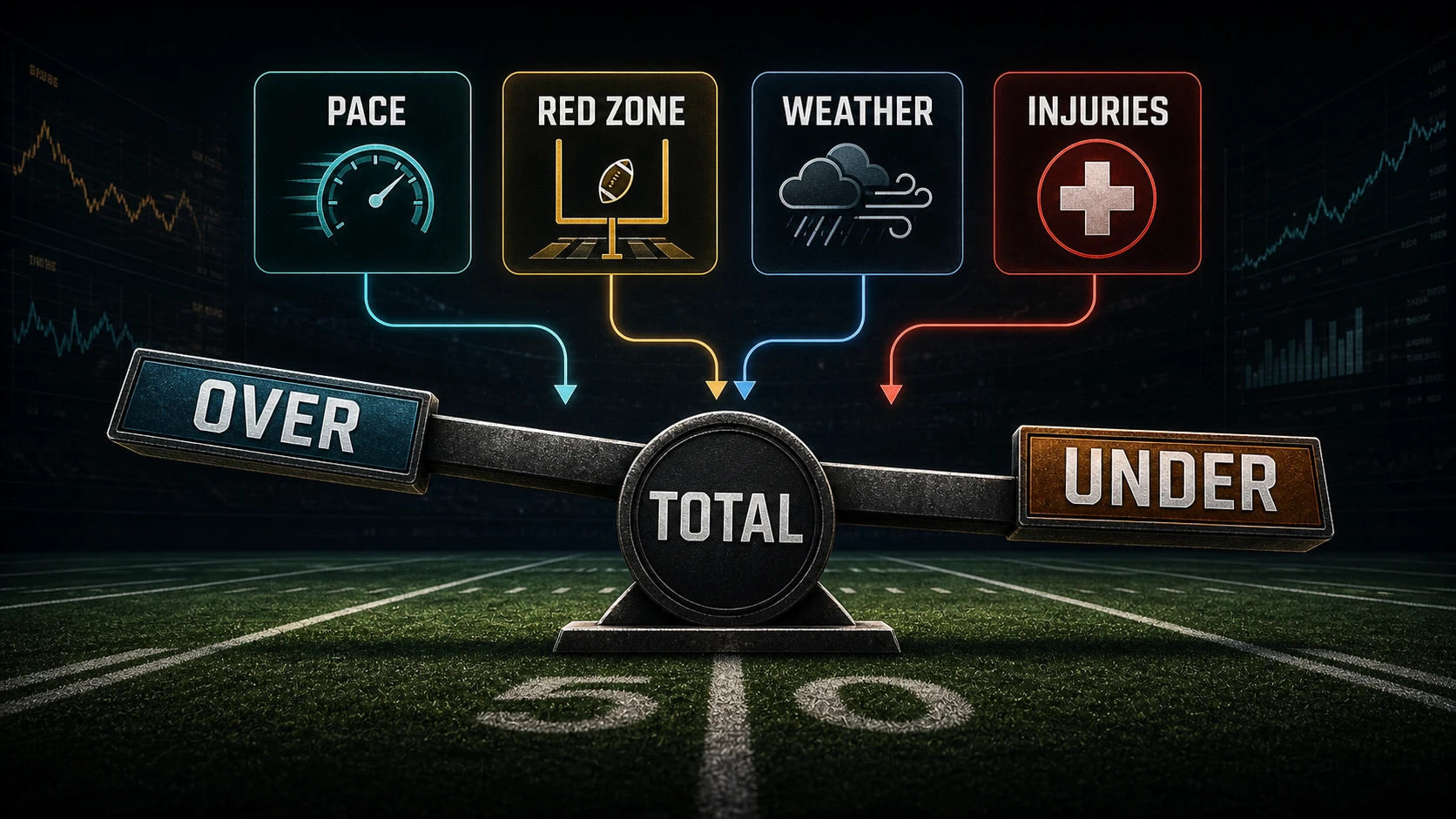
A total is a price, not a weather slogan. The book posts one number for the points both teams will score, and your job is to decide whether the assumptions inside that number are wrong. That sounds simple. It is also where bettors talk themselves into the most fiction: fast teams must go over, rain must mean under, a quarterback injury must already be priced, and a move must be sharp. None of those statements is a handicap until it is tied to a real line and a timestamp.
The useful parts survive without the costume jewelry. There is no synthetic matchup, no pretend sportsbook quote, and no claim that one input is worth a fixed number of points. When the live board has no eligible total, the state is plain: no current, timestamped NFL total is available to evaluate.
Start with the market you can actually bet
Write down the sportsbook, the total, the price, and the time you saw it. Do that before reading a forecast thread or building a pace story. The same game can carry different totals across books and can move while you are researching it. Without the quote, you are handicapping an idea rather than a wager.
Settlement matters too. Standard full-game totals use the combined final score under the book’s posted rules. Whole-number totals can push. Half-point totals force a win or loss. Regulation-only, first-half, team-total, and live markets are separate products; do not borrow a conclusion from one and paste it onto another.
Build the scoring case from possessions and efficiency
Totals begin with how many useful possessions each offense is likely to get and what each offense can do with them. Tempo is part of that, but raw pace is easy to misuse. A team can hurry while producing short, empty drives. Another can play slowly and still create scoring chances through explosive plays, field position, or red-zone execution.
Use only information that existed before kickoff. Rolling efficiency needs a clean cutoff. Injury status needs a source time. Opponent adjustments need to exclude the game being predicted. The moment a feature sees the final score, the closing line, or a postgame depth-chart correction, the backtest becomes a magic trick.
- Play volume: expected drives, neutral-situation tempo, and whether either team can sustain possession.
- Efficiency: down-to-down success, explosive-play risk, pressure allowed, and the quality of the opposing defense.
- Scoring conversion: red-zone roles, kicking conditions, fourth-down behavior, and turnover assumptions.
- Game script: whether a lead would speed the opponent up, bleed the clock, or change personnel.
Treat availability as a tree, not a headline
A missing quarterback matters, but the replacement, play caller, protection, and market response matter with him. The same goes for tackles, centers, receivers, defensive backs, and pass rushers. Ask what changes on the field: depth of target, pressure rate, run-pass choice, clock behavior, coverage structure, and short-field risk. Then ask whether the posted total already moved.
Do not double count. If the market fell after a confirmed absence and your model also applies the full injury adjustment, you may be charging the same news twice. Keep a pre-news estimate, the first tradable post-news quote, and your final decision. That record is more useful than a confident sentence written after the move.
Weather is context, not a universal tax
Open-air football can change quickly, so the forecast must travel with its observation time. Stadium orientation, roof status, sustained wind, gusts, direction, precipitation type, temperature, and field condition all affect the question. The offenses matter just as much. A short passing game can react differently from a vertical one; a mobile quarterback can create value that a simple passing downgrade misses.
There is no honest fixed weather multiplier in this module. Compare scenarios instead. What does the offense look like if the forecast holds? What changes if the roof closes, the wind shifts, or the rain arrives late? When the result depends on a forecast branch the market cannot verify yet, passing is a position.
The companion NFL weather guide explains how to log those inputs without turning a forecast into fake precision.
Read movement without inventing a narrator
An opener and a later quote tell you that the market changed. They do not tell you who moved it or why. News can arrive between snapshots. Limits can rise. Books can copy a reference screen. A stale book can catch up. The useful record is mechanical: opener, current quote, close, timestamps, and the news that was public at each point.
Closing-line value is a process check, not a guarantee that one ticket was good or bad. The closing-line value guide shows how to compare the number you took with the eventual close. Keep that analysis separate from the game result.
Choose the right totals market
The full-game total is not always the cleanest expression of a view. A first-half total can isolate an opening script but loses second-half adaptation. A team total can isolate one offense but adds settlement and pricing differences. A live total can react to observed pace, injuries, and weather, but the quote may move before you finish the calculation.
Pick the market whose failure state you can explain. If your thesis is entirely about one offense, the opponent’s scoring variance can swamp a full-game position. If your thesis depends on late weather, a pregame total may be premature. If the live feed is delayed, do not pretend the screen is tradable.
Grade the process, not the story
Before kickoff, write the total you saw, your fair range, the inputs that would change it, and the reason to pass. After the market closes, record the close from the same market and settlement rules. After grading, keep the result, but do not let one final score rewrite what was knowable beforehand.
The bet-tracking guide structures that log. The NFL picks page carries current graded selections. An empty board stays empty; no selection is manufactured to fill it.
The clean totals checklist
- Confirm the exact market, line, price, sportsbook, and timestamp.
- Estimate possessions and scoring efficiency with pregame-only data.
- Translate injuries into role and scheme changes, then check what the market already absorbed.
- Log forecast time, roof status, wind, precipitation, and field context.
- Compare opener, current quote, and close without assigning an unsupported motive.
- Pass when the data window, settlement rule, or tradable quote is unclear.
What to watch: the first timestamped total whose injury or weather input changes after the quote. That paired update is the next place the handicap can be tested.
Provenance tier: explanatory market mechanics. No historical ATS record, return claim, or synthetic line claim is asserted.
Average NFL total points by recorded weather bucket
Average combined score is grouped only from completed NFL schedule rows with a recorded indoor roof state or numeric wind value.
NFL ATS cover-margin distribution
Bars count completed NFL schedule rows by closing-spread cover margin using the repository canonical home-margin grading convention.