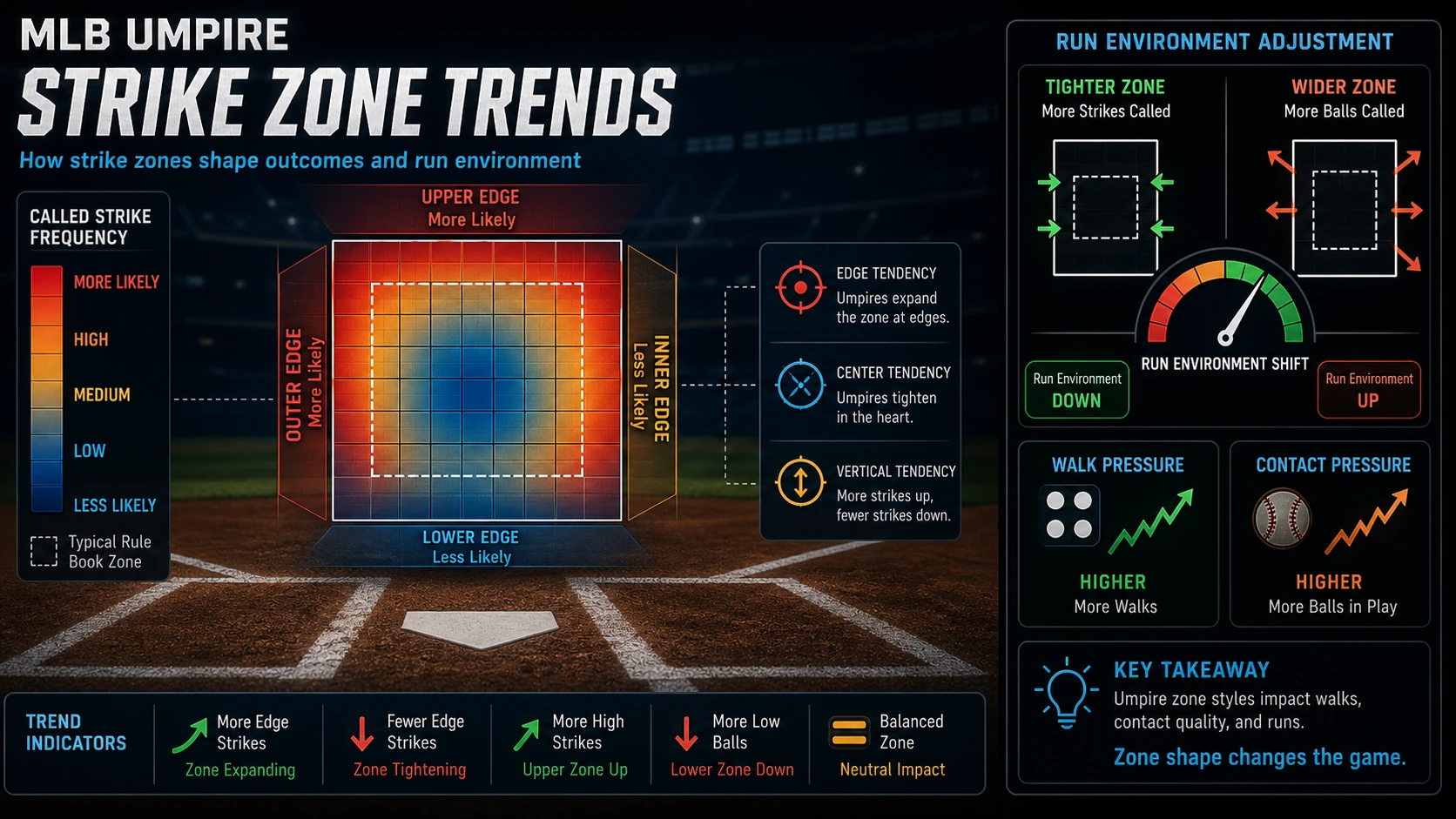
The plate umpire matters, but not in the magical way betting folklore prefers. A name on the lineup card is not an automatic over or under. The useful signal is a measured pattern of called pitches, shrunk toward league average, joined to the pitchers, catchers, park, weather, and market price for that game.
That makes MLB umpire trends a context feature, not a pick generator. The market can know the assignment and still price it imperfectly. It can also know the assignment and price it correctly. The bettor's job is to distinguish those cases without turning a small effect into a television monologue.
Start with called pitches, not reputation
Famous missed calls are memorable and mostly useless. Build the umpire profile from pitch-level data that identifies the location, count, batter and pitcher handedness, pitch type, catcher, and the call. The target should describe how the umpire differs from a league baseline on comparable pitches, not how often social media complains about him.
Borderline pitches carry most of the information. Obvious strikes and obvious balls tell you little about an individual zone. A useful model asks whether the same pitch, in the same context, is called differently with this umpire behind the plate. It also keeps the raw sample size visible, because a dramatic rate from a thin sample is still a thin sample.
Shrink the extremes before trusting them
Umpire assignments are sparse compared with player events. New umpires and infrequent plate assignments can look extreme by accident. Regress those estimates toward the league baseline, then let repeated observations pull the estimate outward. Career history may help, but older seasons should not carry the same weight as recent, comparable work.
The point is not to flatten every difference. It is to stop noise from dressing up as conviction. An honest dashboard should show the estimate, the sample behind it, and the uncertainty around it. When the interval is too wide to separate the umpire from average, the betting conclusion is simple: no umpire adjustment.
The zone works through pitchers and catchers
A wider called zone does not affect every matchup equally. A command pitcher who lives on the edge can benefit more than a pitcher who misses the target entirely. A catcher with a strong receiving profile can change how borderline pitches are presented. A lineup that rarely chases may react differently from one that expands the zone on its own.
Those interactions are why a single umpire rating pasted onto every game is weak modeling. The feature should meet the pitch shapes and locations each starter actually uses, the receiving context behind the plate, and the expected bullpen innings. If those inputs are absent, the umpire signal should stay small.
Totals and props need different translations
For a game total, the zone affects run creation through strikeouts, walks, counts, contact quality, and pitcher workload. That chain is indirect and full of competing effects. For a pitcher strikeout or walk prop, the path may be more direct, but the projection still needs expected innings, pitch count, opponent approach, and bullpen risk.
Do not copy one adjustment across markets. A change that matters to a starter's strikeout distribution may barely move a full-game total once both bullpens and both offenses are included. The market-specific model should decide the translation.
Assignment timing is part of the test
An umpire feature cannot be credited with beating a line that was captured before the assignment was knowable, nor can it use a corrected assignment after the bet. Store the public assignment source, the retrieval time, the projection time, and the price time. If the assignment changes, preserve both versions rather than overwriting history.
This is also where raw provenance belongs. Source identifiers can sit in non-visible attributes when a post has a real citation, but the hash itself must never appear as reader-facing copy. The article should show the claim, not the plumbing.
What a clean validation looks like
Train on earlier games and test on later games. Compare an otherwise identical model with and without the umpire feature. Judge whether the feature improves probability calibration and out-of-sample error, not whether a handpicked set of memorable games went the right way.
If publishing a betting record, name the window and sample and report the ATS win rate as wins, losses, and percentage. If the sample cannot support that statement, omit the record. The honest conclusion may be that the umpire feature helps projection quality without producing a standalone betting rule.
The practical pregame read
- Confirm the actual plate assignment from a timestamped source.
- Use pitch-level called-zone data with shrinkage for thin samples.
- Join the estimate to the scheduled pitchers, catchers, and likely bullpen work.
- Translate the effect separately for totals, strikeouts, and walks.
- Compare with a market price captured after the assignment was public.
- Pass when the estimate is noisy or the price already reflects it.
The umpire is neither invisible nor all-powerful. Treat the zone as one measured input, and it can sharpen a model. Treat the name as a betting system, and the market will happily collect the tuition.
Expected value from graded outcomes
Expected-value cells render only when a verified source binds observed win outcomes to the price paid for the same bets.
Average NFL total points by recorded weather bucket
Average combined score is grouped only from completed NFL schedule rows with a recorded indoor roof state or numeric wind value.