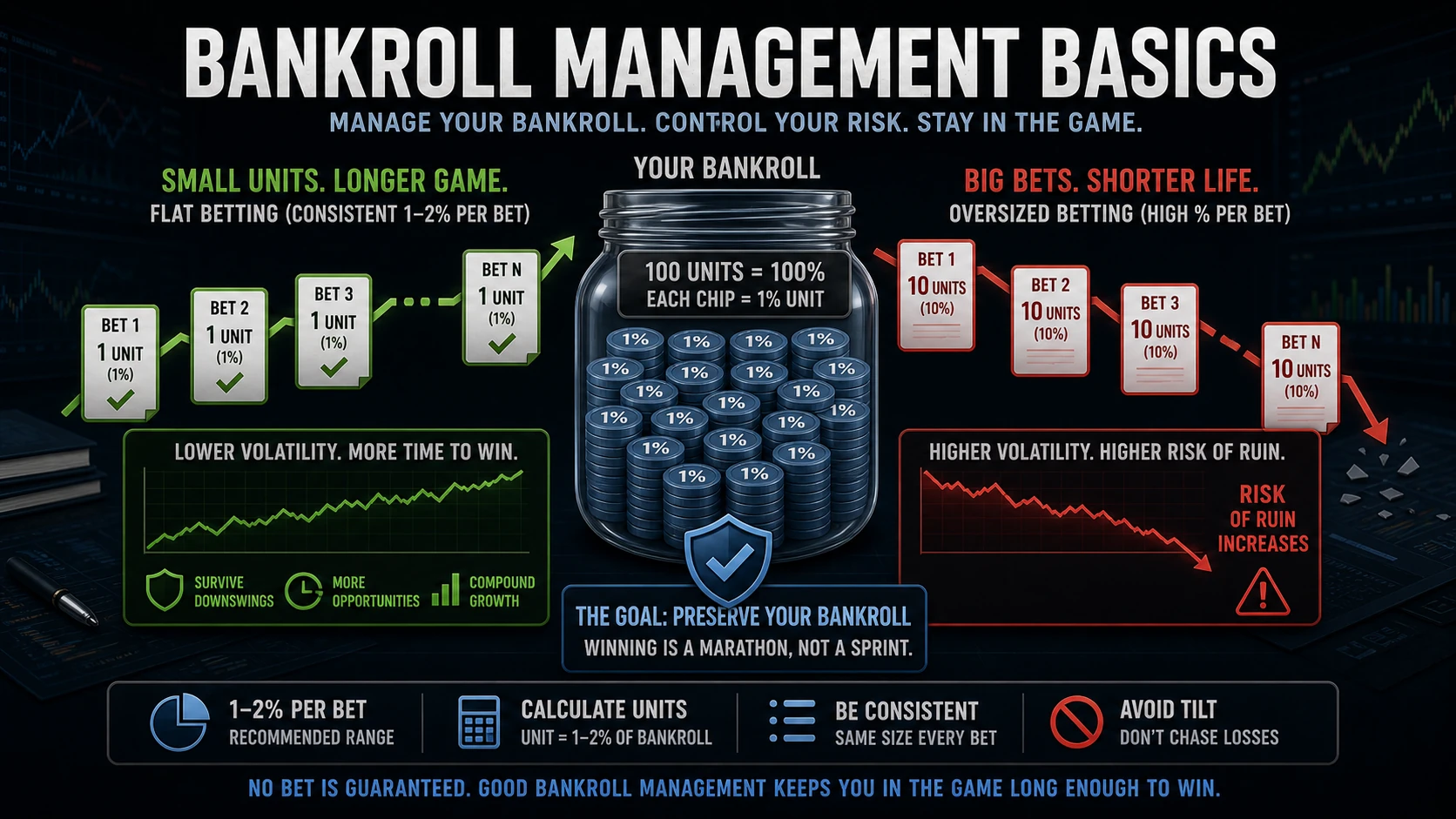
Bankroll management is not the part of betting that makes a good screenshot. It is the part that decides whether you are still around when the screenshot stops looking good. A handicap can be right in the long run and lose repeatedly in the short run. A stake plan has to survive that sentence before it earns the right to discuss upside.
The first rule is separation. A betting bankroll is risk capital with a hard border around it. Rent, savings, debt payments, emergency money, and money promised to somebody else never cross that border. If losing the bankroll changes your ability to meet those obligations, the bankroll is too large.
Define the bankroll before defining the stake
Write down what counts as bankroll, when it is measured, and which open bets are already claims against it. The available balance on one sportsbook is not the full answer if money is spread across books or pending settlement. The correct state includes cash, open exposure, withdrawals in flight, and any funds that are not actually available to risk.
Do not refill the bankroll casually after a drawdown. An automatic refill turns a supposedly limited account into an unlimited claim on future income. If additional funding is ever allowed, it needs a separate review rule and a cooling-off period. Otherwise the loss boundary is theater.
The accounting identity is plain: the next bankroll equals the current bankroll plus settled profit or loss, adjusted for deposits and withdrawals that the ledger records separately. Keeping those flows separate stops a fresh deposit from disguising poor performance.
Flat stakes are a control system
A flat-stake plan risks the same nominal amount on every eligible play during a review window. Its main advantage is not that it maximizes growth. It makes the record interpretable. A winning ticket does not earn a larger next bet, and a losing ticket does not provoke a chase.
The stake should be small enough that an ordinary losing run does not force a decision under pressure. “Ordinary” must come from the uncertainty in the process, not from optimism. If the model has no calibrated probability and no validated error range, the sizing input is missing. The cure is not confidence language. The cure is a smaller stake or no bet.
Flat staking also exposes weak selection. When every ticket carries the same risk, the ledger can show whether the qualifying rule works. Confidence tiers often blur that question because the bettor raises exposure on the picks they already like and then explains the result with the same confidence label.
Probability-based sizing starts with calibration
Kelly-style sizing and related methods are sensitive to the probability estimate. A small error in the estimate can produce a large change in the suggested stake, especially when the quoted price is near the decision boundary. That makes calibration a prerequisite, not an optional polish.
The legal input is a probability produced before the event, calibrated on separate data, paired with the price actually available, and reduced for uncertainty under a written rule. The illegal input is “strong play,” “best bet,” or a model score that has never been mapped to observed frequency.
Even with calibrated probabilities, concentration matters. Several bets can be driven by the same injury, weather system, team, or market move. Treating them as independent can multiply exposure to one thesis. A bankroll plan needs a portfolio view, not merely a ticket-by-ticket calculator.
the Kelly criterion guide covers the formula. the calibration guide covers whether the probabilities deserve to enter it. This article's rule is simpler: no calibrated probability, no variable sizing.
Drawdown rules must be written before the drawdown
A drawdown boundary answers what happens when the bankroll falls, the process loses alignment with the close, or the data pipeline becomes questionable. The possible actions are reduce exposure, pause new bets, audit the model, or retire the strategy. Choose the action while the account is calm.
The stop should not depend on one bad beat or one emotional night. It should depend on a measurable state: bankroll decline, missing provenance, live results outside the validated range, a changed market source, or evidence that the model is seeing stale inputs. Each state needs a cure and an owner.
A pause is not a punishment. It is a diagnostic mode. Lock new exposure, preserve the ledger, compare the current rows with the backtest contract, and identify whether the problem is variance, execution, data, or model drift. Resuming without naming the cause is just chasing with paperwork.
Keep returns out of the sales copy
A betting record should be published as ATS wins, losses, win rate, window, sample, grading rule, and provenance tier when the market is ATS. Return language requires actual prices, actual stakes, and a complete settled ledger. Mixing a hypothetical staking plan with a real win-loss record creates a number nobody actually earned.
Do not annualize a short run. Do not convert a model score into an account-performance claim without a price distribution. Do not hide pushes, voids, rejected bets, or unavailable lines. The clean ledger is less dramatic and far more useful.
the bet-tracking guide supplies the row-level receipt. Closing Line Value Explained adds a process check that can be read beside results without pretending either one settles the question alone.
Operational rules beat motivational rules
“Be disciplined” is not a system. A system defines who can change the stake, when the review occurs, what happens after a loss limit is reached, how pending exposure is counted, and which data failure blocks a bet. The rule should be executable by somebody who is not in the bettor's head.
Use errors as values. “Blocked: bankroll snapshot stale; cure: reconcile settled and pending tickets” is better than letting the form proceed. “Blocked: probability uncalibrated; cure: use the flat-stake policy or pass” is better than guessing. Boundaries keep a temporary feeling from becoming permanent damage.
The watchpoint
The stake plan changes only when the inputs named in the policy change: bankroll, calibrated probability quality, price, open exposure, correlation, or validated process status. It does not change because the last ticket won, the next game is on television, or the writer called it a favorite play.
The goal is not to squeeze the largest possible bet from every opinion. It is to keep the bankroll alive, the ledger readable, and the next decision independent of the last result. Survival is not timid. It is the condition that lets any real edge compound at all.
Bankroll growth from recorded Kelly outcomes
Growth paths are shown only when a verified source supplies recorded bankroll observations for the requested Kelly strategy.
Drawdown by recorded Kelly fraction
Drawdown comparisons are shown only when a verified source supplies observed outcomes for each Kelly sizing strategy.