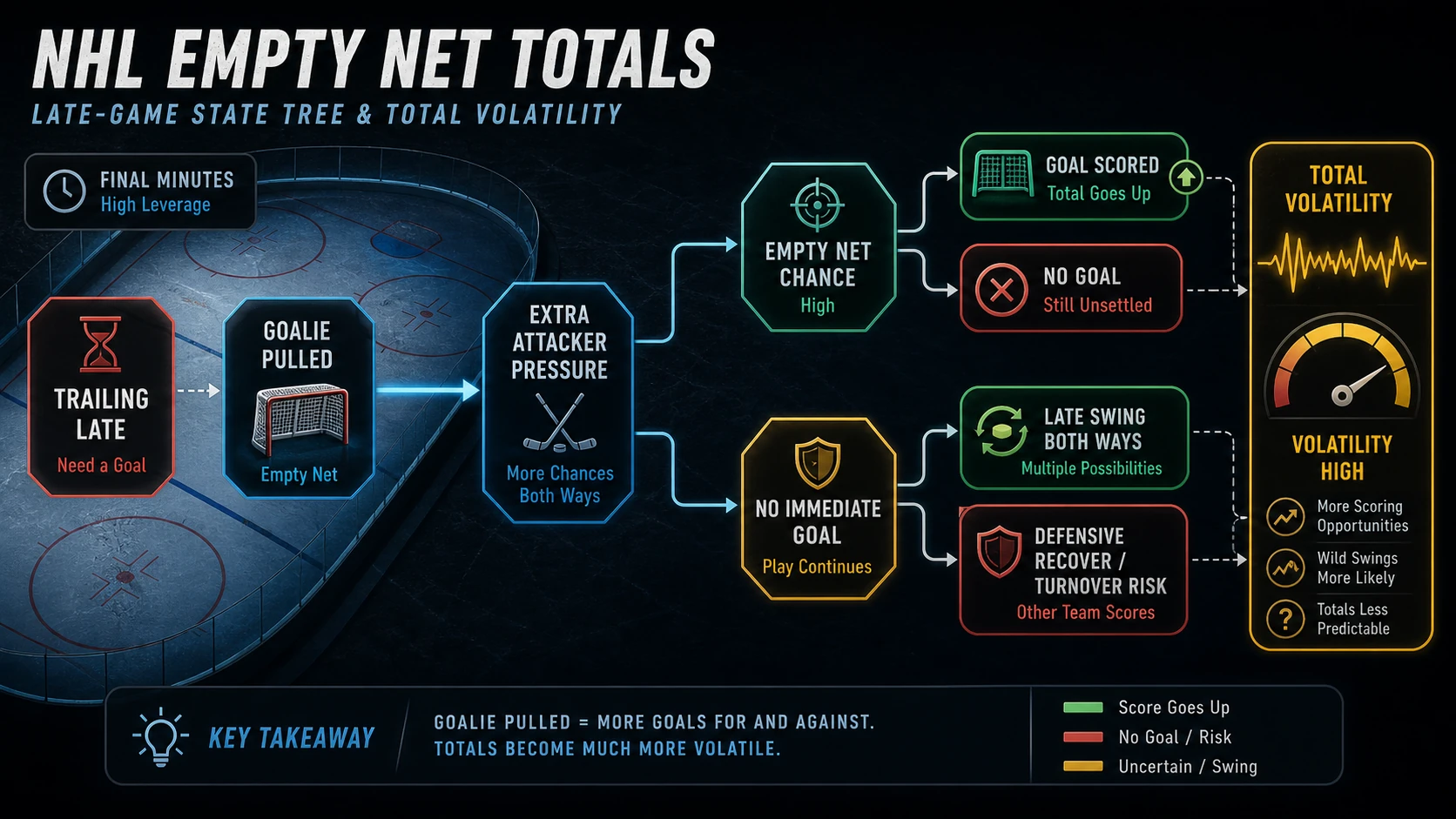
An empty net does not “wreck” a total by magic. It changes the game state. The trailing team trades a goaltender for another skater, the leading team gains a direct path to an unguarded goal, and the next sequence can settle a ticket that looked quiet a moment earlier. That is mechanics, not a betting system.
No timestamped play-by-play or live odds query is attached, so no empty-net frequency, fixed scoring multiplier, or canned wager is published. When score, clock, goalie state, and the tradable market cannot be aligned, the output is no eligible live-total read.
Grade the market that was actually offered
Before thinking about tactics, identify the bet. Is it a standard full-game total, a regulation-only total, a third-period total, a team total, or a live derivative? Does the book include overtime and shootout settlement? What happens on a whole-number line? The sportsbook’s posted rules control the ticket.
An empty-net goal normally counts as a goal in the game total. That simple rule does not tell you whether the bet was good. It tells you how the event settles. Keep settlement logic separate from the probability estimate.
The goalie pull is a state change, not a timestamp rule
Coaches do not pull at one universal moment. The score margin, possession, faceoff location, timeout situation, opponent, and coaching choice all matter. A feed that assumes the goalie is out because the clock crossed a threshold can mislabel the most important rows in the sample.
Use an explicit goalie-state signal when available. When it is missing or contradictory, exclude the row with a reason. “Goalie state unresolved — wait for feed confirmation” is a useful error value. Filling the gap from a generic clock rule is not.
Score and time belong together
A one-goal game late is different from a multi-goal game late. A tie is different from a deficit. The remaining time changes the number of possessions and the chance that the trailing team can establish control. Any model that uses only “late game” flattens states that produce very different choices.
Keep score, clock, manpower, and goalie state on the same event timestamp. Live feeds can arrive out of order. If the score has updated but the goalie flag has not, the apparent state may never have existed on the ice.
The quote moves faster than the essay
Live totals can reprice while the puck is in play. A screen capture from before the goalie pull is not a tradable quote after the pull. Record the sportsbook, line, price, suspension state, and timestamp. If the market was suspended during the only relevant window, there may have been no bet to make.
That is why a pregame total cannot be used as the price in a live empty-net example. The game has revealed scoring, pace, penalties, injuries, and tactics. Compare the state-aware estimate with the current live quote or stop at analysis.
Pregame and live questions are different
A pregame model can include team tendencies only if those tendencies are measured from prior games under a declared window. A live model can condition on the current score and goalie state. Do not use the current game’s eventual pull decision as a pregame feature. That is outcome leakage.
Pregame bettors can still note that empty-net scoring is part of the full-game distribution. They cannot assign a team-specific adjustment from memory. A real tendency needs a source, sample, and coaching window.
Totals are not the only exposed market
An empty-net sequence can affect the leading team’s total, puck line, player scoring, and live moneyline as well as the full-game total. Each market has a different quote and settlement rule. A view about one should not be copied across the board.
The puck-line guide covers the spread-style settlement. The live versus pregame guide explains why a state update does not preserve the old price.
How to build an auditable empty-net sample
- Use completed games with event-level score and clock.
- Require an explicit goalie-state or manpower signal.
- Align event and market timestamps before calculating a decision.
- Keep suspended markets out of the tradable sample.
- Declare full-game, regulation, period, team-total, or puck-line settlement.
- Freeze the feature window before reviewing outcomes.
- Publish exclusions and missing-state reasons with the result.
If the study produces ATS-style spread decisions, report wins, losses, percentage, window, and sample size. Do not replace missing prices with a financial claim.
The bettor’s late-game checklist
Confirm the score. Confirm the game clock. Confirm the goalie state. Confirm whether the market is open. Confirm the exact line and settlement rules. Then ask whether the market has already repriced the state you just noticed.
Check NHL picks for a current graded selection tied to a real quote. A generic empty-net story does not create one.
What to watch: the next confirmed goalie-pull state joined to an open live quote on the same event clock. That aligned row can change the total read; a stale score cannot.
Provenance tier: game-state and settlement methodology. No conditional scoring rate, synthetic live price, historical ATS record, or return claim is published.
Average NFL total points by recorded weather bucket
Average combined score is grouped only from completed NFL schedule rows with a recorded indoor roof state or numeric wind value.
NFL ATS cover-margin distribution
Bars count completed NFL schedule rows by closing-spread cover margin using the repository canonical home-margin grading convention.