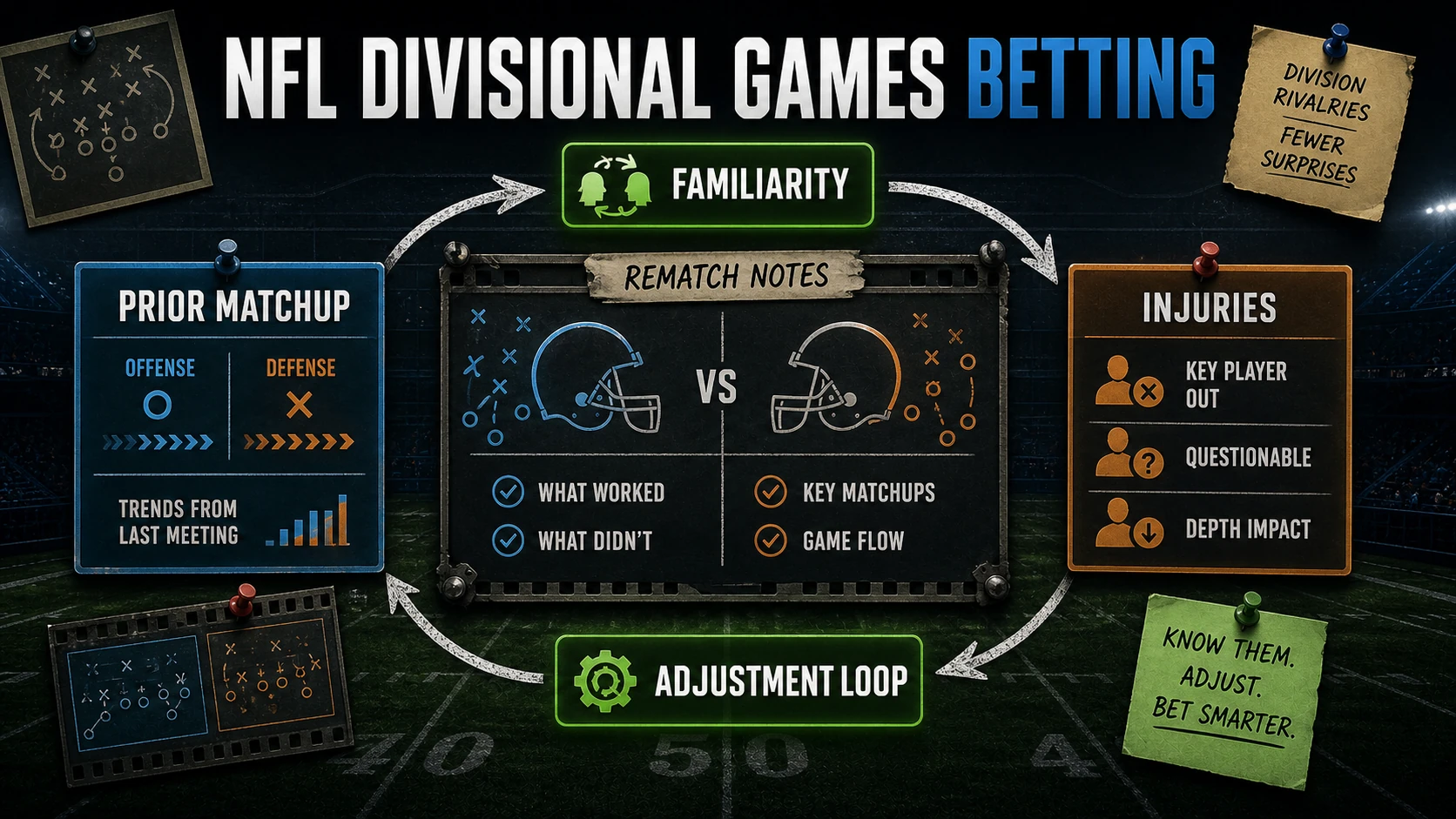
Division games arrive with a story already attached: familiarity, rivalry, revenge, ugly football. The market has heard it too. The useful work begins after the slogan, with a closing line and a question the data can actually answer.
In the frozen 1999–2025 regular-season snapshot, divisional underdogs went 1,359-1,252-74 ATS, a 52.0% win rate across 2,611 decisions. That is the broad record. It does not prove that familiarity caused the result, that totals should be played under, or that every current divisional dog is cheap.
Start with the market, not the rivalry
A divisional flag tells you who is playing. It does not tell you whether the spread is wrong. Price quarterback availability, offensive-line health, rest, travel, weather, and matchup first. Then ask whether the market has charged too much or too little for the rivalry label.
The companion divisional ATS record keeps the historical count, location split, spread bands, and source method in one place. Use it as a baseline, not as a weekly pick generator.
Familiarity is a hypothesis
Coaches can know an opponent well and still lose the matchup that matters. Rosters turn over. Coordinators change. Quarterbacks miss games. “They know each other” is not a measured column in the snapshot.
To test familiarity, define a proxy before looking at outcomes: continuity of the play caller, quarterback, and core personnel; number of prior meetings under the same staffs; or another observable field. Without that definition, familiarity is a postgame story that can explain either result.
Do not smuggle an under into the label
A division game can be slow and physical. It can also feature two healthy offenses, weak secondaries, favorable weather, and a total already shaded down because bettors expect a rock fight. “Division equals under” skips the number that decides whether the bet has value.
Build the total from expected pace, pass rate, explosive-play profile, red-zone opportunity, injuries, and conditions. Add the divisional flag only if a preregistered out-of-sample test shows it improves the estimate.
Rematches need clean chronology
The second meeting is tempting because the first result is vivid. That is exactly why chronology matters. Record the first closing line, game state, injuries, and final score, then freeze the second-game prediction before its market closes.
Do not define the angle as “the first loser gets revenge” after seeing a memorable split. Test every qualifying rematch over a fixed window, preserve pushes, and report W-L-P with the sample. If the result depends on adding home field, a loss margin, or a week cutoff after the fact, it is a new hypothesis.
Heavy favorites are not automatic fades
A large spread can create backdoor risk, but divisional status alone does not make the favorite overpriced. The underdog still needs a path to possessions, points, and late-game offense. The favorite still needs a price that assumes too much.
Before fading, ask what your fair line is and why. If the answer is only “rivalry games stay close,” pass. A reusable handicap names the player, unit, rest spot, or scheme interaction that narrows the margin.
Home dogs still need a home-dog price
Home field and underdog status are already in the spread. A current ticket needs the actual number and side price, not a historical label copied from another market. Compare the available line with your estimate and record the close afterward.
If a split is worth tracking, predeclare it. Keep the location, spread range, date window, market source, and push treatment fixed. That turns a betting cliché into a test that can fail.
A disciplined game-day card
- Confirm the current quarterback and lineups.
- Save the spread, total, and side prices from the declared book.
- Build the matchup without the divisional flag.
- Add only source-backed divisional adjustments.
- Pass when the market has already moved through your number.
- Grade the final selection against the same closing convention.
The betting takeaway
Division games may deserve extra context. They do not deserve automatic bets. The broad historical dog record is real and properly labeled; the weekly edge still has to come from today's players, today's price, and a claim that was written before the result.
Bet responsibly. Rivalry does not reduce variance or excuse a bad number.
Bankroll growth from recorded Kelly outcomes
Growth paths are shown only when a verified source supplies recorded bankroll observations for the requested Kelly strategy.
Expected value from graded outcomes
Expected-value cells render only when a verified source binds observed win outcomes to the price paid for the same bets.