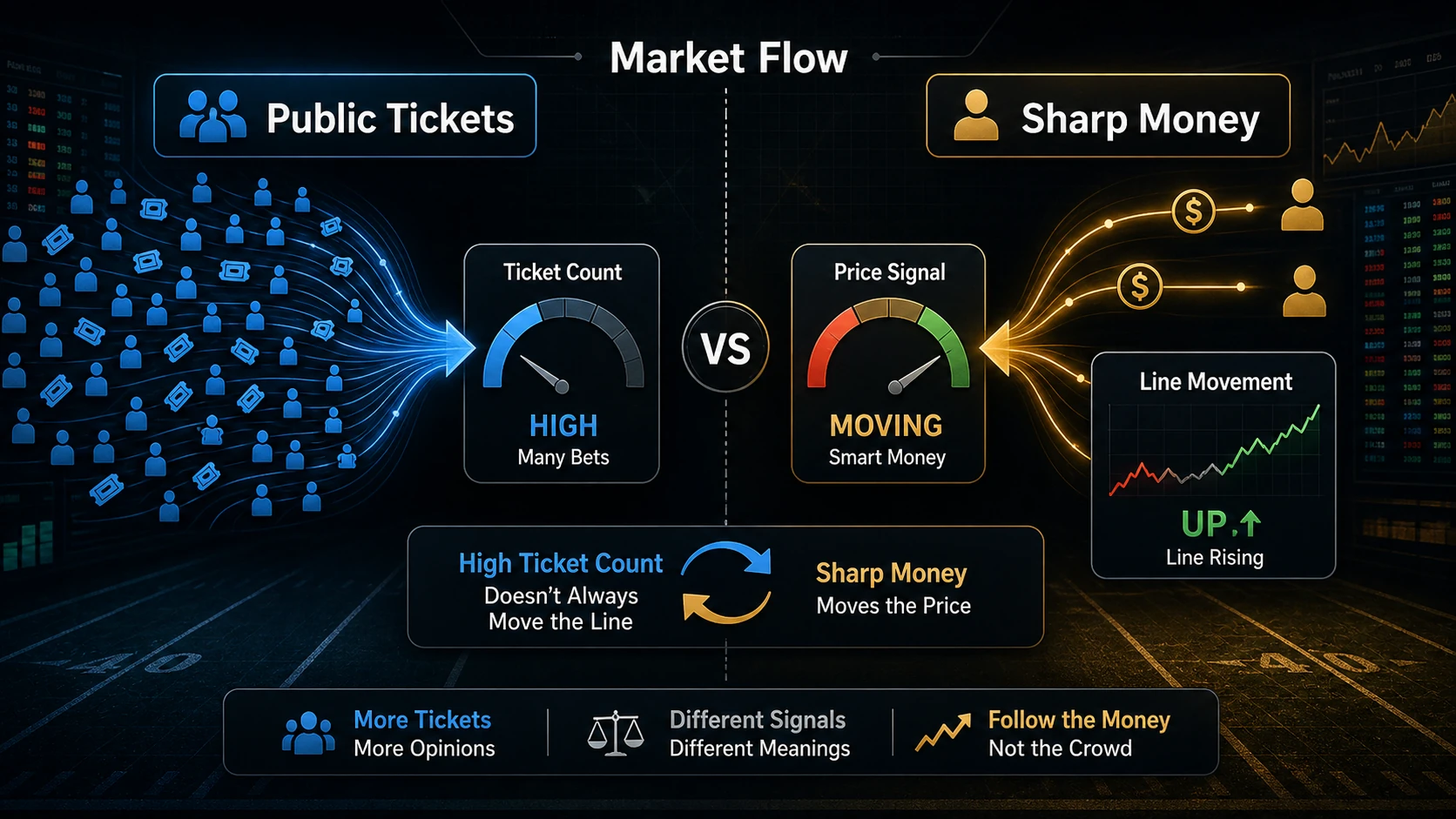
Every sports betting board carries two stories at once. One is told by the number of tickets — the public — and the other is told by the dollars — the sharps. Reading both at the same time is one of the highest-leverage skills in sports betting, because the disagreement between them is where edge tends to live. This article unpacks what sharp money actually means, how to interpret public betting percentages, and how to use the gap between ticket pct and money pct to your advantage.
What "sharp money" actually means
"Sharp" is not a job title. It is a shorthand for accounts that books respect — bettors who win consistently and whose action causes the line to move, even when the dollar amount is modest. A respected wager of $5,000 from a known winner moves a line faster than $50,000 from a hundred recreational accounts.
Sharp money tends to share these traits:
- Big tickets, few tickets. Large dollar amounts on a small share of total bets.
- Early or very late. Sharps either bet openers (before the line is sharpened) or hammer steam right before kickoff when injury news lands.
- Underdogs and unders. Statistically, both have produced more long-term value than favorites and overs.
- Counter-public. If 80 percent of the public is on one side, sharps are often quietly stacking the other.
Public money: the recreational tilt
The public bets favorites, overs, primetime games, and popular brands. That is not a slur — it is just how casual money flows. People watch Patrick Mahomes, Josh Allen, Jalen Hurts, or the Cowboys on Sunday Night Football, hammer the better-known team, and like the Over because they want a fun game to watch. The book knows this, and the line is often shaded a half point or more in the direction the public wants to go.
If you only look at one number, look at how the line is moving relative to where the tickets are. Public money piling on one side without the line moving in that direction is one of the cleanest tells in the market.
Ticket pct vs money pct: the most important table on the page
Every sharp tracking site shows two numbers per game:
- Ticket pct (or bet pct): the share of total tickets on each side. This is the headcount.
- Money pct (or handle pct): the share of total dollars on each side. This is the wallet.
When the two numbers disagree, you have a signal. Consider this scenario:
Eagles -3 vs Giants +3
Tickets: Eagles 78%, Giants 22%
Money: Eagles 38%, Giants 62%
78 percent of the bets are on Philly, but only 38 percent of the dollars are. That means the Giants money is roughly six times larger per ticket. A handful of large wagers are landing on the dog while the public piles small bets on the favorite. Books call this scenario a liability fade, and it often precedes a line move toward the underdog despite the public love.
Reverse line movement
The single most quoted sharp signal is reverse line movement (RLM): when the line moves away from the side getting most of the tickets. Example:
- Open: Cowboys -2.5
- Public: 75% of tickets on Cowboys
- Close: Cowboys -1.5
The book should be moving toward the Cowboys to discourage more action on the favored side. Instead, the line moved a full point toward the Giants. Why? Because real money — sharp money — bet the Giants. The book respected that money more than the public's volume.
RLM is not a guaranteed winner, but it is one of the most consistent indicators that something other than recreational action is shaping the line. The next step is measuring whether that move gave you closing line value. You can monitor live line movement and ticket vs money splits across sports on our picks dashboard.
Steam moves, sharps, and syndicates
A "steam" move is a sudden, simultaneous line move across multiple books. Steam usually means a syndicate — a group of bettors operating with shared capital and shared models — has hit several books at once with the same play. A line that goes from -3 to -4 within five minutes at five different books is a steam move.
Chasing steam after the move is risky. The sharp got the better number; you are getting the worse one. The value of seeing a steam move is in understanding what the market just learned, not in necessarily following it.
How to read the board like a sharp
- Look at money pct first, ticket pct second. Headcount is noise; dollars are signal.
- Find the disagreement. Big ticket-to-money gaps are flags.
- Compare current to opening line. If the line moved against the public, somebody respected put real cash on the unpopular side.
- Check the timing. Sharp action right at open or 30 minutes to kickoff is more meaningful than midweek noise.
- Beware of "trap" framing. Books rarely "trap" — that is a Twitter myth. They balance books and respect sharp action. The line is mostly honest.
Putting it into a model
Sharp signals are features, not strategies on their own. Reverse line movement, steam, and ticket-vs-money divergence all become inputs you can blend with power ratings, situational data, and player availability. In our model builder, sharp action and line movement are available as feature artifacts you can weight against your other inputs. The workshop ships a "sharp signal blender" template that combines RLM, steam, and ticket/money gap into a single score you can backtest against any sport.
The top modelers on the creator marketplace publish their sharp-feature recipes alongside their builds — useful both for remixing and for understanding what features actually generate edge versus which ones look promising but flatten on backtest.
Timing and the sharp calendar
Sharp action does not arrive uniformly across the week. The pattern across an NFL slate looks roughly like this:
- Sunday night / Monday: openers post. Sharp models that beat the closing line take their swings here, hitting numbers before they sharpen.
- Tuesday to Thursday: midweek movement. Mostly noise, some sharp adjustments as injury reports clarify.
- Saturday: respected accounts position before the public floods in.
- Sunday morning: public money pours in, lines shade toward the popular side, and sharps with late information (inactives at 90 min) take the other side.
If you only have time to watch one window, watch the Saturday-to-Sunday-morning gap. That is where most of the actionable sharp-vs-public divergence happens.
Practice reading the board without staking
The Gridiron auto-battler ships a "market mode" that shows simulated ticket-vs-money splits and asks you to call which side the sharps are on. It is the fastest way to build pattern recognition without burning real bankroll. After 50 reps you start spotting the 38/62 money/ticket inversions in a glance instead of having to compute the average ticket size manually.
Common misreads
- "Public is on the favorite, fade them." Sometimes. But favorites cover roughly 50 percent of NFL games — fading the public blindly is not edge.
- "Sharp side is whichever is opposite of the public." Sharp side is whichever the dollars are on, not whichever the bodies are off.
- "Line moved toward me, I am sharp." The market does not validate you. The closing line beats almost everyone over time.
Frequently asked questions
What does "sharp money" mean?
Wagering action from accounts the book respects — proven long-term winners whose bets move the line at modest dollar sizes. Concentrated, large tickets rather than spread-out small bets.
What is the difference between ticket pct and money pct?
Tickets = share of bet headcount. Money = share of dollar handle. An 80/20 ticket split with a 35/65 money split means the minority side's average bet is roughly seven times larger — the classic sharp footprint.
What is reverse line movement?
The line moves AGAINST the majority of tickets. 75 percent of bets on Cowboys -2.5 but the line drops to -1.5 means sharp money is on the Giants. RLM is one of the most consistent signals.
Should I always bet against the public?
No. Blind contrarian betting loses because public is right roughly half the time. The signal is ticket/money disagreement plus RLM, not ticket percentage alone.
What is a steam move?
A sudden simultaneous line move across multiple books — typically a syndicate hitting several sportsbooks at once with the same play. Chasing after the move is risky because you get the worse number.
How do I tell sharp action from injury news?
Cross-reference timing with public information. A Tuesday-to-Thursday move with no news is likely sharp. An 11:45 AM Sunday move after a QB downgrade is news, not sharps.
Bottom line
Sharp money is the dollar weight of accounts the book respects. Public money is volume, not expertise. The most actionable signal is the gap between ticket pct and money pct, especially when paired with reverse line movement. If 80 percent of the tickets are on one side and the line is moving the other way, professional money is on the unpopular side.
Reading the market this way takes practice. Track lines from open to close, log the ticket and money splits, and pay attention to which signals actually correlate with covers in your own data. The framework in our betting log guide is built for exactly this. The market is mostly efficient — but the edges that exist live in places where the public and the dollars disagree.
Line movement versus recorded public ticket share
This chart remains empty until a verified source table binds public ticket share and line movement for the same market observations.
Model calibration from graded predictions
Calibration points render only when a verified source binds prediction probabilities to settled outcomes for the same observations.