
Running backs are back in the conversation. That is not the same as running backs being mispriced. The cited notes say Miami intends to keep De'Von Achane , while Saquon Barkley and Christian McCaffrey remain central names around contending offenses. Those are real roster signals. None of them is a spread, a player prop, an opening price, or a graded ATS record.
The distinction is where most loud football takes fall apart. A personnel story can be correct and still tell you nothing about whether the betting market is wrong. To move from “this back matters” to “this side is playable,” you need the price, the role, the opponent, and a timestamp. The source set for this article supplies pieces of the football picture. It does not supply a market verdict.
The famous names are context, not a position
Miami's stated intent to retain Achane matters because continuity affects how an offense can be built. Barkley and McCaffrey matter because defenses must account for backs who can shape more than one phase of a game. That is useful scouting context. It still leaves the betting question unanswered: what assumption is embedded in the current line, and where does your estimate differ?
A bettor cannot answer that from a press-conference quote. A team can value a running back and still be overpriced. A defense can devote resources to the box and still fail to create a playable total. A back can be important to an offense while his player prop already reflects the workload. The word “important” belongs in the football report. The word “edge” belongs only after the comparison with a real price.
The cited note about Miami's fans having waited for reasons to believe is a reminder that emotion travels faster than evidence. Fan enthusiasm can affect attention and ticket flow, but this source set contains no public-betting split or line movement tied to that enthusiasm. It would be dishonest to claim the market either followed the crowd or ignored it.
Chicago is the research lead, not the finished bet
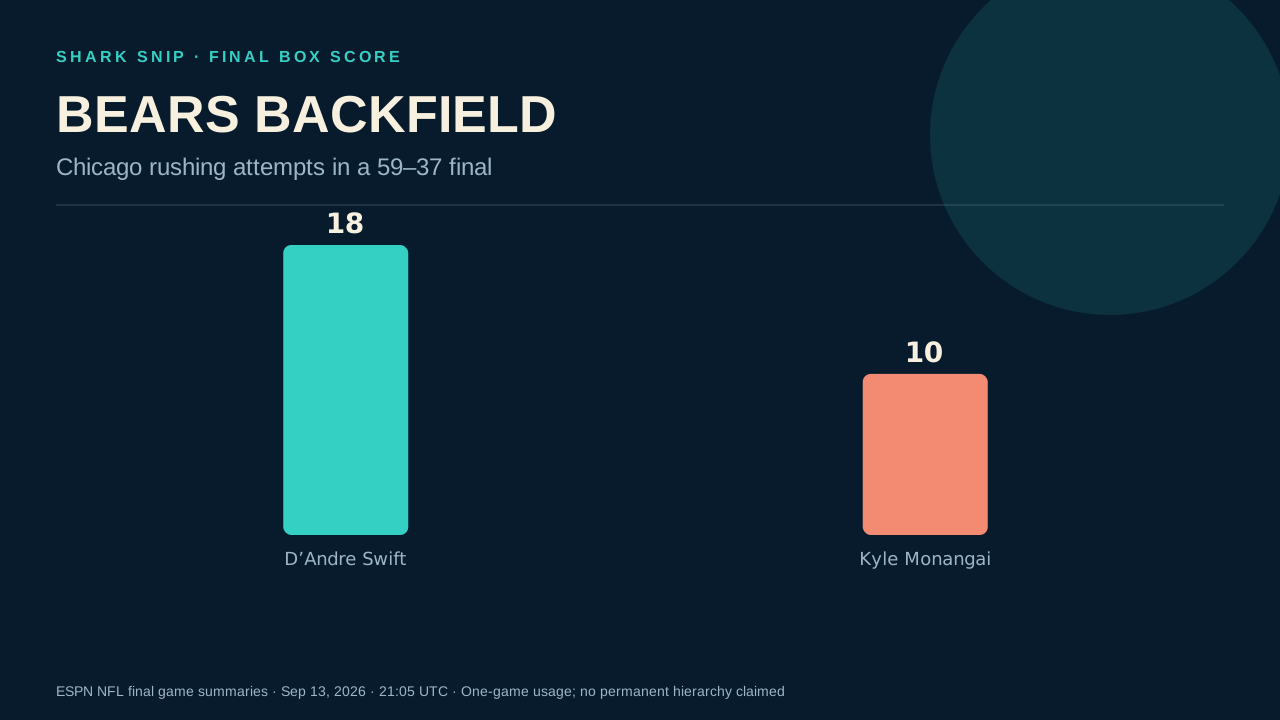
The quieter facts in the ledger concern the Bears. Chicago is listed among the league's top six rushing attacks, alongside Buffalo, Baltimore, Washington, New York, and New England . Its offensive line is described as third-best, behind Denver and Philadelphia .
Those facts are more useful than a comeback slogan because they identify a mechanism worth investigating. A productive rushing attack paired with a highly regarded line can support efficiency, early-down stability, and red-zone opportunity. But the citations do not give the evaluation method behind those rankings, the time window, or a betting price. They tell us where to look next; they do not authorize a wager.
The next step is to pull usage, blocking, opponent front, and market rows for the same game. The usage-and-opportunity guide shows why counted opportunity matters, while the NFL spreads guide explains the price side of the comparison. Chicago becomes interesting when those two records meet. Until then, “top six” and “third-best” are scouting labels, not a quantified edge.
A roster move can support the thesis without pricing it
Miami also used its first selection of day three on cornerback Keionte Scott . That is a real roster fact, and it may tell us something about the front office's priorities. It does not prove a run-first identity, predict Achane's workload, or move an offensive price by itself. Draft capital on the other side of the ball is not a substitute for a usage projection.
This is the discipline a clean betting column owes the reader: preserve the fact, narrow the inference. The roster note belongs in a team-building discussion. If later injury reports, depth-chart decisions, or snap data connect it to offensive strategy, the conclusion can grow. The current source row does not make that bridge.
What would make the running-back story bettable
Start with a real market snapshot. For a side or total, save the spread or total across more than one book and record when it was available. For a player, save the prop line and price. Then add the football inputs: expected role, line health, opponent structure, and late availability. The closing-line value guide gives the final check. If the wager repeatedly beats the close and the results are reported as an ATS win-loss record with percentage, window, and sample size, the story has become evidence.
No such record is present here. There is no ATS sample for teams led by star backs, no closing-line series for Miami, and no prop history for Achane in this source set. That means the article cannot honestly say the market has agreed, disagreed, or finished moving. It can say the league is talking about backs again and that Chicago's rushing and line rankings deserve a closer look.
Capture order matters. Save the price before the role or injury news that supposedly creates the opportunity, then save the market after the news. Without the earlier snapshot, a writer can always claim the move was obvious. Without the later snapshot, there is no evidence the market reacted. The same before-and-after discipline should govern player props, sides, and totals.
Read the board before buying the revival
The best version of the running-back comeback is not a declaration. It is a list of questions. Which backs have stable roles? Which lines can sustain the run game? Which opponents force a change in approach? Which prices moved after those facts became public? The injury-impact guide helps with availability, and the NFL odds desk supplies the board that this source set lacks.
Achane, Barkley, and McCaffrey are worth studying. Chicago's rankings are worth following. None of those statements requires pretending we have a bet. The sharp move is to keep the football evidence, wait for the market evidence, and refuse to turn a popular position group into an automatic side or prop recommendation at any price before the available market, opponent, and current role are compared in full.
Bankroll growth from recorded Kelly outcomes
Growth paths are shown only when a verified source supplies recorded bankroll observations for the requested Kelly strategy.
Expected value from graded outcomes
Expected-value cells render only when a verified source binds observed win outcomes to the price paid for the same bets.