
Skip to content
Back to guides
shark-snips

Pleaser Sports Betting Explained: The High-Risk Flip Side of a Teaser

Shark Snip Editorial 5 min read

Read the price, role, and market first

Pleaser sports betting moves the spread against you 6–7 points for a bigger payout — the reverse of a teaser. We show live lines, the math, and why it is a lottery ticket.
7 sections

Shark Snip Editorial

House byline of the Shark Snip analytics desk — numbers sourced from the data pipeline, not vibes.

No evidence embed is attached

The published shark-snips row has no pick-card or chart block yet.

A pleaser bet is a parlay where you give away 6 to 7 points per leg for a bigger payout — the exact opposite of a teaser. You turn a -1.5 favorite into a -7.5 requirement, and the book pays +600 or more on two legs because the probability of covering drops off a cliff.

How does pleaser sports betting work?

Pleaser sports betting is a parlay where you move the spread against yourself by 6 to 7 points per leg for a larger payout — the opposite of a teaser.

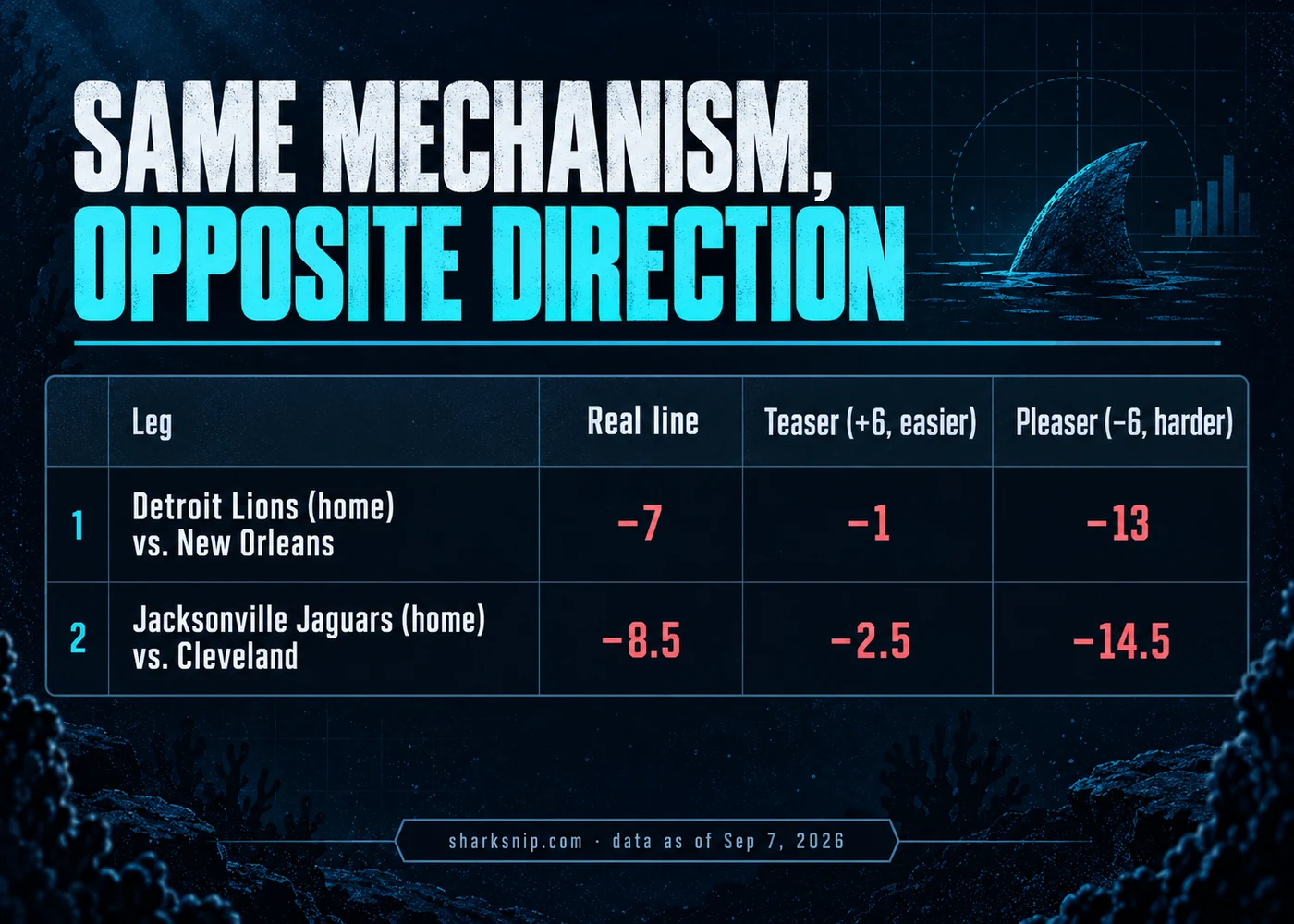
A pleaser moves the spread against you. If the Cowboys are -1.5 at home , a 6-point pleaser makes them -7.5. They must win by 8 or more. A 7-point pleaser makes them -8.5. Every leg in the parlay gets the same penalty. The payout jumps — two legs at +600, three legs at +1700 — because the book knows most of these tickets lose.

How the math works on real lines this week

Our live single-book lines show home spreads across NFL and college slates. Applying a standard 6-point NFL pleaser to this week's lines illustrates the leap:

  • Cowboys -1.5 over Cardinals → Cowboys -7.5 (must win by 8+)
  • Seahawks -5.5 over Titans → Seahawks -11.5 (must win by 12+)
  • Twins -1.5 over Padres → Twins -7.5 (baseball pleasers are rare; this shows the magnitude)

In college, 7-point pleasers are more common. North Carolina -7.5 at TCU becomes -14.5. San Jose State -38.5 at USC becomes -45.5 — a number that has almost no historical precedent for covering. The wider the original spread, the more absurd the pleaser line becomes.

Why the payout looks tempting but is not

A two-leg 6-point pleaser at +600 implies you need to win roughly 14 percent of the time to break even (1 divided by 7). But each leg is not a coin flip. NFL favorites of -7.5 or more cover less than half the time historically. Two independent legs at that rate hit together about 22 percent of the time — still a losing proposition at +600. And the legs are not independent: game script, weather, and market efficiency correlate them. The book bakes in extra margin on top of the compounding probability. Our same-game parlay math breakdown shows how correlation kills parlay EV; pleasers suffer the same structural flaw.

Where pleasers live in the product

You will find pleaser options in the same parlay builder where you build teasers — DraftKings, FanDuel, Caesars, and offshore books all offer them. They are usually buried under "exotic parlays" or "special teasers." Our NFL picks feed and college football picks feed show straight spreads, totals, and model projections — not pleasers — because our models optimize for closing-line value, not lottery tickets. If you want to see what a disciplined edge looks like, start there.

The college trap: talent gaps masquerade as pleaser opportunities

College lines like Arkansas-Pine Bluff at Missouri (-54.5 ) or Eastern Illinois at Minnesota (-43.5 ) tempt bettors into thinking "this team wins by 60, so -48 on a pleaser is free money." It is not. Blowout variance in college football is massive — backdoor covers, mercy rules, fourth-quarter substitutions, and coaching mercy all shrink margins unpredictably. A 7-point pleaser on a -43.5 line creates a -50.5 requirement. The sample of games where a 50-point favorite covers by 51+ is effectively zero. Our college modeling piece explains why variance explodes at the extremes.

What a responsible pleaser ticket looks like (if you must)

If you want a pleaser thrill, put $5 on a two-leg 6-pointer, track the closing line on each leg, and stop if you are not beating the close after 10 bets.

Bottom line

A pleaser is a teaser in reverse — you sell points instead of buying them. The payout looks large because the probability is small. On this week's board, a 6-point pleaser turns the Cowboys -1.5 into -7.5 and the Seahawks -5.5 into -11.5. Neither has a historical cover rate that justifies the price. If you have a model that beats the market by a touchdown consistently, bet straight spreads at higher limits. If you do not, a pleaser is a lottery ticket with a sports veneer. What would change our mind: a tracked model showing positive expected value on 6-point pleasers after 500+ bets with a verified CLV log — meaning the model line sees the true spread at least 6.5 points tighter than the market line on the pleaser legs consistently.

Expected bankroll growth at 55% edge

Expected geometric growth of a $100 bankroll under different Kelly multipliers across 1000 bets at p=0.55, decimal=2. Full Kelly maximises long-run growth but produces the deepest drawdowns; fractional Kelly trades growth for variance.

Drawdown by Kelly fraction

Median and 95th-percentile max drawdown by Kelly fraction over a 1000-bet horizon. Halving Kelly almost halves drawdown; quartering it cuts drawdown by ~70%. Figures are illustrative ballparks from the Kelly literature.

Frequently asked questions

What is a pleaser bet in sports betting?
A pleaser is a parlay (one ticket, all legs must win). You move the spread against yourself by 6 to 7 points per leg. The payout jumps because the bet gets way harder. If the Cowboys are -1.5 favorites , a 6-point pleaser makes them -7.5. They must win by 8 or more.
How does a pleaser differ from a teaser?
A teaser moves the line in your favor (a -7.5 favorite becomes -1.5). That makes the bet easier to win but pays less. A pleaser moves the line against you (a -1.5 favorite becomes -7.5). That makes it harder to win but pays more. Both are parlays. The teaser buys safety. The pleaser sells it. Our vig guide shows how the book builds margin into both.
What do typical pleaser payouts look like?
Payouts vary by book. A two-leg 6-point pleaser often pays around +600 (risk $100 to win $600). A three-leg 6-point pleaser pays roughly +1700. A 7-point pleaser pays more because each extra half-point you give away cuts the win probability further. Compare that to a standard two-team spread parlay at about +260. The book offers a lottery-style payout because the true probability of hitting a 6-point pleaser is low — roughly 12 to 15 percent per leg, compounded across all legs.
When does a pleaser make mathematical sense?
Almost never for a recreational bettor. The breakeven win rate on a two-leg +600 pleaser is about 38 percent per leg (1 divided by 7, then square root). Real-world cover rates for favorites giving 7+ points are lower than that in the NFL and even lower in college where variance is higher. The math only works if you have a model that consistently beats the closing line by more than the pleaser penalty. If you have that model, you should bet straight spreads for higher volume and lower variance. See our CLV guide (beating the final line) for why beating the close matters more than chasing payouts.
What would change our mind on pleaser value?
If a tracked model showed positive expected value on 6-point pleasers after 500+ bets with a verified CLV log — meaning the model line sees the true spread at least 6.5 points tighter than the market line on the pleaser legs consistently. For example, if our model projects the Seahawks as a true -11 favorite over the Titans (market -5.5 ), then a 6-point pleaser to -11.5 has edge. But that requires a model that beats the market by a touchdown consistently, which we have not seen in any public or private tracking. Until then, pleasers are entertainment — not investment. Check our track record and model builder to see what verified edges actually look like.

Build a free model in 60 seconds →

Go →
5m read time
10 players/teams
8 key angles
Angles in this read 6 angles

Names and terms found in this article

This article's context stays anchored to North Carolina, San Jose State, Arkansas-Pine Bluff, Cardinals and Cowboys and closing line value, model and price, all of which appear in the post itself.
North CarolinaSan Jose StateArkansas-Pine BluffEastern IllinoisFull KellyHalving KellyCardinalsCowboysSeahawksTitansclosing line valuemodelpriceweatherpleaser bets
Share this guide Help another reader make a sharper decision.

Get picks in your inbox

One email, every slate — ranked edges, no touts. Unsubscribe any time.

Start free — pick NFL

Go →

Continue with evidence

Related reading and source status

Related Reads

query: loadMergedBlogPostCards + scoreRelated · n = 6

No graded source picks match this article yet

The public.source_accuracy_scores 90-day query returned no rows for this article's inferred sport.