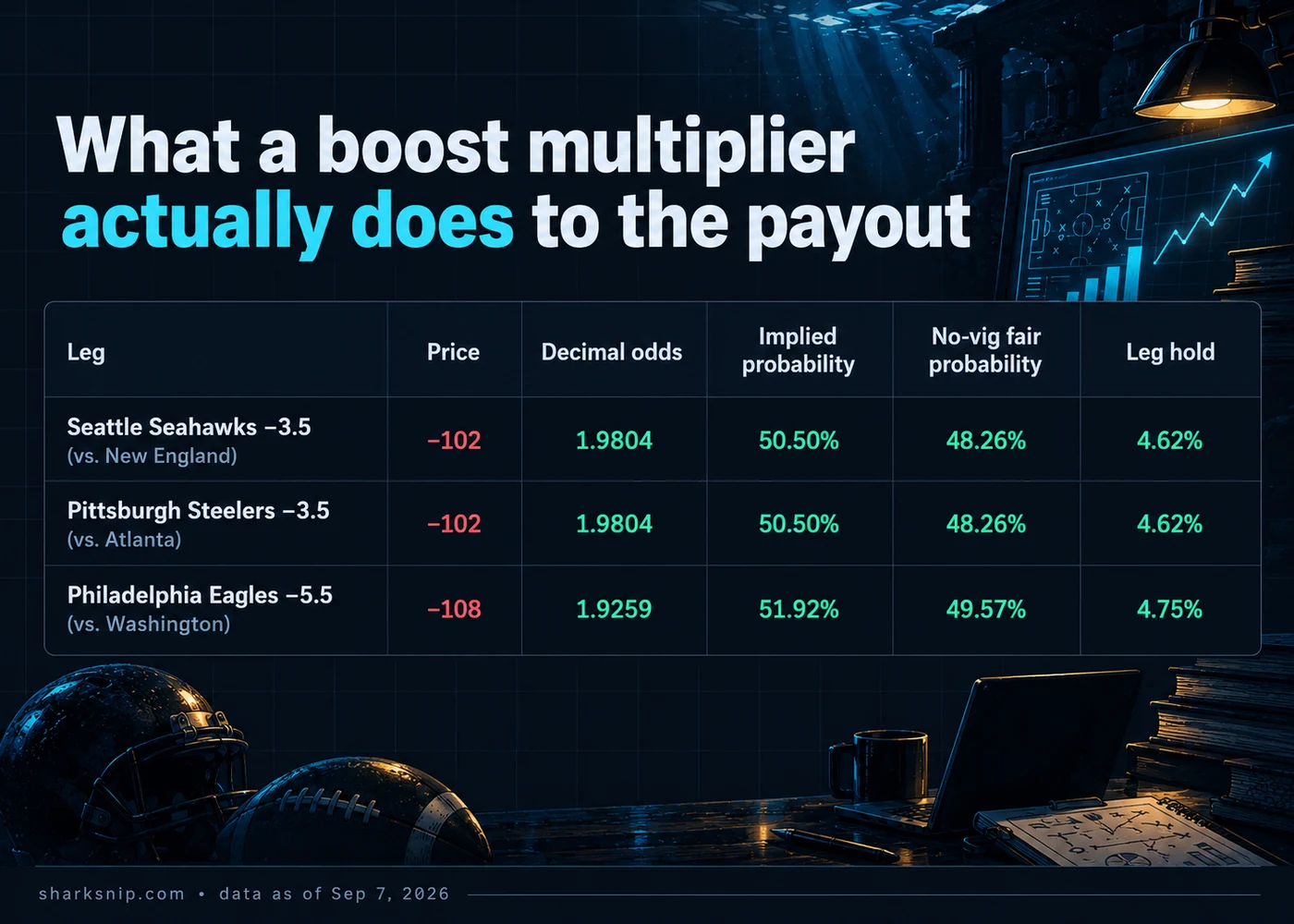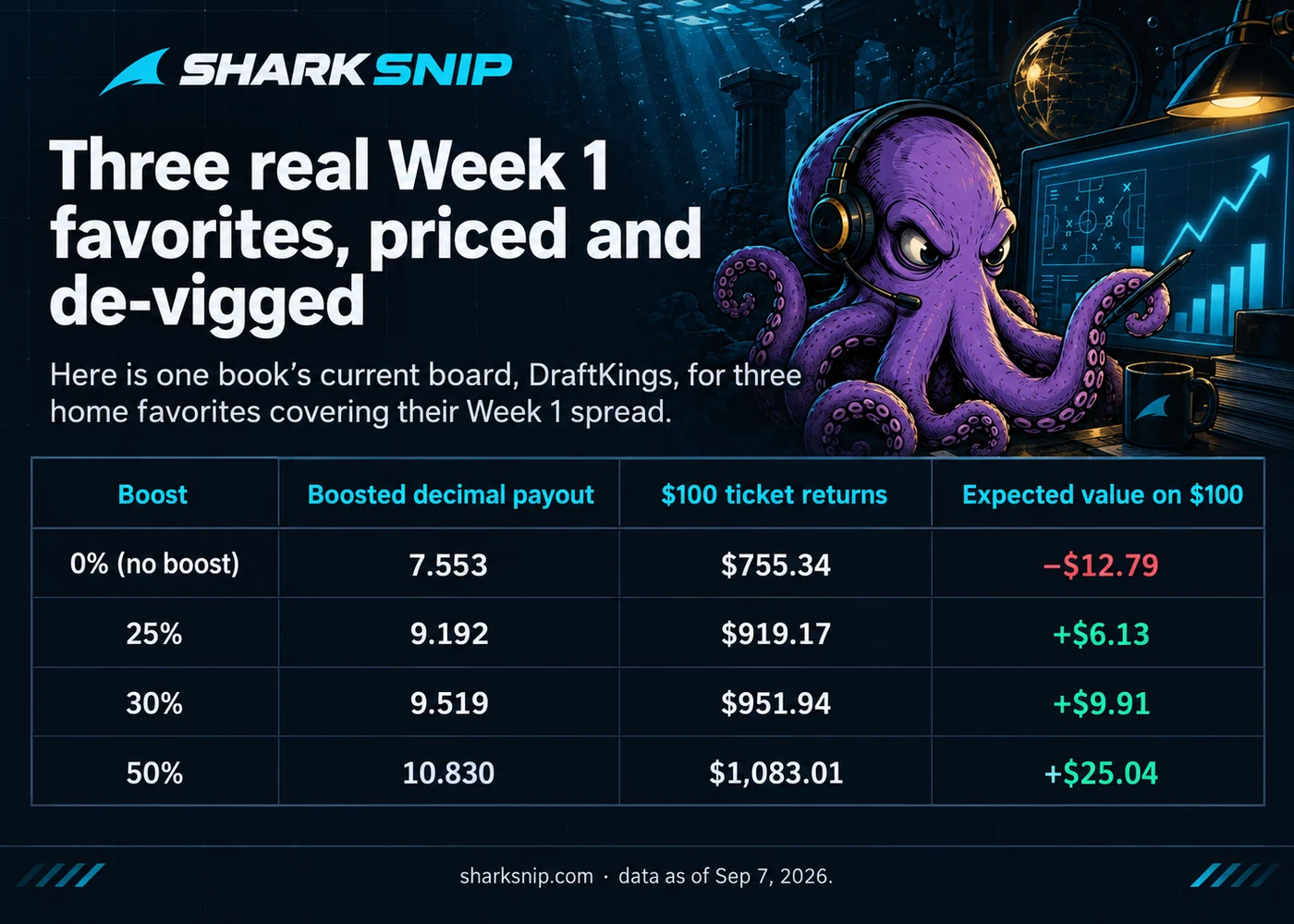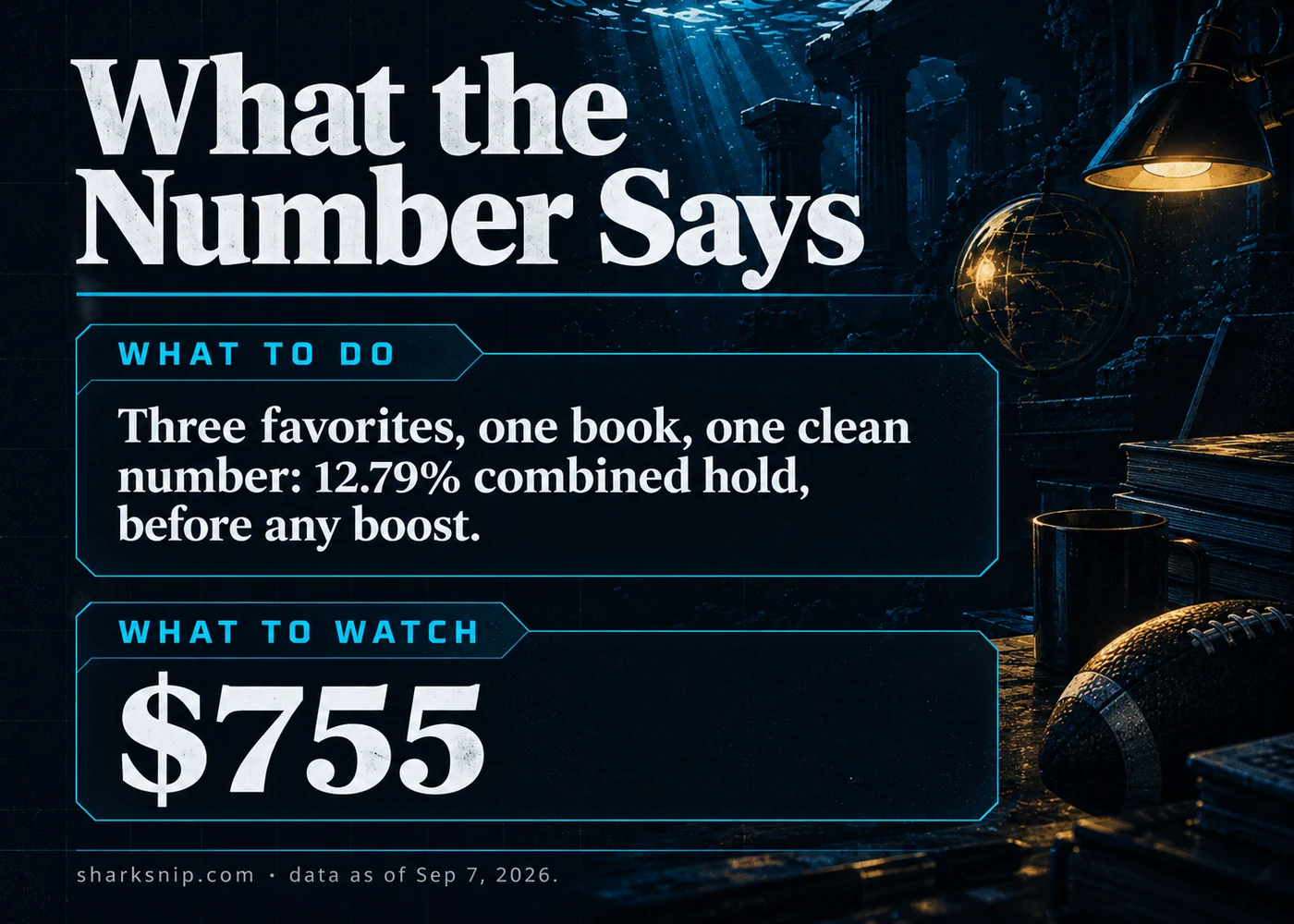

Books advertise boosted parlays like they are giving away free money. Our live lines show the vig still sits at double a straight bet.
What a parlay betting boost actually does
A parlay betting boost takes a specific ticket and increases the advertised payout. If the fair combined odds are plus two fifty and the book offers plus three fifty that looks like a forty percent lift. The catch is the unboosted price already carried heavy vig. The boost might trim it some. You are still paying roughly double the tax of a single minus one ten bet.
Books choose the legs. They pick correlated favorites like Chiefs minus five and a half , Ravens minus three and a half , Falcons minus three and a half where the joint chance is higher than naive math suggests. Then they pad the price. The boost is a marketing layer on top of that pad.
Why the vig survives the boost
Vig on a parlay compounds. Two minus one ten legs at fair fifty fifty each give a twenty-five percent win rate. Fair odds are plus three hundred. The book offers plus two sixty. That is roughly twelve percent vig. Three legs: twelve and a half percent fair win rate. Fair odds plus seven hundred. Book offers plus six hundred. Roughly fourteen percent vig. A fifty-percent odds boost on the three-leg moves the offer from plus six hundred to plus nine hundred. The implied vig drops from fourteen percent to nine percent. Better but still not a straight-bet price.
Our live slate illustrates the raw material. Home spreads range from Commanders at Lions minus one and a half and Cowboys at Cardinals minus one and a half at the tight end to massive college gaps like Arkansas-Pine Bluff at Missouri minus fifty-four and a half and Eastern Illinois at Minnesota minus forty-three and a half . Books build boosted parlays from the tight NFL lines because the correlation is real and the public bets them heavily.
How to evaluate a boosted parlay before you click
- Strip the vig from each leg. Get a fair single-leg probability. Our vig guide shows the workflow.
- Multiply for the independence baseline. If three legs are fifty-five percent, fifty-three percent, fifty-one percent fair the naive parlay is fourteen point eight percent. Fair odds roughly plus five seventy-six.
- Adjust for when legs move together. Positively correlated legs like two favorites in high-scoring offenses raise the true joint chance. Negatively correlated legs lower it. The book knows this. You have to estimate it.
- Compare your fair price to the boosted price. If your correlation-adjusted fair is plus four fifty and the boosted offer is plus five hundred the vig is still roughly five percent. That is the decision line.
We built this exact workflow into our workshop tool. Chain a devig block a correlation overlay and a live-odds compare. The output tells you whether the boost actually clears the vig hurdle.
Where boosted parlays sometimes make sense
Two narrow cases. First a two-leg boost on uncorrelated markets like an NFL spread and an MLB moneyline from different games where the book assumes zero correlation and the boost simply trims the standard parlay vig. Second a promotional risk-free parlay where a losing ticket refunds in site credit. The expected value of the refund can flip a negative-EV ticket to positive if you would have bet the legs straight anyway.
Outside those cases the boost is a discount on a high-margin product. The same logic applies to same-game parlay boosts and PrizePicks-style multi-leg tickets. Different fee structures same correlation trap.
What the current slate tells us
On today's board the NFL home favorites cluster around minus one and a half to minus five and a half. Commanders at Lions minus one and a half . Bills at Browns minus two and a half . Cowboys at Cardinals minus one and a half . Chiefs at Buccaneers minus five and a half . Ravens at Vikings minus three and a half . Falcons at Colts minus three and a half . Seahawks at Titans minus four and a half . A typical three-leg boosted parlay picks three of these. The correlation is positive. Good offenses home field rested. The book's joint model already expects them to hit together more often than independence. The boost just lets the book keep a smaller slice of a larger pie.
College lines show the extreme end. San Jose State at USC minus thirty-eight and a half . New Mexico State at Florida State minus thirty-one and a half . Idaho at Utah minus thirty-three and a half . Massachusetts at Rutgers minus thirty and a half . Books rarely boost these because the public knows they are coin-flip sweat tickets despite the spread. The boosts live in the NFL minus one and a half to minus five and a half band where the sharp-side narrative sells.
What would change our mind
If a book ran a boosted parlay where the implied vig after correlation adjustment fell to five percent or less effectively matching a straight minus one ten we would call it a genuine edge and flag it in Tonight's Edge. In our live data even the best boosted tickets on slates like this one sit at eight to ten percent vig. The math does not lie. A discount on a bad price is still a bad price.
Next time you see a boosted three-leg parlay plug the three lines into our free workshop devig tool. If the true odds number beats the boosted price by three percent plus fire. If not close the app.
Bet responsibly. Set limits. Never chase losses.
Market read
The betting version of this topic starts with the board, not the prediction. For Parlay Boost Promos: The Hold Still Bites, write down the opening number, the current number, the price, the book, and the reason the market might move. That habit keeps vig, hold, spreads and moneyline from turning into a vibes-based handicap.
Named teams matter because public demand and true team strength are not the same thing. Chiefs, Bills, Ravens and Lions can attract different kinds of money depending on quarterback reputation, primetime visibility, recent playoff memory, and injury headlines. If Josh Allen, Ja'Marr Chase, Bijan Robinson and Puka Nacua are part of the handicap, decide whether the market already priced their best-case version.
How to turn the angle into a betting checklist
- Convert the price to implied probability before arguing the football side.
- Tag the bet type: opener, stale line, injury reaction, schedule adjustment, weather move, public-brand tax, or derivative market.
- Write the invalidation rule before placing the bet. Quarterback news, offensive-line injuries, weather, or role changes can kill the edge.
- Record the close. If the number consistently closes worse than your entry, the process is not as sharp as the story sounds.
Pair this workflow with closing-line value guide, vig and hold guide, bet tracking workflow so each angle has a price, a timing window, and a review loop.
Concrete examples to test the thesis
- Chiefs market moves should be split into real power-rating change versus public demand.
- Bills or Ravens schedule spots should be checked for rest, travel, short weeks, and division familiarity.
- Josh Allen injury or role news should be mapped across spreads, totals, team totals, and player props instead of one market only.
- Ja'Marr Chase narrative steam needs a price ceiling; once the edge is gone, a correct take can become a bad bet.
That is the difference between analysis and action. The article can identify the pressure point, but the bet only exists if the number still leaves room after vig, hold, and correlation.
When to back off
The cleanest way to protect against a bad thesis is to define what would change your mind. If a quarterback practices fully, a weather forecast calms down, a key offensive lineman returns, or the line moves through a key number, the original edge may no longer exist.
That is why every serious NFL betting workflow needs notes, not just tickets. Track the reason, the number, the price, the close, and the postgame review. Over time, that log will tell you whether the angle is actually profitable or just memorable.
Bet-or-pass checklist
Use this matrix before turning the article into a pick, draft target, waiver bid, or lineup rule. The first column is the player or team name, the second is the role or market, the third is the price, and the fourth is the reason it could fail. That last column matters most. Josh Allen, Ja'Marr Chase, Bijan Robinson and Puka Nacua and Chiefs, Bills, Ravens and Lions can all look obvious in a short blurb, but a real decision needs the fail state written down before the room gets noisy.
- Role: what has to be true about snaps, routes, carries, usage, quarterback play, or coaching tendency for this idea to work?
- Price: is the market asking you to pay for the median outcome, the ceiling outcome, or an outdated story?
- Timing: should you act before schedule release, after camp reports, after inactive news, or only once the number moves?
- Correlation: does this idea connect to vig, hold, spreads and moneyline, and does that connection make the position stronger or more fragile?
- Exit rule: what news would make you downgrade the player, pass on the bet, reduce exposure, or pivot to a different article path?
Examples worth price-shopping
A useful example board has three rows. Row one is the premium version: the name everyone wants and the price that may already be expensive. Row two is the uncomfortable value: the name with a real role but a reason the room is hesitant. Row three is the trap: the name that sounds right until you compare role, environment, and price side by side.
For this topic, start with Josh Allen as the premium row, Ja'Marr Chase as the value row, and Bijan Robinson as the trap-or-fragile row. Then rerun the same exercise with Chiefs, Bills, and Ravens. The names can change as news breaks, but the board structure keeps the analysis from collapsing into one player take.
The final column should be an action, not an opinion. Examples: draft at a one-round discount, bet only if the spread stays under a key number, add to a watch list but do not chase, use as a bring-back in tournaments, or wait for injury news. The more specific the action, the easier the article is to apply.
When to update the take
This page should be treated as a living research note. Revisit it at predictable checkpoints: after schedule release, after the first depth-chart wave, after the first real preseason usage data, before draft weekend, and again once Week 1 lines or player props settle. Each checkpoint should answer the same question: did the information change the role, the price, or the timing?
Do not update only because a name is trending. Update because the input changed. A beat-report quote is weaker than first-team usage. A viral highlight is weaker than route participation. A market move is only useful if you know whether it came from injury news, public demand, sharp resistance, or simple book cleanup. That discipline is what separates a useful 2026 hub from a stale preseason take.
Price examples and pass rules
Use names as evidence, not decoration. The useful SEO win is that Josh Allen, Ja'Marr Chase, Bijan Robinson and Puka Nacua and Chiefs, Bills, Ravens, Lions and Cowboys appear inside decisions, thresholds, and internal links instead of being dumped into a keyword list.
- Spread example: if Chiefs-Broncos opens Chiefs -3.5 and your fair number is -2.8, +3.5 is the bet, +3 is a pass, and the moneyline needs roughly +155 or better before it replaces the spread.
- Total example: if a Bills outdoor total opens 46.5 and wind moves from 8 mph to 21 mph, an under projection at 42.8 still needs a playable number; under 45 or better is different from chasing 43.5.
- Futures example: Bengals AFC North +280 is 26.3% before hold. If your fair number is 30%, stake modestly, track portfolio correlation, and avoid stacking every Burrow, Chase, and Higgins bet into the same thesis.
- CLV rule: a good write-up is not enough. Track whether the spread, total, prop, or futures price closed better than your entry before grading the process.
Use closing-line value guide, vig and hold guide, bet tracking workflow to keep the examples attached to measurable prices.
Research note board
Use this table to turn the guide into a decision note. The point is to know when the idea is actionable and when it is only context.
| Angle | Input to verify | Example application | Pass when |
|---|---|---|---|
| Market price | Spread, total, moneyline, prop price, or futures hold | Chiefs and Bills compared through vig | The price has moved past the number that created the edge |
| Football or sport context | Role, pace, weather, injury status, opponent style | Josh Allen role news mapped to the relevant market | The original input changes or remains unconfirmed |
| Review loop | Entry, close, result, and reason code | hold logged with a clear thesis | You cannot explain whether the process beat the market |
Breakeven win % at common American odds
The win rate you need to break even at each price. Pick odds shorter than -150 and you must win >60% just to stay flat — a hurdle most casual handicappers never sustain.
Implied probability vs no-vig fair line
Sportsbook-implied win probability vs the no-vig fair-line probability at common American odds. The vig column is the cost you pay above fair — at -110/-110 that is ~2.4 points of implied probability per side.