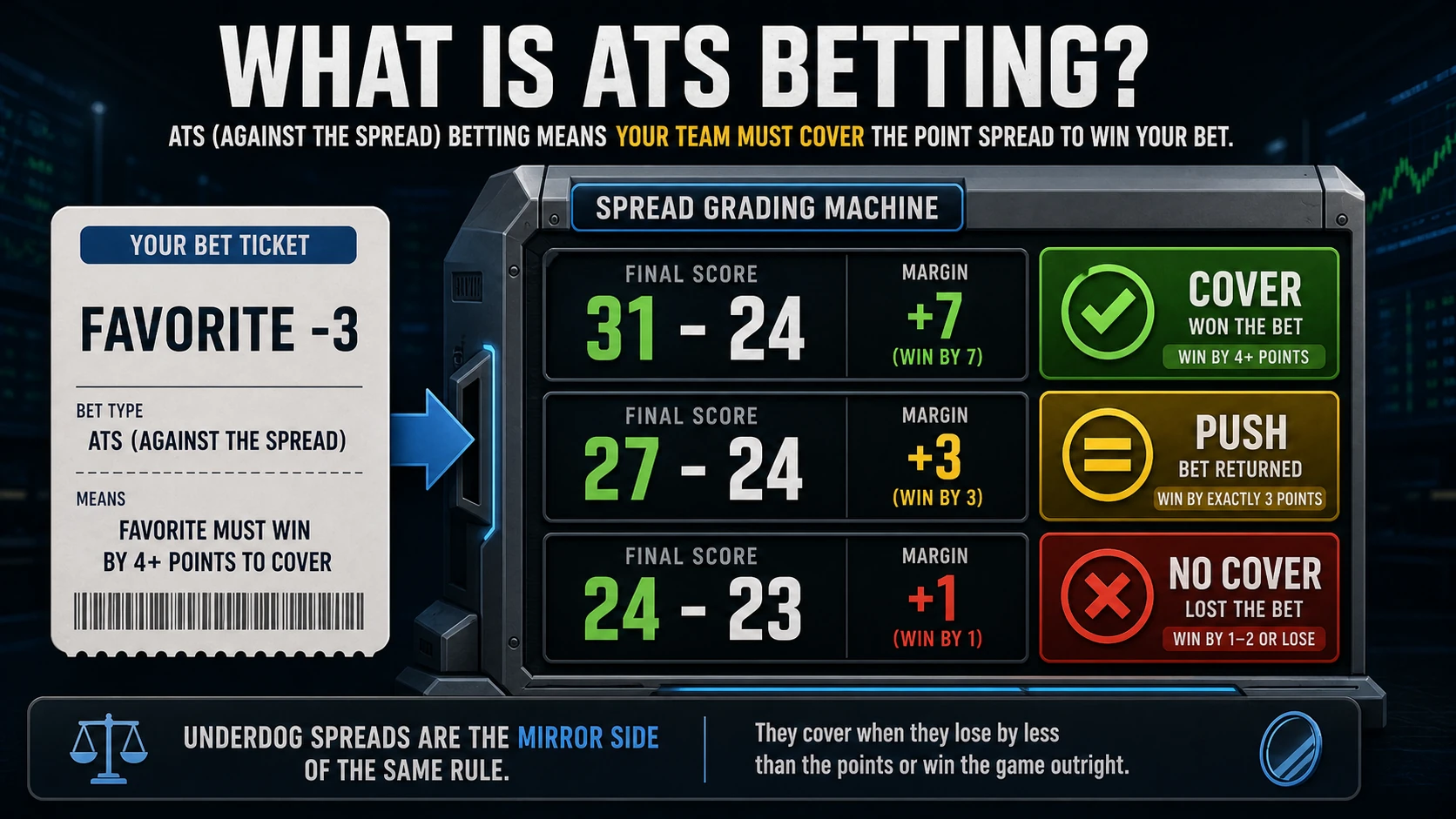
ATS means against the spread. It answers a different question from who won the game: did the selected side beat the bookmaker’s handicap? That distinction is the whole game. A favorite can win and fail to cover. An underdog can lose the game and still cash the spread ticket.
The spread creates the grading line
A point spread gives one team a handicap and the other the opposite side of the same line. To grade the wager, apply the spread to the selected team’s final margin under the book’s settlement rules. The adjusted result is a win, loss, or push.
The sign convention matters. Store the team, side, spread, price, and captured timestamp together. A record built from lines with mixed home-team and selected-team signs can look plausible while grading every favorite backward.
Favorite, underdog, cover, and push
The favorite covers by winning by more than the listed handicap. The underdog covers by winning outright or losing by less than the handicap. When the adjusted result lands exactly on the grading line, the wager pushes and the stake is returned under standard settlement.
Half-point spreads remove the push at that line. Whole-number spreads can push. Always use the booked line rather than a later consensus line; a small difference can change the grade.
An ATS record needs context
A proper record lists wins, losses, pushes, cover rate, named window, and sample size. The record should also identify the market source, price policy, and provenance tier. “Hot ATS” without those fields is a slogan, not evidence.
Situational splits need the same discipline. Home underdogs, road favorites, short rest, division games, and weather buckets can create dozens of cuts from the same schedule. The more splits you try, the easier it is to discover a flattering pattern by accident.
Small samples are stories
A short run can be worth describing, but it should not be sold as a stable betting edge. Keep confidence intervals or another uncertainty measure beside the record, and compare the split with a broader baseline. A result that disappears when one game is removed is not ready to drive a wager.
Do not patch this problem by pooling unrelated seasons or teams without a reason. More rows help only when they measure the same football question under compatible rules.
Price determines the break-even rate
ATS grading tells you whether the side covered. Profitability also depends on the price paid. Convert the exact booked price to its implied break-even win rate and store that price with the wager. A cover record without prices cannot support a return claim.
This page does not repeat a universal juice figure in authored copy because no live market row is attached to the article. The current price, not a remembered convention, sets the break-even threshold.
Closing line and booked line play different roles
The booked line settles the wager. The closing line helps evaluate the decision process. Save both, with timestamps and books, rather than replacing one with the other. A bet can win despite a poor number and lose despite a strong number.
Closing-line movement is evidence about market agreement, not proof that the bet had positive expectation. Use it alongside a complete graded record and a documented model or handicapping rule.
Team ATS records are descriptions, not forecasts
A team’s past cover record includes the market’s prior expectations, changing injuries, opponents, coaches, and prices. It does not reveal an enduring personality called “good ATS.” The spread moves specifically to balance current information.
Use a team record to ask better questions. Was the market slow to update quarterback play? Did the schedule create repeated rest advantages? Did one stale opening line drive the split? Then test that mechanism on later games rather than betting the label.
Model records must freeze the prediction
A spread model should save its prediction, model version, feature cutoff, booked or decision line, and event timestamp before the game. Settlement then joins the final score under one grading rule. Editing the prediction after line movement or kickoff destroys the record.
Publish the full eligible sample. Excluding “bad data” after seeing the result is allowed only under a predeclared rule that applies to wins and losses alike.
Read the live receipts, not a typed example
The season receipts widget on this page is the place for current NFL grading. Its values come from the precomputed receipts_summary path named in the module comment, rather than from prose typed into this article. When no graded picks exist for the selected season, the correct surface is an honest empty state.
The article body does not manufacture a team record, model record, or price example. That keeps the explainer stable while the data-bound widget carries the changing result.
The practical ATS checklist
Before trusting an ATS claim, ask for the selected side, booked spread, booked price, settlement result, model or decision timestamp, named window, sample size, and provenance tier. Then check whether pushes were excluded from cover rate and whether every eligible wager stayed in the ledger.
ATS is simple to define and easy to abuse. Grade the exact ticket, keep the clock intact, and let the receipts do the talking.
NFL ATS cover-margin distribution
Bars count completed NFL schedule rows by closing-spread cover margin using the repository canonical home-margin grading convention.
Model calibration from graded predictions
Calibration points render only when a verified source binds prediction probabilities to settled outcomes for the same observations.