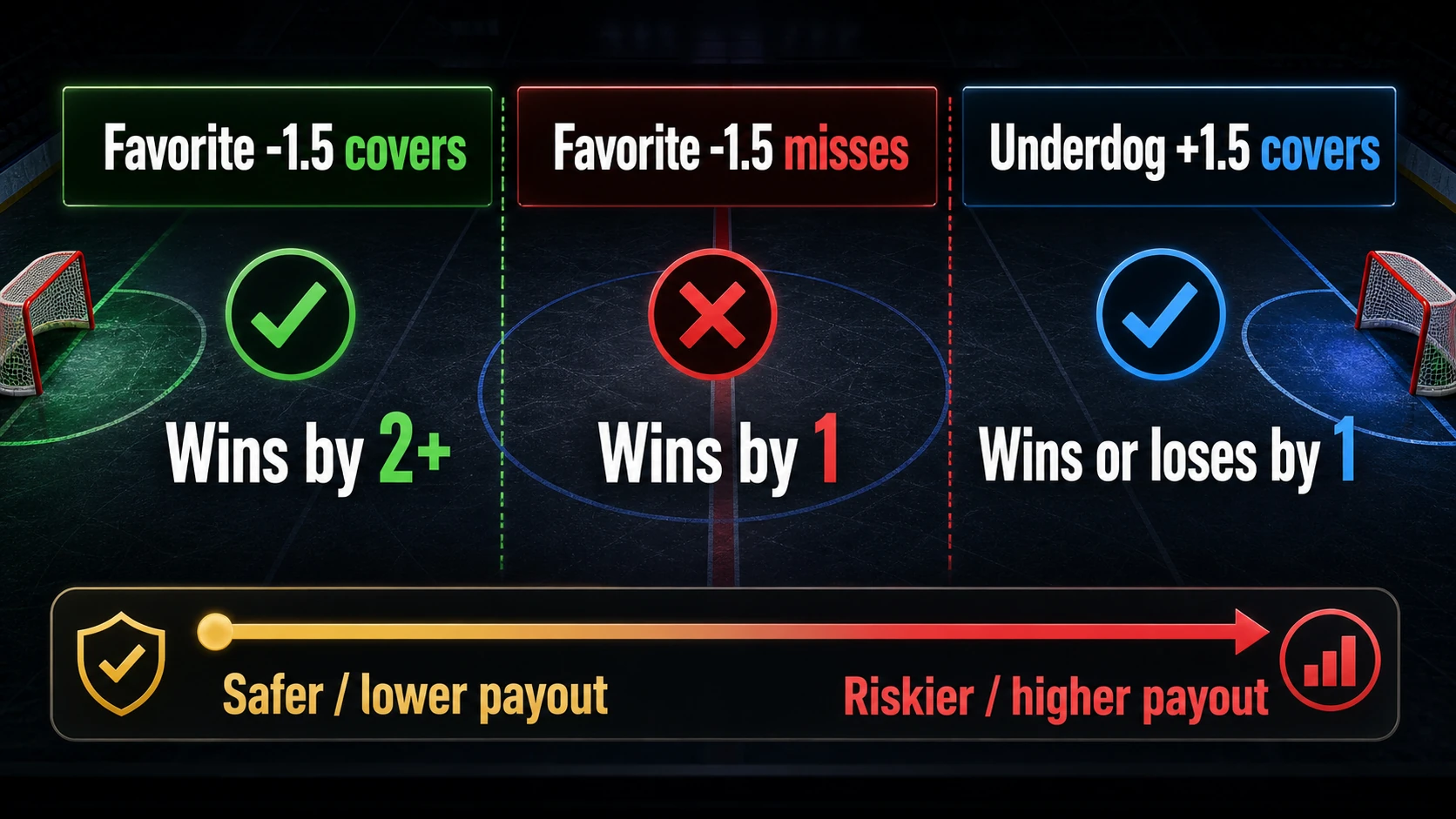
The puck line is hockey’s margin market. The common board asks the favorite to clear -1.5 goals and gives the underdog +1.5. The arithmetic is easy. The price is the hard part. A side can offer more ways to cover and still be a bad bet because the book has already charged for those paths.
Provenance tier: market-rule explainer. The spread figures describe settlement structure. No source-linked historical cover table, sportsbook snapshot, or model run is attached, so no cover rate, price band, or profitable record is published.
Start with the settlement rule
On a standard puck line, the -1.5 side needs a final margin of at least two goals. The +1.5 side covers by winning the game or losing by one. That is the contract. Everything else—team quality, goalie news, special teams, rest, or empty-net risk—belongs in the probability estimate.
Confirm whether the market includes overtime and shootout settlement, whether a postponed game remains action, and how a goalie or venue change is handled. A regulation puck line is not the same product as a full-game puck line. Never compare prices across products until the rules match.
More cover paths do not guarantee value
The underdog cushion looks comfortable because several final scores cash it. The book knows that. The price reflects those extra paths, sometimes aggressively. The favorite’s -1.5 looks demanding because a one-goal win loses, but the payout may compensate. Neither side is automatically sharp.
Convert the available quote to an implied probability, remove the market’s vig with a declared method, and compare that result with your own source-backed cover probability. If you cannot produce the second number without a hunch, you do not have a value calculation.
Project margin, not just the winner
A moneyline model answers whether a team wins. A puck-line model answers how often the final margin lands on each side of a threshold. Those are related questions, not identical ones. A team can have a strong win probability and still play many one-goal games.
The clean route is to model a distribution of final goal margins or simulate from source-backed scoring inputs. Then count how often each side covers under the exact settlement rule. Keep the model version, data cutoff, and quote timestamp with the probability so the result can be reproduced.
Goalie information needs a timestamp
A starter change can alter the projected score distribution, but “backup starting” is not a universal adjustment. Use a named, timestamped confirmation and rerun the model with the prior for that goalie. Capture the puck-line quote after the news. A pre-news model compared with a post-news price is a broken comparison.
The same rule applies to injuries and lineup changes. Store what was known at bet time. A final lineup assembled after warmups cannot be fed into a backtest of a wager supposedly placed earlier.
Special teams belong in the distribution
Power-play and penalty-kill inputs can matter because they change expected scoring and game-state paths. Use rolling features calculated only from games completed before the event. Do not call a rank or a recent streak predictive without testing it in an untouched window.
A good puck-line feature earns its place by improving out-of-sample probability quality or cover decisions. A colorful hockey narrative that never changes a calibrated probability is commentary, not a model input.
Empty-net goals change the margin path
Late in a close game, a trailing team may trade defensive protection for another attacker. That creates a different scoring state. For a live puck line, the relevant inputs include score, time remaining, possession context, goalie state, and the current quote.
Do not paste a generic empty-net rate onto every game. Estimate the state from a declared play-by-play source, keep the sampling window visible, and grade the rule forward. The companion empty-net totals guide covers the same state from the total bettor’s side.
Separate pregame and live claims
A pregame model can use projected lineups, rest, team strength, and expected starter states. A live model must add the current score, clock, manpower, and market quote. Mixing a final-game fact into a pregame row creates leakage; using a pregame distribution after the game state has changed creates stale pricing.
Keep the two products in separate evaluations. A model that grades well before puck drop has not proved it can price a pulled-goalie state, and a live engine has not proved an opening-market edge.
How to grade a puck-line process
Declare the book or consensus source, quote time, settlement rule, data cutoff, model version, and side-selection rule before reviewing results. Include every eligible pick. Report the ATS-style win-loss record, percentage, window, and sample size. If prices vary and you want a financial analysis, attach the actual prices and a separate source-backed calculation instead of assuming a standard quote.
Hold out future games. Do not keep adjusting a threshold against the same season until the record looks clean. The best-looking historical split is the one most in need of a forward test.
A practical card review
First, verify the product and rules. Next, confirm the starter state and the data cutoff. Build the margin distribution. Capture the current quote. Remove vig. Compare fair and market probabilities. Pass when the gap is too small, the inputs are stale, or the market has moved beyond the model’s tolerance.
Use the NHL picks page for graded rows, the goalie-confirm guide for information timing, and the model leaderboards for records that declare their window and sample. A familiar team name is not part of the settlement rule.
What to watch before the next puck-line bet
What to watch: the next verified starter update and the first same-market quote after it. Rebuild the margin distribution on that timestamp; if the source-backed cover probability no longer clears the price, the bet disappears.
NFL ATS cover-margin distribution
Bars count completed NFL schedule rows by closing-spread cover margin using the repository canonical home-margin grading convention.
Model calibration from graded predictions
Calibration points render only when a verified source binds prediction probabilities to settled outcomes for the same observations.