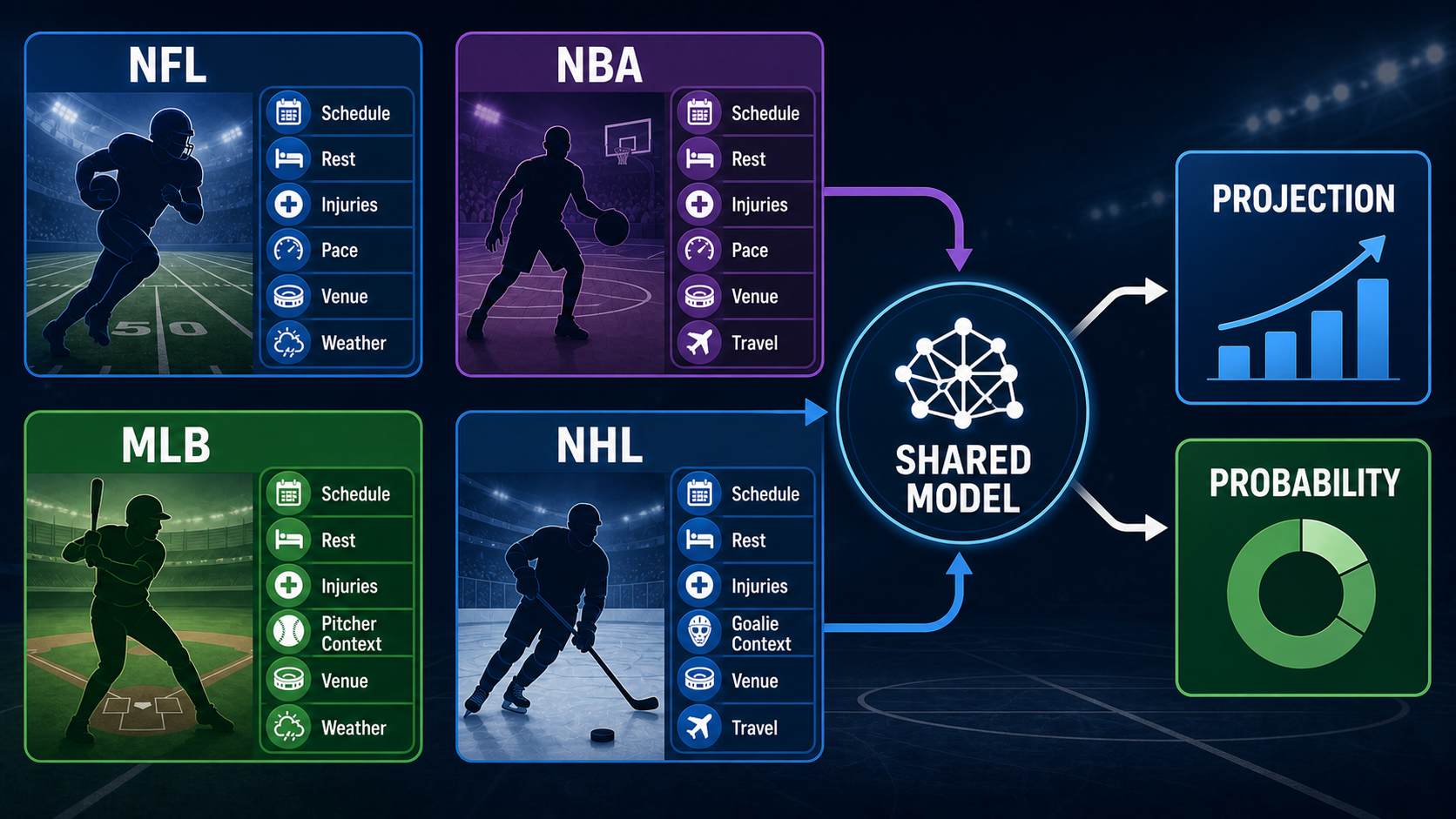
How can the same prop workflow work for NFL, NBA, MLB, and NHL when each sport describes opportunity in a different language? That is the practical question behind this method family. A feature store is the organized shelf where reusable sports signals live. Instead of rebuilding minutes, snaps, pitcher context, or goalie context for every model, the feature store gives each workflow a consistent, timestamped source of truth.
The plain-English version
A feature store is the organized shelf where reusable sports signals live. Instead of rebuilding minutes, snaps, pitcher context, or goalie context for every model, the feature store gives each workflow a consistent, timestamped source of truth.
The novice trap is to treat the method name as magic. The useful move is to ask what information the method can learn, what it cannot learn, and what kind of sports question it is actually built to answer. A method that is excellent for ranking team strength can be poor for a single player prop, and a method that wins a backtest can still be unbettable if the edge appears only after the market has moved.
Start with the target. A spread model, moneyline model, player prop projection, DFS lineup optimizer, and fantasy ranking all answer different questions. Then check the timestamp of every feature. If the feature would not have been known before the bet, contest lock, or lineup decision, it does not belong in the model. Finally, compare the output to the right benchmark: the closing line, the posted prop, the field ownership, or the best available projection.
Method-by-method guide
sport-feature-store
A sport feature store is the shared layer that stores reusable team, game, player, and market inputs with consistent definitions. In sports terms, this is the part of the model that decides how to translate noisy pre-game inputs into a usable betting, fantasy, or DFS signal instead of a loose opinion.
Where it helps: It lets one workflow compare NFL, NBA, MLB, and NHL context without rebuilding every join and timestamp rule. The practical test is whether the block improves decisions on games it has not seen, not whether it explains last night's box score after the answer is known.
Where it fails: It fails when definitions are vague, stale, or allowed to change without versioning and backtest notes. The fix is usually cleaner targets, stricter time cuts, a smaller feature set, or a calibration layer before the output reaches a staking or lineup workflow.
nfl-player-feature-store
The NFL player feature store organizes player opportunity, role, matchup, injury, and game environment features. In sports terms, this is the part of the model that decides how to translate noisy pre-game inputs into a usable betting, fantasy, or DFS signal instead of a loose opinion.
Where it helps: It supports receiver, rusher, and quarterback props where snaps, routes, QB status, coverage, and weather all matter. The practical test is whether the block improves decisions on games it has not seen, not whether it explains last night's box score after the answer is known.
Where it fails: It can mislead when depth-chart changes, late inactive reports, or usage splits are not timestamped correctly. The fix is usually cleaner targets, stricter time cuts, a smaller feature set, or a calibration layer before the output reaches a staking or lineup workflow.
nba-feature-store
The NBA feature store tracks team-level pace, rest, matchup, injury, and market context for game and total models. In sports terms, this is the part of the model that decides how to translate noisy pre-game inputs into a usable betting, fantasy, or DFS signal instead of a loose opinion.
Where it helps: It helps a model understand whether a total moved because of pace, injuries, defensive matchup, or schedule context. The practical test is whether the block improves decisions on games it has not seen, not whether it explains last night's box score after the answer is known.
Where it fails: It can overstate rest or pace effects if back-to-back context is not separated from opponent quality. The fix is usually cleaner targets, stricter time cuts, a smaller feature set, or a calibration layer before the output reaches a staking or lineup workflow.
nba-player-feature-store
The NBA player feature store stores minutes, usage, rates, rotation context, and opponent matchup for player props. In sports terms, this is the part of the model that decides how to translate noisy pre-game inputs into a usable betting, fantasy, or DFS signal instead of a loose opinion.
Where it helps: It helps project points, rebounds, and assists when an injury changes minutes or usage for a teammate. The practical test is whether the block improves decisions on games it has not seen, not whether it explains last night's box score after the answer is known.
Where it fails: It fails if probable lineups, minutes limits, or late scratches arrive after the feature snapshot. The fix is usually cleaner targets, stricter time cuts, a smaller feature set, or a calibration layer before the output reaches a staking or lineup workflow.
mlb-feature-store
The MLB feature store captures game-level context such as starters, bullpen, park, weather, handedness, and market fields. In sports terms, this is the part of the model that decides how to translate noisy pre-game inputs into a usable betting, fantasy, or DFS signal instead of a loose opinion.
Where it helps: It supports moneyline, run line, and total models where pitcher and park context can dominate the baseline. The practical test is whether the block improves decisions on games it has not seen, not whether it explains last night's box score after the answer is known.
Where it fails: It can become stale quickly when lineups, openers, or bullpen availability change after the first data pull. The fix is usually cleaner targets, stricter time cuts, a smaller feature set, or a calibration layer before the output reaches a staking or lineup workflow.
mlb-player-feature-store
The MLB player feature store keeps hitter and pitcher player-game context such as batting order, platoon, recent workload, and park. In sports terms, this is the part of the model that decides how to translate noisy pre-game inputs into a usable betting, fantasy, or DFS signal instead of a loose opinion.
Where it helps: It helps hitter props and fantasy projections compare contact skill, lineup slot, opposing pitcher, and run environment. The practical test is whether the block improves decisions on games it has not seen, not whether it explains last night's box score after the answer is known.
Where it fails: It can overfit small platoon samples or miss late lineup scratches if refresh timing is weak. The fix is usually cleaner targets, stricter time cuts, a smaller feature set, or a calibration layer before the output reaches a staking or lineup workflow.
nhl-player-feature-store
The NHL player feature store organizes line assignment, power-play role, shot volume, goalie context, and team environment. In sports terms, this is the part of the model that decides how to translate noisy pre-game inputs into a usable betting, fantasy, or DFS signal instead of a loose opinion.
Where it helps: It supports shots, points, and DFS projections where line combinations and power-play time drive opportunity. The practical test is whether the block improves decisions on games it has not seen, not whether it explains last night's box score after the answer is known.
Where it fails: It can break when morning skate lines differ from game deployment or when goalie confirmation arrives late. The fix is usually cleaner targets, stricter time cuts, a smaller feature set, or a calibration layer before the output reaches a staking or lineup workflow.
Sports walkthrough
The same prop workflow changes by sport. NFL context might start with routes, snaps, target share, pressure, and weather. NBA context might start with minutes, usage, pace, and injury status. MLB context might use pitcher handedness, park factors, batting order, and bullpen. NHL context might use lines, power play, goalie, and shot environment. Feature stores let those sport-specific panels feed one modeling pattern.
Concrete names keep the model honest: CeeDee Lamb needs route and target context, Luka Doncic needs NBA minutes and usage context, Shohei Ohtani needs MLB pitcher and lineup context, and Connor McDavid needs NHL line and power-play context. Those examples are not there to imply a pick; they force the workflow to deal with real role changes, injury context, usage shifts, opponent quality, and market reaction instead of abstract rows in a table.
The workflow is deliberately boring. Define the event, gather only pre-decision information, produce a projection or probability, compare it with the market or contest environment, size the action conservatively, and then record what happened. When the number closes, the closing price becomes the first audit. When the game finishes, the outcome becomes the second audit. Over a useful sample, both audits matter more than whether one bet won.
Validation workflow
Validate this method family in the same shape it will be used live. Train on older games, tune on a later slice, and reserve the newest window for the final check. If the method uses player props, keep player identity, team context, injury status, and market number aligned to the timestamp when the decision would have been made. If it uses DFS simulations, lock the slate, salary, ownership, and injury assumptions before grading lineups.
Compare against a plain benchmark before celebrating lift. A model should beat a naive average, a market-only view, and a smaller interpretable version before the extra complexity deserves product space. The important comparison is not whether the method can explain the past; it is whether it improves decisions after fees, vig, contest rake, stale lines, and real lineup constraints are included.
Review failures as carefully as wins. A losing pick that beat the close can still be a useful process signal, while a winning pick that took a bad number can be a warning. Group errors by sport, market, player role, team, confidence bucket, and price range so the builder can tell the difference between normal variance and a broken assumption.
Expert notes
The main feature-store risk is time travel. A clean store records what was known at each decision time, not just the final clean version of the data after the game.
Grain matters. Player-game, team-game, possession, play, slate, and contest rows should not be mixed casually. Many sports modeling errors are really grain errors.
Reusable features need ownership. If several models depend on the same usage feature, changing its definition changes every downstream backtest. Version important definitions.
Sport-specific stores should share conventions but not force false sameness. NFL snaps are not NBA minutes, and NHL line assignment is not MLB batting order, even if all are opportunity signals.
When not to use this family
Do not use a method just because it is more advanced than a baseline. If the data is thin, the target is unstable, the sport context changed, or the market already absorbs the signal, a simpler model with better validation is usually the better tool. The warning sign is a model that needs a long explanation for why its live results should be ignored.
Watch for leakage, repeated samples, and hidden correlation. A player prop model can accidentally learn same-game information through closing lines, a DFS optimizer can double count teammate correlations, and a ratings model can overstate certainty after one noisy result. If a method cannot survive a walk-forward split, a holdout season, and a calibration check, keep it in research.
Decision checklist
| Modeling question | Useful block | Risk check |
|---|---|---|
| What is the cleanest baseline for this sports decision? | sport-feature-store | Confirm the target, feature timestamp, and market comparison are all aligned before training. |
| Which block adds lift without turning noise into confidence? | nhl-player-feature-store | Compare walk-forward performance, calibration, and closing-line value before trusting the output. |
How Shark Snip uses it
Shark Snip uses sport-feature-store, nfl-player-feature-store, nba-feature-store, nba-player-feature-store, mlb-feature-store, mlb-player-feature-store, and nhl-player-feature-store to keep model inputs consistent across Tinker and DFS workflows.
The block names above are intentionally visible in this article so model builders can connect the concept to the actual building blocks in Tinker, DFS simulation, and the model marketplace. Shark Snip treats these methods as components in a workflow: feature preparation, model fit, probability repair, portfolio construction, and post-game evaluation. No block is allowed to skip validation because every sport has small samples, changing incentives, and noisy injury information.
The most useful model is not the one with the most intimidating name. It is the one whose assumptions match the sport question, whose inputs were available at decision time, whose output is calibrated enough to compare with a price, and whose failures are visible before real bankroll or contest exposure is increased.
Related reading and tools
Keep going with building your first model with Tinker, closing-line value, bet tracking. These links connect the method family to the betting, DFS, and model-building workflows readers already use.
NBA example board
Use the named prop board instead of a generic “good matchup” note. Nikola Jokic assist and rebound props should start with touch volume and whether Denver is using him as a hub. Shai Gilgeous-Alexander points props should start with free-throw equity, opponent rim pressure, and whether the market has already priced his usage. Luka Doncic PRA props, Jayson Tatum three-point volume, and Victor Wembanyama blocks or rebounds each need different inputs even when the headline market looks similar.
- Jokic assists: check teammate shooting availability, pace, and whether the defense sends help early.
- Shai points: separate true usage from a public star tax when the Thunder are heavily favored.
- Doncic PRA: watch blowout risk because rebounds and assists can disappear before points do.
- Tatum threes: price attempts, not only make rate, especially against switch-heavy defenses.
- Wembanyama blocks and rebounds: account for opponent rim attempts, foul risk, and minute stability.
How to keep NBA examples from going stale
Recheck the Celtics, Thunder, Nuggets, and Spurs context before acting because rotations move quickly around rest, injuries, and playoff leverage. The example is still useful if the player changes teams or the line changes, as long as the input stays explicit: minutes, usage, pace, matchup, and price. Pair this with reading NBA player props and NBA prop market structure when you need a deeper prop workflow.
Sport-specific model signals
Use names as evidence, not decoration. The useful SEO win is that CeeDee Lamb, Luka Doncic, Josh Allen, Ja'Marr Chase and Bijan Robinson and Chiefs, Bills, Eagles and Lions appear inside decisions, thresholds, and internal links instead of being dumped into a keyword list.
- Prop EV example: Luka Doncic points or PRA at 32.5 should be checked against projected minutes, usage without key teammates, pace, spread, and back-to-back fatigue before price.
- MLB: a Dodgers at Rockies first-five total of 5.5 should account for starter xFIP, K-BB%, handedness, Coors Field run environment, wind, bullpen rest, and umpire zone.
- NHL: a Maple Leafs puck-line price at +160 needs confirmed goalie, 5v5 expected-goal share, special-teams edge, and empty-net probability before the margin bet makes sense.
- UFC: an Islam Makhachev-style grappling favorite needs takedown entries, control time, get-up rate, and submission exposure; an Alex Pereira-style striker needs knockdown equity and round-by-round cardio risk.
- DFS value example: NBA showdown builds need projected minutes, usage, salary, ownership, and late-swap flexibility before a star salary is worth paying.
- Stack example: an NBA same-game entry with Doncic points, teammate assists, and opponent threes needs one coherent pace script instead of three unrelated legs.
The goal is not to mention every star. It is to show how the model changes when the example changes from Doncic to Shohei Ohtani, Igor Shesterkin, Connor McDavid, or Tom Aspinall. Revisit and update the board when lineups, minutes, starters, goalie confirmations, weigh-ins, or market prices change.
Educational analysis only, not a bet recommendation. Model outputs can be wrong, markets move, and sports data can contain injuries, role changes, reporting gaps, and contest-specific constraints.