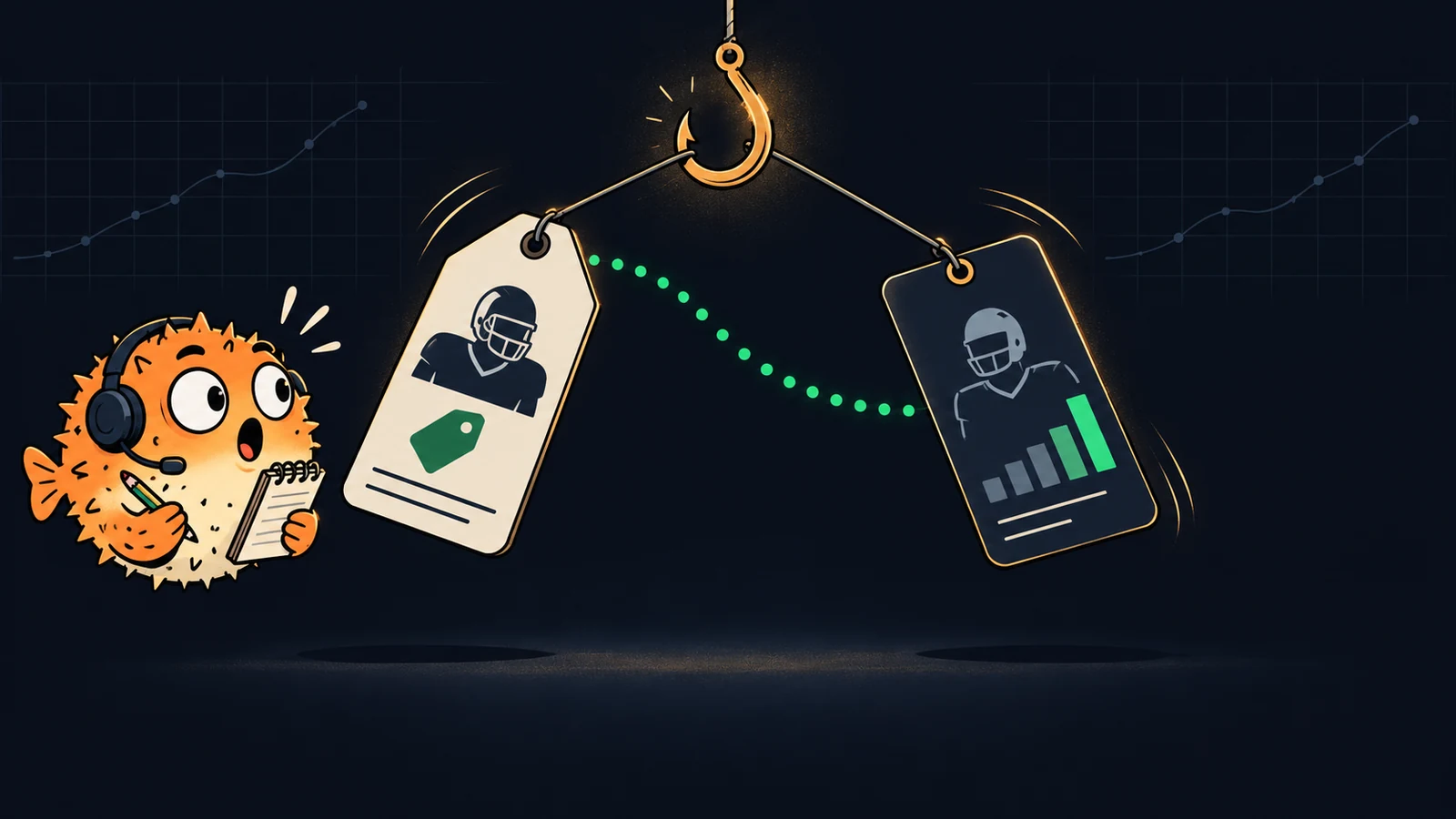
No auditable RB1 hit-rate result is published in this module because it declares no backtest source. The headline promises a historical test, but a result without the ADP rows, scoring rules, cohort definition, and graded outcomes is not a result readers can inspect. Rather than keep a confident percentage with no receipt, this pass leaves the number out and keeps the part that can still help: how the test should be built, challenged, and reported.
The chart is context, not the backtest
The first configured chart reads average PPR output by season for running backs from nfl_player_weekly. It can show how weekly production changes across stored seasons. It does not contain preseason ADP or a top-finish cohort, so it cannot answer the headline question. Calling it a hit-rate chart would be a category error.
The scatter reads carries and PPR output from stored running-back player-weeks. It is useful for seeing how similar rushing volume can produce different weekly fantasy results. It still does not connect a preseason rank to a season-end finish. A real backtest needs that bridge.
Define the cohort before looking at the answer
Start by freezing the preseason market source and the cutoff date. Decide what qualifies as an RB1 selection, which league format the ADP represents, and how duplicate or missing players are handled. Then define the outcome: season-end rank, points per game, total points, or another measure. Those choices are not paperwork. They can change which players count as hits.
Availability needs its own rule. A back who plays well but misses time is different from a healthy back whose role collapses. You can publish both views, but you cannot switch between them after seeing which one makes the thesis look better. Write the grading rule first and keep it fixed.
Keep the time axis clean
The market snapshot must come before the season it predicts. Depth-chart news, injuries, and later ADP cannot leak backward into the preseason cohort. The same rule applies to features. If the model uses snap share, coaching changes, or health information, each value must be available as of the draft snapshot.
This is where many tidy-looking fantasy studies break. They use a final-season database to rebuild a preseason feature, then celebrate the accuracy. That is not foresight. It is a replay with the ending left in the frame.
Report the denominator every time
A record needs a window and a sample count. A subgroup also needs its own denominator. “Veteran backs struggled” is not enough. Readers need to know how the subgroup was defined, how many observations qualified, and whether the rule existed before the result was inspected.
Uncertainty matters most when the subgroup gets small. A dramatic split from a thin bucket should be labeled as fragile, not upgraded into a law of drafting. The honest conclusion may be that the sample cannot distinguish a real effect from ordinary season variance.
Separate prediction from explanation
After grading the cohort, inspect why the hits and misses differed. Opportunity variables such as snaps, routes, carries, and targets can help explain role stability. Efficiency and touchdown outcomes may explain the final finish while remaining less useful for the next projection. The running-back regression guide lays out that distinction.
Do not choose a profile because it describes the winners beautifully. Test it on a later window that was not used to invent the rule. If the pattern vanishes, the original story may have been an artifact of the sample. A backtest earns trust by surviving data it did not get to study.
What a publishable result should include
- Market source and timestamp. Readers can identify the preseason board that formed the cohort.
- League and scoring rules. The definition of a successful finish is reproducible.
- Window and sample count. Every headline and subgroup names its denominator.
- Missing-data policy. Injuries, team changes, and absent ADP rows are handled consistently.
- Held-back validation. Any predictive profile is checked outside the window used to discover it.
- Provenance tier. Readers can tell which inputs were live preseason data and which were added later.
How to use the method on draft day
Until a source-backed result is attached, do not treat the title as evidence that early running backs are good or bad bets. Use the live draft kit to compare current roles and prices. Use the ADP tier framework to avoid paying more than comparable profiles cost. Then judge the running-back case on opportunity, role stability, and the price of being wrong.
The cure for a missing backtest is not a softer adjective. It is the actual table, the actual grading rule, and a result that another person can reproduce. Until those receipts exist, the honest answer is no published hit rate.
DFS outcome leverage versus recorded ownership
This chart remains empty until a verified source binds ownership projections to settled lineup outcomes for the same contests.
Prop hit rate versus recorded line distance
This chart remains empty until a verified source binds a player projection distribution, the offered prop line, and the settled result.