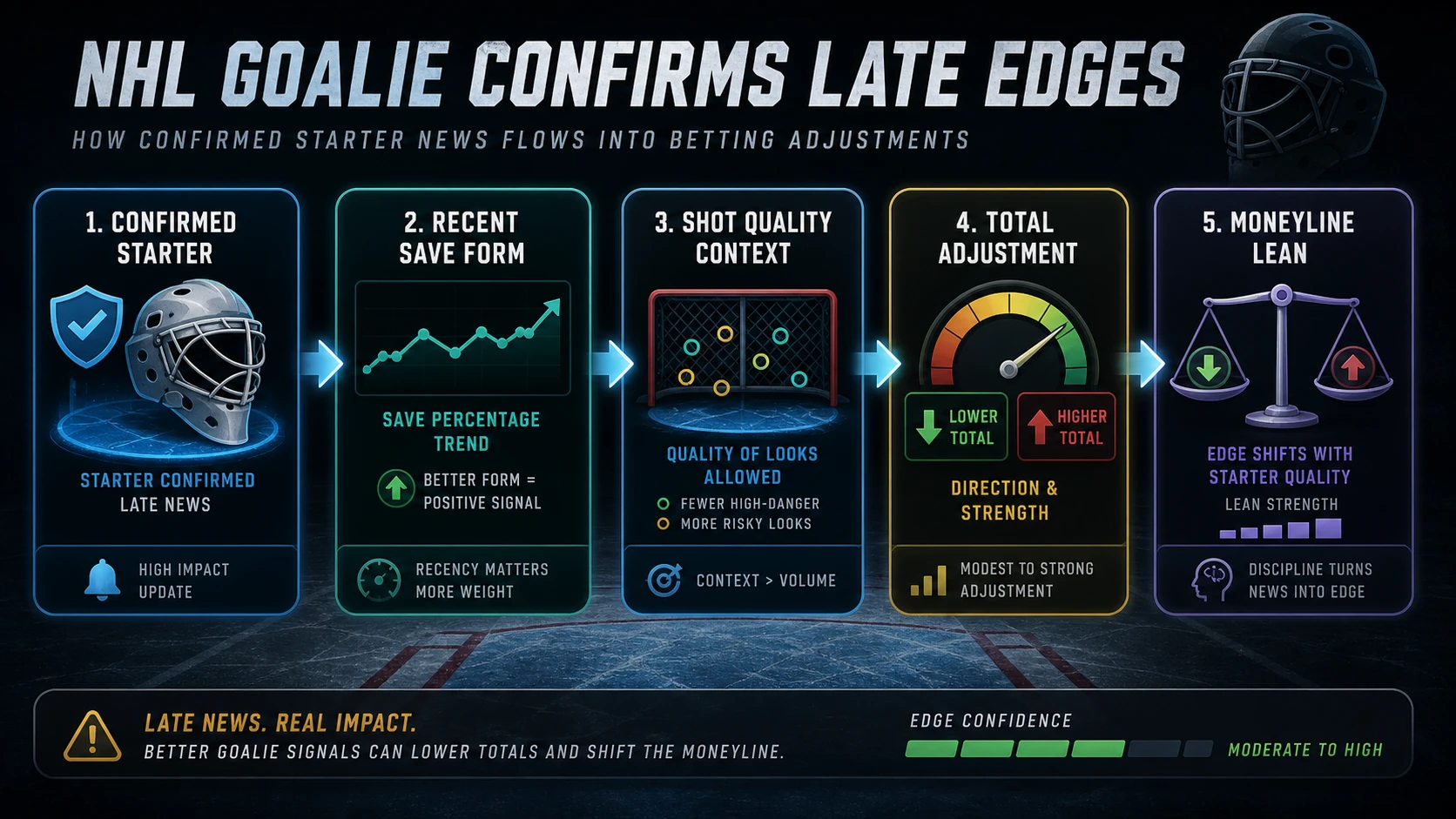
A goalie confirmation is information, not a coupon. The useful version of the NHL starter beat is simple: identify what the market expected, capture who was actually named, record when the news became public, and compare a real quote before and after that moment. Skip any one of those steps and the story turns into hindsight.
Provenance tier: methodology only. No source-linked confirmation ledger or sportsbook snapshot is attached, so no move size, response time, hit rate, or profitable record is published.
Projection and confirmation are different states
Pregame pages often collapse four different things into one green checkmark: a projected starter, a goalie inferred from skate work, a reporter’s expectation, and a club-confirmed starter. That shortcut is harmless for a casual lineup card and dangerous for a model. Each state carries a different amount of uncertainty.
Store the state with the name. “Projected” means the system has a best guess. “Confirmed” means a named source has made the assignment public. “Changed” means the confirmed name differs from the model’s prior. “Unavailable” means the evidence is too thin to claim any of the above. Those labels stop old assumptions from surviving under a fresh timestamp.
The timestamp is part of the fact
A starter name without a publication time cannot be joined honestly to a market. The question is not merely who played. It is what a bettor could know before placing a wager. Save the source publication time, the time your system received it, and the time the quote was captured. Those clocks answer different operational questions.
Also keep the source chain short. A club post or an on-site report is primary evidence. An aggregator can help discover it, but a copied headline should not silently become the canonical timestamp. When two credible reports disagree, preserve both and mark the starter state disputed until a stronger source resolves it.
Snapshot the market instead of describing it later
“The line moved” is not a record. A usable row needs the same market, the same book or declared consensus rule, a quote captured before the confirmation, a quote captured after it, and the event start time. Otherwise the apparent reaction may be ordinary market drift, a different book, or a stale screen.
The first task after a genuine change is therefore not to bet. It is to rerun the model and capture the available quote. The model’s revised fair probability and the market’s current implied probability must be expressed on the same basis. If that comparison cannot be made, the edge is unmeasured.
Price the goalie, not the label
“Backup” is a roster label, not a calibrated adjustment. Some second goalies are close substitutes for the expected starter. Others change how a team protects the slot, exits the zone, or manages rebounds. The adjustment should come from information available before the game: the model’s prior for the named goalie, expected workload, team context, and uncertainty around a small or stale sample.
Do not smuggle the game result back into that prior. A brilliant emergency start does not prove the pregame adjustment was wrong, and a bad goal does not prove it was right. Grade the prediction against the market and the declared target over an eligible sample, not against one memorable save.
Keep each market’s question separate
A goalie change can matter to the side, the total, team totals, saves, and opposing shot props, but those markets do not share a single mechanical answer. A weaker stopping prior may affect expected goals. A team’s defensive response may affect shots. A book may suspend one derivative while leaving another open. Treat each quote as its own market row.
This is also where settlement rules matter. A player prop may void when the named goalie does not start, while a game market remains live. Read the book’s rule before treating a stale-looking derivative as an executable opportunity.
A clean confirmation log
For every candidate event, save the scheduled matchup, projected starter, confirmed starter, confirmation state, primary source, source publication time, receipt time, quote time, market identity, book identity, model version, and final grading status. Keep raw text or a durable source reference so the decision can be audited later.
The log should allow an honest empty state. “No trustworthy confirmation,” “market suspended,” “quote arrived after the move,” and “model did not cover this market” are useful outcomes. Forcing every news item into a pick creates exactly the selection bias the log is supposed to prevent.
How to evaluate the process
Pre-register the eligible event definition, the quote source, the maximum information delay, and the market target. Then report the resulting record with its window and sample size. For side markets, use ATS-style win-loss reporting only when the target is actually a spread; otherwise use the metric appropriate to the declared model and include its provenance artifact. Do not translate a missing price history into a return claim.
Separate discovery from validation. The same season used to invent a goalie adjustment cannot prove that adjustment. Freeze the rule, move to untouched games, and keep every eligible event, including confirmations that produced no wager.
What to do on game day
Start with the latest projected lineup, but label it projected. Watch named sources. When a credible confirmation lands, record it before interpreting it. Rerun the relevant model, capture the current quote, check the book’s rules, and compare like with like. Bet only when the declared threshold is met by real inputs.
Use the NHL picks page for graded market rows, the puck-line guide for spread settlement, and the empty-net guide for late-game total mechanics. When any required input is absent, the sharpest output is no confirmation-based play.
What would change the decision
What to watch: a named starter confirmation paired with the first market quote captured after publication. If the rerun produces a reproducible gap under the registered rule, the row enters the ledger; otherwise the news remains information, not a play.
Line movement versus recorded public ticket share
This chart remains empty until a verified source table binds public ticket share and line movement for the same market observations.
Model calibration from graded predictions
Calibration points render only when a verified source binds prediction probabilities to settled outcomes for the same observations.