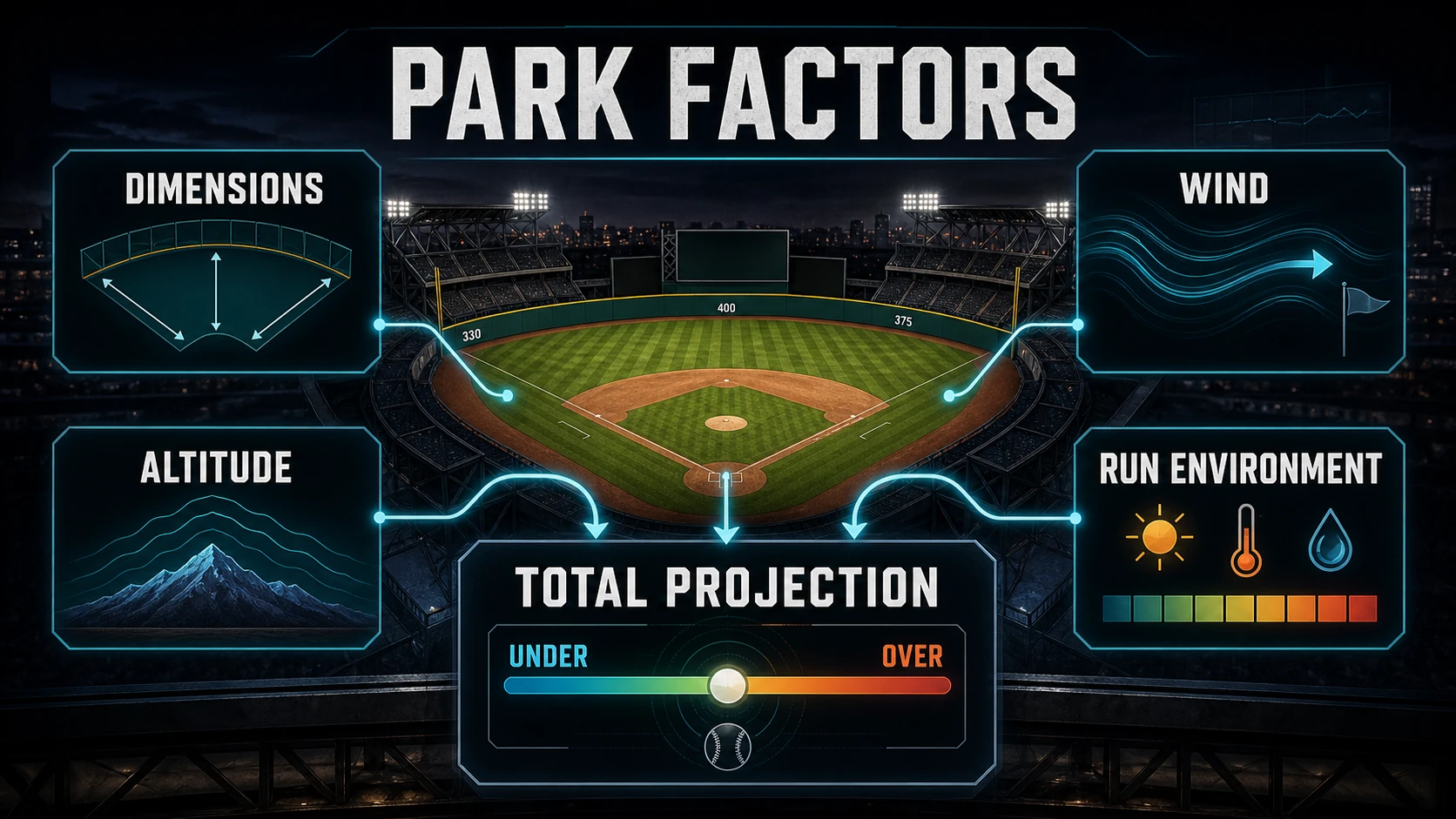
Park factor is where smart baseball analysis can turn into double counting with a straight face. The venue matters. So do weather, roster quality, pitcher mix, defensive alignment, and the market’s own adjustment. Put them all into one vague “Coors bump” and you can make any total look actionable.
A park factor needs a defined outcome
There is no single park factor. A venue can affect home runs, doubles, singles, foul outs, and total scoring differently. A run factor answers a different question from a home-run factor, and a factor for one handedness may not describe the other side of the plate.
The baseline matters too. A raw home scoring average reflects the home team, its opponents, the schedule, and the weather it happened to draw. A useful factor tries to separate venue from those participants. Read the methodology before trusting the label.
That distinction is essential when reviewing totals on the matchup grid. A displayed park tag should identify which outcome and source it represents, not collapse the entire venue into one adjective.
Build neutral first, then adjust once
A clean totals model starts from a declared baseline: starting pitchers, expected lineups, bullpen state, defense, and other non-venue inputs. The park adjustment belongs at one known stage. If the pitcher or hitter projections are already park adjusted, applying a full venue multiplier again counts the same environment twice.
The model card should answer three questions. What is neutral? Which fields already contain venue context? Where is the final park adjustment applied? If those answers are missing, a precise total can still be structurally wrong.
The feature pipeline in the model builder should make that lineage visible. A park feature without provenance is not safer because it has decimals.
Geometry and atmosphere act through different paths
Wall distance, wall height, foul territory, playing surface, roof configuration, and sight lines are persistent venue properties. Air density, wind, temperature, humidity, and precipitation change by game. Both can alter outcomes, but they should not be merged carelessly.
Coors Field is the obvious reminder that atmosphere and geometry can reshape contact outcomes. Camden Yards is the reminder that construction changes can break an old factor. The lesson is not a permanent ranking of parks. It is that venue assumptions need versions.
When a wall moves or a roof policy changes, older data may describe a different environment. Mark the change point and avoid averaging incompatible eras into one smooth number.
Rolling estimates need shrinkage and patience
A short rolling window reacts quickly but can mistake schedule and weather noise for a structural park shift. A long window is stable but slow to acknowledge a real change. A defensible estimate combines recent evidence with a broader prior and preserves the uncertainty around the result.
Split only where the data supports it. Handedness, batted-ball type, and season can be informative, but every split reduces the sample. The model should shrink sparse cells rather than printing an extreme factor as fact.
Updates in the workshop should carry the source window and methodology so a user can tell whether a change came from new games or a changed model.
The registered chart above shows the league-wide exit-velocity distribution in the MLB Statcast 2024 dataset after its declared filter. It has no park field. It can describe contact context, but it cannot tell you whether Coors, Camden, or another venue created the contact or changed its outcome.
Weather is a game input, not a timeless park trait
Use forecast and observed conditions with timestamps. A long-run park factor cannot know today’s wind direction, roof state, or delay risk. A weather adjustment cannot replace the venue geometry that remains when the air changes.
Keep the layers separate in both code and prose. Venue factor, current weather, and uncertainty should be inspectable. If the roof state is unknown, return that state as unknown rather than assuming indoor or outdoor conditions.
Delay risk also affects pitching plans. A stoppage can shorten a starter’s outing and shift innings to the bullpen, changing the total through a path that is not simply “better hitting weather.”
Player props need the matching sub-factor
A home-run prop should not inherit a generic run factor without checking the mechanism. A hits prop may respond differently from a total-bases prop. The venue can influence opportunity, contact conversion, and scoring without moving every market in parallel.
On the player props page, the useful display is the exact factor applied to the exact target, with source and update time. “Hitter park” is too broad to audit.
The price decides whether the factor matters
Books know where the game is played. Naming an extreme park is not an edge. The betting question is whether your properly adjusted distribution differs from the offered total enough to clear margin and model uncertainty.
Track any graded ATS result as wins, losses, win rate, named window, and graded sample size. Do not advertise units or a venue-only split discovered after the season. Park analysis earns trust through methodology and out-of-sample performance, not through a memorable over.
A park factor is valuable when it makes the projection more honest. It becomes dangerous when it becomes an all-purpose excuse to move the number.
Average NFL total points by recorded weather bucket
Average combined score is grouped only from completed NFL schedule rows with a recorded indoor roof state or numeric wind value.
NFL ATS cover-margin distribution
Bars count completed NFL schedule rows by closing-spread cover margin using the repository canonical home-margin grading convention.