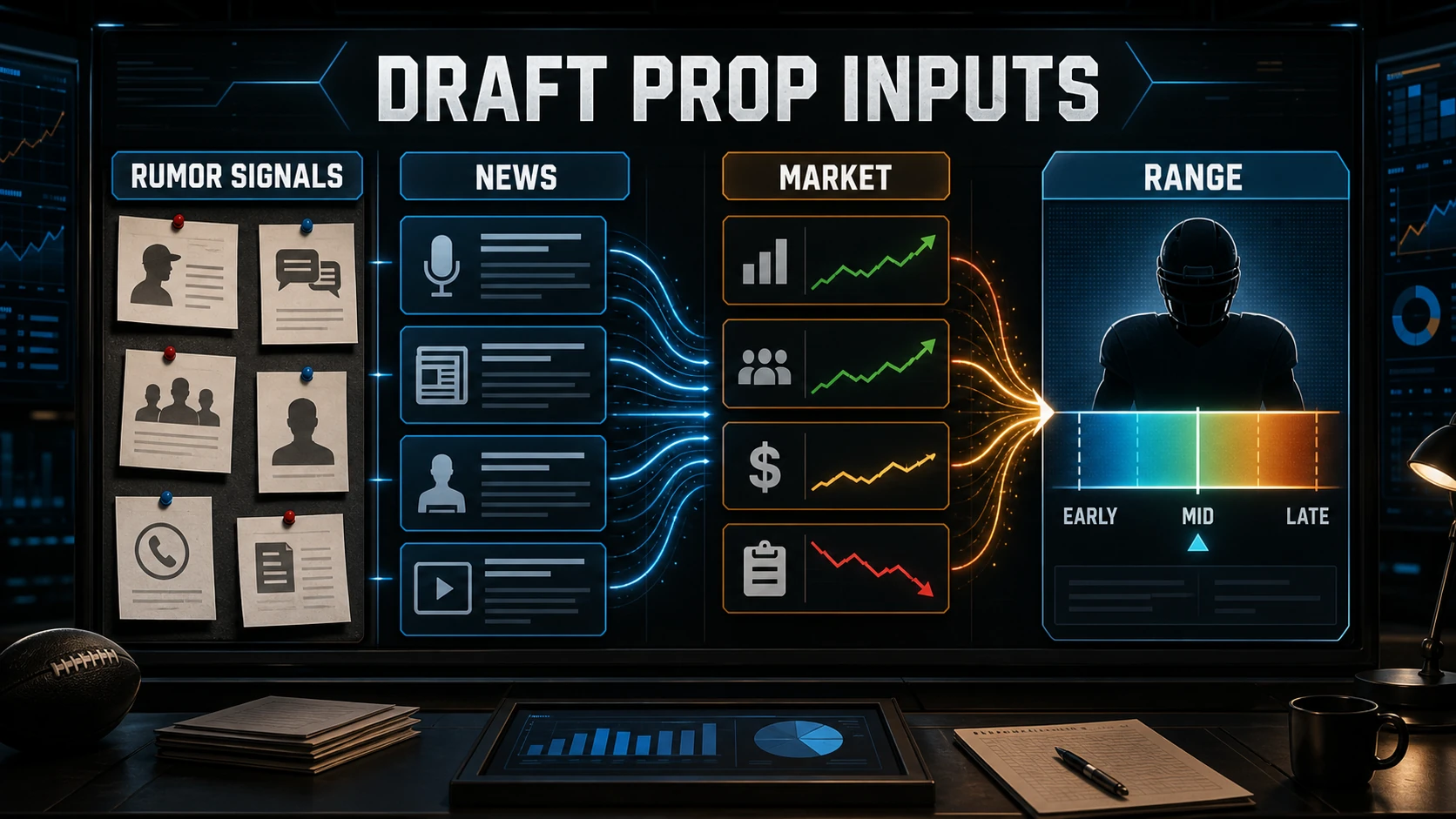
The draft is a rumor market with a clock. A report can be accurate and still be useless after the price moves. A prospect can be your favorite player in the class and still be a bad ticket. The work is to separate information from timing, then timing from value.
This guide does not publish sample odds or made-up expected value. Draft boards move too quickly for decorative prices. Use the live market you can actually bet, save it with a timestamp, and make the thesis answer to that number.
Know the contract before the prospect
Draft props can settle on a player's selection slot, the first player chosen at a position, a position-group count, or a team's first pick. Read the exact wording and house rules before comparing probabilities. Trades, position labels, pushes, and withdrawn players can be handled differently across books.
Save the settlement language with the market snapshot. If the wording changes later, keep both versions. A winning opinion under one definition can be a void or loss under another.
Snapshot the board
A useful draft ledger records the book, market, candidate, side, price, timestamp, and limit state. “I liked the under on Tuesday” is not an auditable claim. The ticket must show what was available when the decision was made.
When a market is suspended, mark it suspended. When a candidate is absent, mark the selection unavailable. Do not backfill a later price into an earlier thesis or borrow another book's line after the pick is known.
Devig mutually exclusive markets
First-at-position boards and other mutually exclusive markets can be converted into implied probabilities, summed, and normalized to remove the book's margin. Compare your candidate probabilities with that fair board rather than comparing raw American prices one at a time.
Your probabilities must also sum to a coherent whole. If every candidate looks like value, the model is not expressing confidence; it is ignoring the market hold or missing part of the field.
Build a source ledger, not a rumor pile
Label every report by source type: team statement, league transaction, named reporter, agent comment, prospect camp, or anonymous report. Record the publication time and whether another source independently confirmed it.
Do not count copies of the same report as corroboration. A rumor repeated across accounts is still one rumor. Weight specificity, access, and prior reliability, but keep the original language beside the model input so the interpretation can be challenged.
Price movement is data, not proof
A fast move tells you the market reacted. It does not tell you the report was true or that the new price is fair. Ask whether the move crossed your estimate. If it did, the information may still be right while the wager is gone.
That is the central discipline of draft betting: missing a number is cheaper than chasing it. A stale thesis does not become current because the prospect's name is still on the board.
Player-position props need a distribution
A draft-slot over or under is not a binary scouting grade. Build a distribution across plausible team slots, trades, and fallback ranges. The tails matter because one trade can skip several expected landing spots at once.
Do not assign a team to a player because the fit reads well. Name the evidence that moves probability toward that slot and the evidence that would move it away. When the source is weak, widen the distribution instead of forcing a confident side.
Team props need decision-maker context
A roster need is not the same as a front-office preference. Track the general manager, head coach, coordinator, draft capital, current depth chart, and realistic alternatives at the pick. A team can address a need later or trade out of the slot entirely.
Keep “should draft” separate from “will draft.” The market settles the latter.
Correlated props require one story and two prices
Two legs can describe the same draft path, but correlation does not rescue a bad number. Price each market on its own, then check how the book handles the pair. If the parlay terms or correlation adjustment are opaque, skip the combination.
A clean portfolio also tracks shared exposure. Several tickets tied to one prospect, one trade, or one source are not independent bets. Record the common failure condition before sizing the card.
Review the close without rewriting history
After the market shuts, compare each saved entry with the final available price and grade the ticket under the stored settlement rule. The review should ask whether the source was timely, whether the probability changed for a defensible reason, and whether you kept betting after the edge disappeared.
Report results only from real tickets with real prices. If the archive is incomplete, publish the selection record and missing-data count rather than inventing a return.
The betting takeaway
Draft props reward speed only when speed is attached to a source ledger and price discipline. Save the contract, timestamp the board, normalize the market, and let a moved number go. The prospect is not the bet. The bet is the gap that still exists when you can click it.
Bet responsibly. Draft markets are volatile and often thin; decide limits before news starts moving the board.
Prop hit rate versus recorded line distance
This chart remains empty until a verified source binds a player projection distribution, the offered prop line, and the settled result.
Breakeven win rate at recorded American prices
Breakeven probability is calculated only from American prices that were actually captured in the odds-history table.