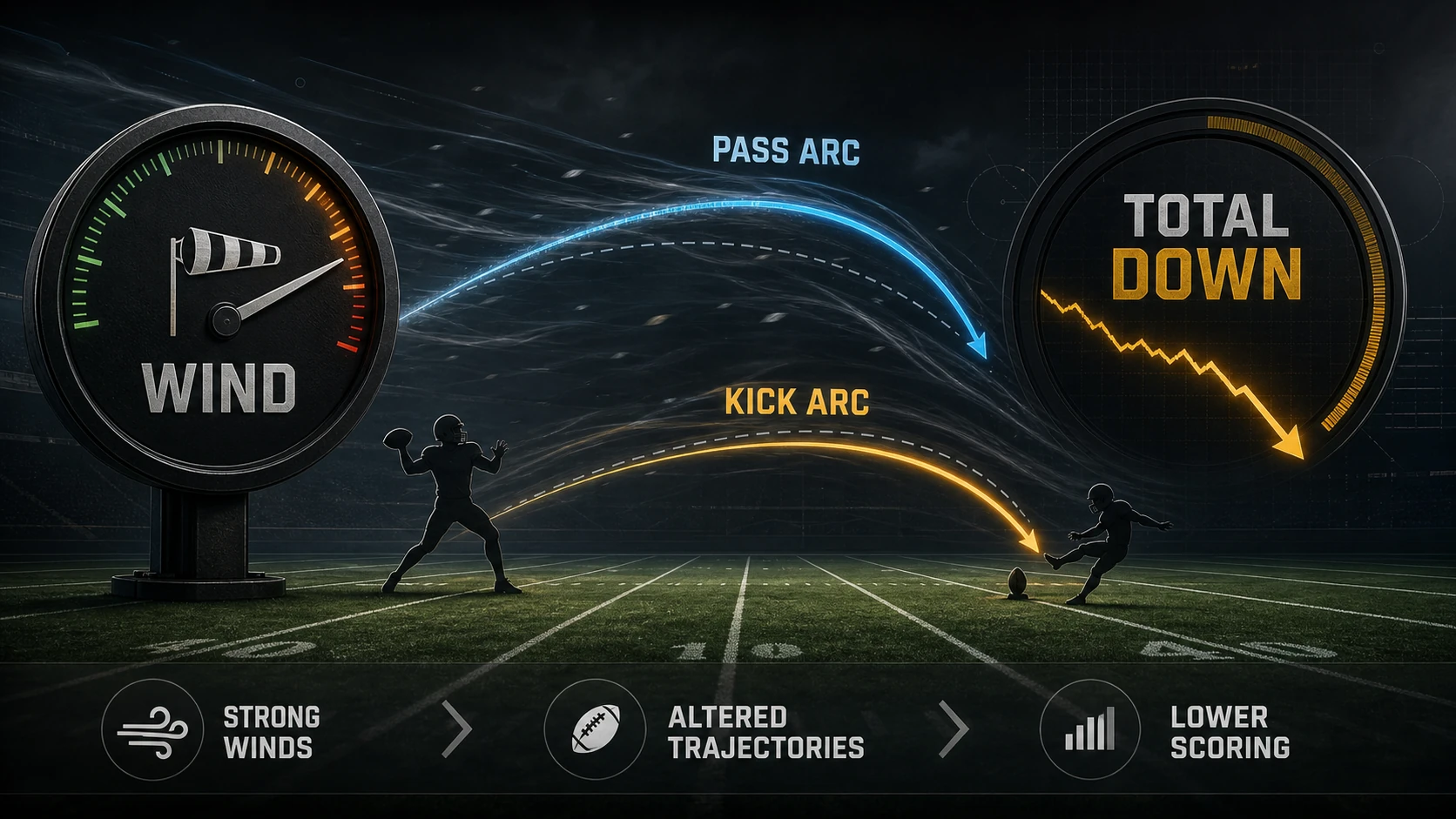
Weather is real. Weather betting mythology is realer. Every cold Sunday produces the same confident script: wind means under, snow means chaos, a warm-weather quarterback cannot function, and the market has not noticed the giant flag whipping above the stadium. Most of that is a story looking for a line.
The useful approach is duller and sharper. Freeze the forecast, freeze the market quote, describe the offense, and write down what would change your mind. No historical weather-results query is attached, so no magic wind threshold, points deduction, or weather-only win rate is published. When the required inputs are missing, the state is: no verified weather adjustment can be made from this snapshot.
Start with the stadium, not the icon
A cloud symbol does not tell you how a football game will play. Confirm the venue, playing surface, roof type, and announced roof status. Note how the field sits relative to the wind and whether the forecast describes conditions at the stadium or a broad city reading. A retractable roof turns an outdoor forecast into a decision tree. Until the roof decision is verified, both branches stay open.
Keep kickoff timing attached. A storm that arrives after the game is not a game input. A front moving through warmups can matter even when the daily forecast looks mild. Weather is a timestamped observation, not a permanent property of a matchup.
Wind has direction, texture, and consequences
“Windy” is not one variable. Sustained wind and gusts create different problems. Direction matters because a crosswind can affect throws and kicks differently from a wind running down the field. Stadium bowls, open ends, and nearby structures can make the field experience different from the airport reading.
Translate conditions into football questions. Does the offense rely on deep boundary throws? Can it live on quick concepts and yards after the catch? Does the quarterback create value on the ground? Is the kicker likely to face long attempts? Will the coaching staff become more aggressive on fourth down? Those are mechanisms. “Wind equals under” is not.
Cold and precipitation need an accomplice
Temperature can affect equipment, grip, recovery, substitution patterns, and kicking. Rain or snow can affect footing, ball security, visibility, and route precision. The surface and maintenance plan matter. So do the players. A power run game, a short passing attack, and a vertical timing offense do not carry the same weather exposure.
Do not assign a fixed scoring penalty from one forecast field. Build scenarios. In the dry branch, which matchups drive the total? In the wet branch, which play types disappear and which become more important? In the changing-weather branch, does one half face different conditions from the other? The point is not to predict the sky perfectly. It is to know which assumptions your wager needs.
Forecast age is part of the handicap
A weather note without a provider and observation time is stale by definition. Keep the forecast that existed when you made the decision, not the cleaner forecast published after kickoff. If you backtest weather, the feature must use the forecast available at bet time. Final observed conditions are an outcome-side fact and cannot be slipped into a pregame model.
This is the same leakage problem that ruins sports models everywhere. A perfect record built with postgame weather, final injury statuses, or the closing market is not foresight. It is a recap wearing a model badge.
Match the weather snapshot to the market snapshot
Record the sportsbook, total, price, and timestamp beside the forecast. Then record the next material forecast update and the next market quote. That sequence lets you ask a real question: did the market change after public weather information changed? It still does not prove causation, but it prevents the common trick of pairing an early forecast with a late line and calling the difference an edge.
A move is not a narrator. Books can copy a reference screen, raise limits, react to an injury, or correct a stale number in the same interval. Keep the evidence separate and resist the urge to label every drop “sharp weather money.”
Do not double count what the market already moved
If your baseline model uses the current total, some public weather information may already be inside that number. Adding a full independent weather adjustment can charge the same news twice. Keep a pre-weather fair range, the first verified post-update quote, and the final range. Ask what remains different between your assumptions and the market’s.
The companion NFL totals guide covers the broader price-first workflow. The closing-line value guide explains how to grade the quote you actually took rather than the story you told about it.
Props and sides need their own weather logic
A total is not the only market exposed to conditions. Passing depth, reception distribution, rushing opportunities, kicking decisions, and defensive scoring can move in different directions. A weather thesis that lowers deep passing can still raise short targets or quarterback rushing. Do not copy a full-game under argument into every player prop.
Likewise, weather does not automatically favor the underdog or the better rushing team. The side depends on which roster is better equipped for the specific conditions and what the spread already assumes. Start over for each market.
The weather card worth keeping
- Venue, surface, roof type, and verified roof status.
- Forecast provider, observation time, and kickoff window.
- Sustained wind, gusts, direction, precipitation, and field context.
- Offensive style, quarterback mobility, protection, kicking, and coaching choices.
- Sportsbook total, price, and timestamp from the same research window.
- The forecast or market change that would cancel the position.
Check the NFL picks page for a current selection tied to a real quote. Use the bet-tracking guide to preserve the forecast and line you actually saw. An empty board stays empty; no synthetic storm game fills it.
What to watch: the next verified roof or forecast update paired with the first tradable quote after it. That pair can change the scenario; an isolated weather icon cannot.
Provenance tier: operational weather methodology. No historical ATS record, fixed scoring multiplier, or weather-only return claim is made.
Average NFL total points by recorded weather bucket
Average combined score is grouped only from completed NFL schedule rows with a recorded indoor roof state or numeric wind value.
NFL ATS cover-margin distribution
Bars count completed NFL schedule rows by closing-spread cover margin using the repository canonical home-margin grading convention.