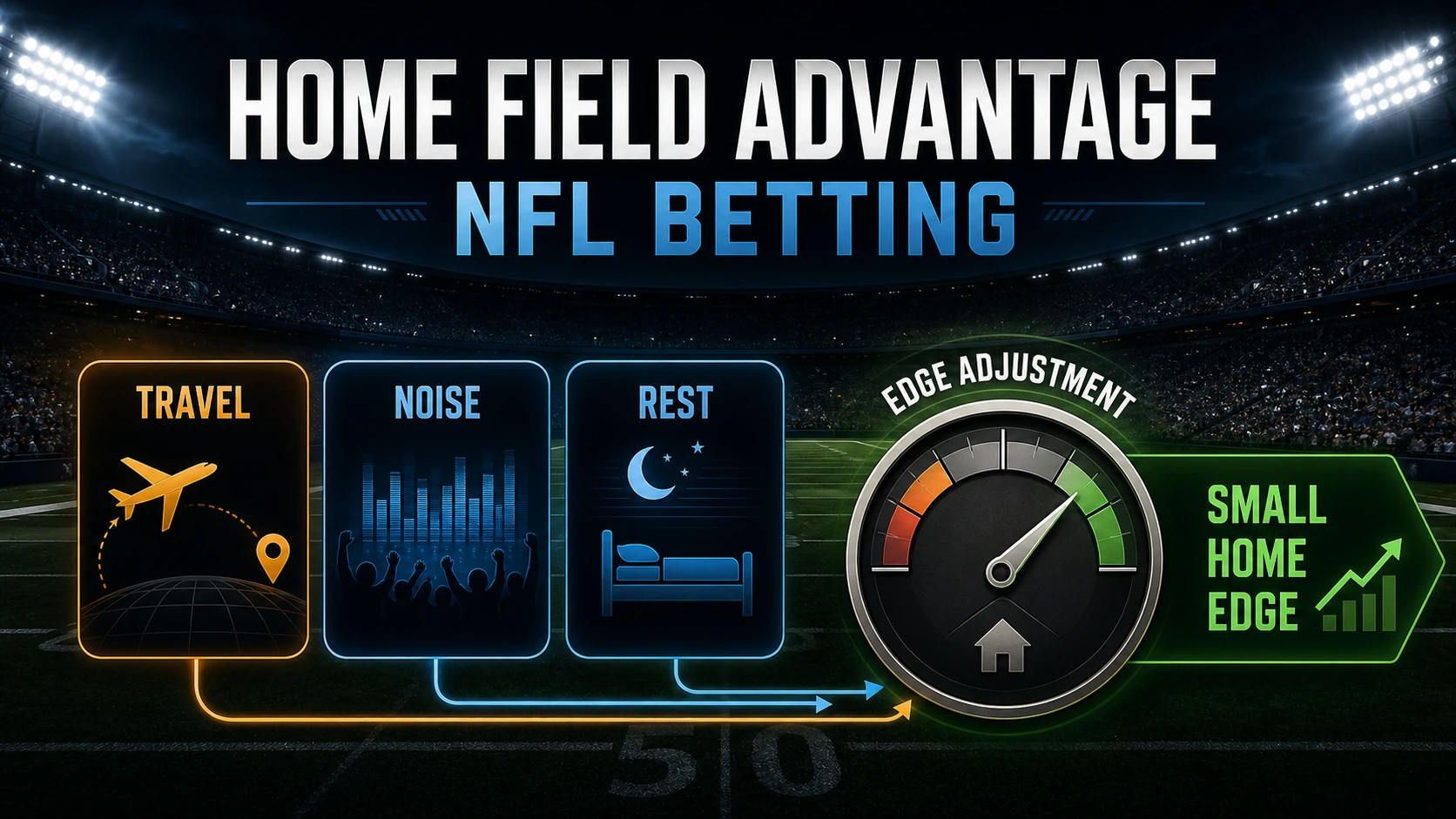
For decades, “home field is worth three points” was treated as a rule. It was never a law of nature. Venue, travel, rest, weather, crowd communication, and team quality move together, so a useful adjustment has to be built for the matchup rather than copied from an old handicapper’s notebook.
What home field advantage actually measures
Home-field advantage is not one force. It is a bundle of travel, sleep schedule, crowd communication, surface familiarity, weather exposure, and routine. Those effects can point in the same direction, cancel each other, or matter very little in a particular game.
- Travel. Direction, distance, and schedule can alter preparation.
- Surface and weather. Familiar conditions matter only when they change how either team plays.
- Communication. Crowd pressure can expose an offense already struggling with protection or cadence.
- Routine. Familiar facilities help, but they do not rescue a weak matchup.
Start with the teams on a neutral field, then add only the home components you can defend. The weather guide is useful when conditions are strong enough to alter play calling or execution. “Outdoor game” by itself is not an edge.
The result has moved, but it is not a causal estimate
The first chart uses completed regular-season rows from public.schedules. Average home scoring margin was 2.41 points across 801 games in 2014-2016, 1.59 across 801 in 2017-2019, 0.17 across 269 in 2020, 2.31 across 854 in 2021-2023, and 2.15 across 570 in 2024-2025. Provenance tier: historical results.
Those values describe what happened; they do not isolate the price of the stadium. Stronger teams can play more home games in postseason-free scheduling quirks, rosters change, and the market already anticipates venue. Use the series to reject the frozen three-point rule, not to declare a replacement constant.
Home dog spots
The broad home-dog slogan does not carry the case. Home teams catching from +2.5 through +3.5 went 223-231 ATS (49.1%, regular seasons 2014-2025, n=454 graded decisions; 16 pushes excluded). Provenance tier: historical live-pregame spreads from public.schedules.
Other buckets in the same query differ, but none is a permission slip. Team quality, injuries, rest, matchup, and the offered price still decide whether one current game deserves a wager. The chart is a map for investigation, not a list of automatic plays.
The home-dog checklist
Division familiarity, late-season incentives, and difficult conditions can be worth investigating, but none is a bet by itself. Ask whether the factor changes the fair line and whether the market has already priced it. A story that cannot move a number is not an edge.
Road favorite traps
A team can be clearly better and still be a poor wager at the posted spread. Public demand for recognizable road favorites may influence the price, but “public tax” is not a number you get to add without evidence. Build the neutral estimate, account for the setting, and compare the result with the board.
The trap is not “road favorite.” The trap is paying past fair value because the team name makes the margin feel safer than it is. The spread primer explains why the winner and the cover are different questions.
Concrete example
Suppose two teams are even on a neutral field and your sourced matchup work moves the home side ahead. Compare that fair margin with the posted spread; do not bolt on a second home premium because the stadium feels intimidating. That kind of contextual layering is the difference between handicapping and repeating a slogan. You can test the same logic in Shark Snip Studio before risking a dollar.
Building a dynamic HFA component
The cleanest model stops treating home field as one number and instead tests separate features: venue, travel direction, rest, kickoff window, weather exposure, and the current roster. Each field needs a pregame timestamp and a reason it belongs.
- Venue: surface, roof, and conditions.
- Travel: direction, schedule, and recovery time.
- Kickoff context: rest and routine changes.
- Roster interaction: whether the setting magnifies a real weakness.
Add one component at a time, test it on later seasons, and remove it when the holdout does not improve. Do not double count a venue effect already absorbed by the team rating.
Validating against the public market
Compare the model’s fair line with the exact spread and price available at decision time. When the gap is large, identify which component created it and what new information would make it disappear. Agreement among several models is context, not proof.
You can stress-test assumptions in Gridiron, but the useful output is the reason the line moved. A model that cannot name its venue input has not earned a confident home-field adjustment.
Outdoor versus indoor HFA
The roof chart shows stored feed categories, not clean stadium archetypes. Across regular seasons 2014-2025, average home scoring margin was 2.06 across 2,321 outdoor games, 2.30 across 487 dome games, 1.08 across 432 rows marked closed, and 1.73 across 55 rows marked open. Provenance tier: historical results from public.schedules.
Those descriptive averages do not prove that a dome creates a larger edge. Team mix and schedule remain confounders. Treat roof as one feature and combine it with the actual weather, surface, travel, and matchup instead of assigning a universal venue bonus.
Common HFA mistakes
- Using the same number every year. Recalculate from a declared window.
- Ignoring travel and rest. The venue label does not capture the full trip.
- Assuming roof type settles the question. The stored categories remain confounded by team and schedule.
- Overpaying for a hot home record. Keep every split attached to its ATS window and sample.
- Forgetting injuries. Quarterback and offensive-line changes can dominate a venue adjustment.
Playoff HFA
Playoff home records mix venue with seeding because stronger regular-season teams are more likely to host. Test postseason games separately and control for team quality before calling the raw split a home-field effect. A tiny playoff sample does not justify another bonus on top of the team rating.
Bottom line
NFL home field is real as a set of conditions, not as a universal coupon. The documented small-home-dog sample offers no blanket edge. Build from the teams, add only venue effects you can source, and keep every ATS record tied to its percentage, window, and sample. The sharp question is not “How much is home worth?” It is “What does being home change in this game, and is that change already in the line?”
NFL ATS cover-margin distribution
Bars count completed NFL schedule rows by closing-spread cover margin using the repository canonical home-margin grading convention.
Model calibration from graded predictions
Calibration points render only when a verified source binds prediction probabilities to settled outcomes for the same observations.