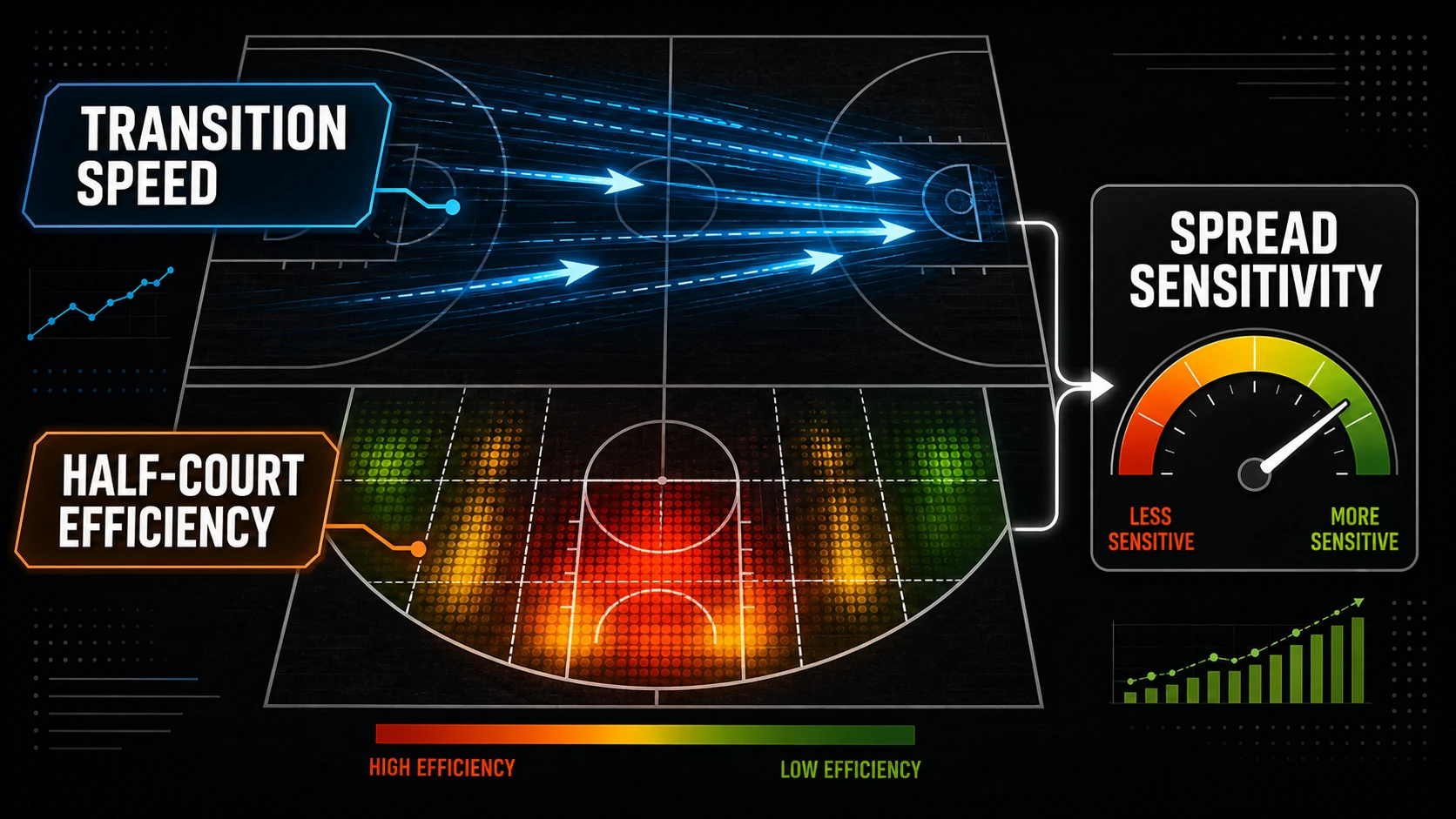
Pace is not shorthand for over. It is the count of opportunities a game is likely to produce. What those opportunities become depends on efficiency, turnovers, offensive rebounds, free throws, and which team can impose its preferred shape. Treating pace as a one-word betting system throws away the part that matters.
The useful question in NBA pace betting is how tempo changes the distribution of the game. More possessions can lift the total, amplify a real efficiency gap, and give a favorite more chances to separate. Fewer possessions can compress the margin and keep an underdog alive. None of that guarantees a side. It tells the model where to look.
Measure possessions, not vibes
A fast-looking team is not always a high-possession team. Transition intent, early-clock shots, offensive rebounds, turnovers, and free throws all affect the final count. Use a consistent possession definition and keep overtime separate from regulation so the pace estimate is comparable.
Do not substitute raw event counts for pace without checking the dataset. A play-by-play feed can log substitutions, reviews, and administrative events that have nothing to do with possessions. The model needs a basketball denominator, not merely a busy file.
The registered play-by-play view below counts rows with recorded scoring fields by team. It is a coverage check, not a pace ranking; possessions still require a basketball definition.
Blend both teams' preferences
A matchup pace is not a simple copy of the faster team's average. One offense may push after misses while the opponent sends players back to stop transition. One defense may pressure the ball and create chaos while another concedes slow half-court possessions. Coaching, lineup, venue, rest, and score expectations all influence which style survives.
Build the estimate from both teams and test the interaction. Recent lineup-specific pace can be useful when a rotation change is real, but a short burst should be shrunk toward a longer baseline. If the expected ball handler or center is uncertain, the pace range should widen.
Pace moves totals through opportunity
The clean totals framework separates expected possessions from expected scoring per possession. A fast matchup with poor shooting and strong transition defense can still stay below the market. A slower matchup with elite efficiency and frequent free throws can still clear it. Pace sets the opportunity count; efficiency decides the conversion.
That separation makes the model easier to debug. When a total misses, ask whether the game created the projected number of possessions and whether those possessions scored as expected. A single combined prediction hides which assumption failed.
Pace can change the spread distribution
When one team has a genuine per-possession advantage, extra possessions give that edge more chances to appear. That can widen the expected margin and reduce the chance that one strange shooting stretch decides the game. A slower game can do the opposite by concentrating the result into fewer events.
This does not mean fast games always favor favorites. The efficiency edge must be real, and higher possession counts can also create more scoring variance. Model the margin distribution rather than repeating a slogan about tempo. The spread is a price, not a referendum on which team prefers to run.
Lineups can rewrite the tempo
Point guards, backup ball handlers, rim-running centers, and switchable defensive groups can change how quickly a team attacks. An injury can remove transition creation or force a slower reserve into control. A small lineup may push pace while giving up offensive rebounds that extend opponent possessions.
Use expected lineup minutes, not a season average detached from the available roster. If the rotation is unknown, publish a range or pass. A precise pace estimate built on the wrong lineup is decorative arithmetic.
Props inherit pace through role
More possessions create more team opportunities, but player props do not scale evenly. The player must be on the floor and involved in the actions that gain volume. A high-usage creator may absorb extra shots and assists. A low-usage spacer may see almost no change. A center's rebound chances depend on the opponent's shot profile as much as the pace itself.
Translate team pace into each player's minutes and role. Do not add the same bump to every starter. The correct adjustment can be positive, negligible, or even negative when a faster lineup changes who closes.
Live pace needs patience
Early game pace is noisy. Free throws, reviews, turnovers, and a few transition possessions can make a short segment look faster or slower than the underlying intent. A live model should count actual possessions, inspect shot-clock usage, and update the rotation assumptions rather than extrapolating the scoreboard.
Preserve the pregame estimate and show why the live estimate changed. A new lineup pattern is evidence. A burst of made shots is mostly an efficiency result. Confusing the two is how a live total model chases points that already happened.
Validate the tempo feature forward
Train on earlier games, test on later games, and compare a model with pace inputs against the same model without them. Measure whether the feature improves error and probability calibration. If publishing an ATS record, include wins, losses, percentage, window, and sample. If the subdivision is thin, do not turn it into a rule.
Pace can be one of the most useful NBA features because it connects team style to totals, spreads, and props. It can also become a story machine when the definition is loose. Count the possessions, model the interaction, and let the price decide whether the insight is actionable.
The pace card
- Use a consistent regulation possession definition.
- Blend both teams' styles and expected lineups.
- Separate possession count from efficiency.
- Translate tempo into player opportunity by role.
- Update live only when new possessions or rotations justify it.
- Pass when lineup uncertainty makes the pace range too wide.
Tempo is not the pick. It is the frame around the pick. Get the frame right, and the rest of the projection has somewhere honest to live.
NFL ATS cover-margin distribution
Bars count completed NFL schedule rows by closing-spread cover margin using the repository canonical home-margin grading convention.
Model calibration from graded predictions
Calibration points render only when a verified source binds prediction probabilities to settled outcomes for the same observations.