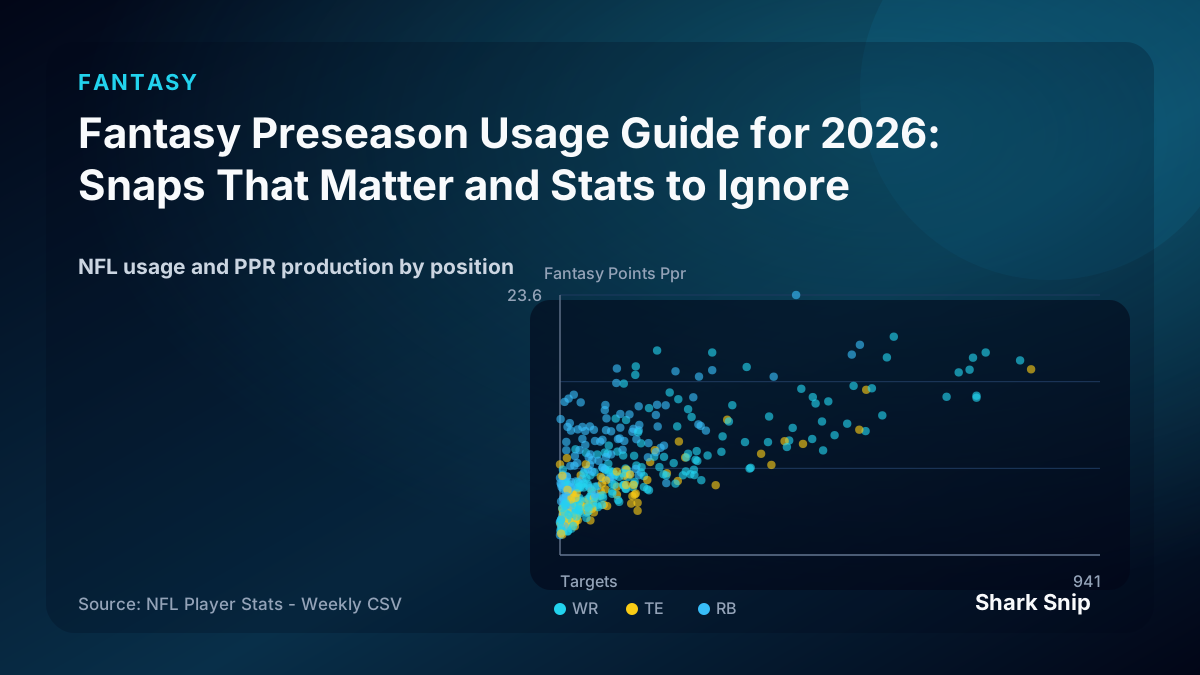
Preseason box scores can make the wrong player famous for a week. A backup running back with 70 yards against third-team defenders is not the same as a starter playing every third-down snap with the first offense. Fantasy drafters should care about usage, not August stat lines.
Who Lines Up When Starters Are On The Field
The only preseason snaps that tell you anything are the ones played alongside the first-team offense. A backup running back ripping off chunk gains in the fourth quarter against guys who'll be selling insurance in September is noise. The signal is who jogs onto the field with the actual starting quarterback and the real offensive line. Watch the opening two or three series like a hawk: which back gets the first carry, who's split out wide in three-receiver sets, which tight end is in-line versus flexed. That pecking order at full strength is what carries into Week 1, and it's available to anyone willing to watch instead of reading a box score.
The common mistake is grading the wrong reps. People see a name at the top of the rushing line and draft accordingly, never noticing those yards came against third-stringers after the studs hit the showers. Pressure-test every preseason takeaway with one question: who was across from him? If you can't confirm the competition was first-team defense, throw the number out. Coaches also script early-game personnel, so the alignment you see in those opening drives is closer to a stated depth-chart intention than anything a beat reporter will hand you. Trust your own eyes on who's out there with the ones.
Route Participation And The Committee Tells That Matter
For pass-catchers, snaps are table stakes; route participation is the real currency. A receiver can play forty snaps and run a route on a handful of them if he's blocking on runs and sitting out empty sets. What you want is the guy who's on the field for the dropbacks and actually releasing into a pattern, especially on third down and in two-minute looks. Those are the obvious passing situations where the offense reveals who it trusts. A backup who stays in for those packages with the starters is telling you he's the next man up, regardless of where the printed depth chart slots him.
Running back committees announce themselves in the details, not the carry count. The tell that matters is third-down and two-minute work: the back who stays on the field when it's obvious pass is the one with standalone value, because passing-down usage survives game scripts that bury a pure early-down grinder. Watch goal-line reps too, since the guy who gets the short-yardage hat near the end zone owns the touchdown equity. When two backs split first-and-second down evenly but one clearly owns the passing snaps, that's not a true committee for fantasy purposes. Pressure-test it by asking which back you'd want if the team trailed by ten.
First-team deployment is the signal
Watch who plays with the starting quarterback, who leaves the field in two-minute drills, and who gets red-zone snaps. A receiver catching one pass from Joe Burrow or Dak Prescott with the starters can be more informative than a 100-yard night after the starters sit.
For rookies like Carnell Tate, Jordyn Tyson, and Makai Lemon, preseason value comes from alignment and route role. Are they outside-only players, slot movers, red-zone specialists, or full-time receivers? That answer moves rankings.
Running backs need role labels
Running back preseason touches can be misleading because teams protect veterans and test rookies. The key is role: early downs, third downs, goal line, two-minute, and pass protection. A back who blocks on third down can earn more fantasy-relevant snaps than a back with better rushing highlights.
If a team gives a young back goal-line work with the first unit, that matters. If the same back piles up carries after the starting offensive line sits, it is a note, not a ranking change.
Tie every note to draft cost
Preseason usage should move players differently based on price. A late-round receiver earning first-team routes can jump tiers. An early-round star sitting out does not need a downgrade because a backup scored in August.
The best draft rooms keep a preseason usage column next to ADP. That prevents overreacting to clips while still acting fast when a real role appears.
Practical checklist for Fantasy Preseason Usage Guide for 2026
Start by writing the decision in plain English: Fantasy football preseason usage guide for 2026: how to read first-team snaps, route participation, rookie roles, and misleading box scores. That keeps the page tied to a concrete lineup or draft decision, not a generic 2026 NFL take. Tag the note with fantasy-football, nfl, 2026-fantasy, preseason so you can find the same angle again when the board, depth chart, or injury report changes.
Checkpoint one is "Who Lines Up When Starters Are On The Field." Do not move past it until the data you are using would have been available before the decision. The supporting evidence should connect to this claim: The only preseason snaps that tell you anything are the ones played alongside the first-team offense. A backup running back ripping off chunk gains in the fourth quarter against guys who'll be selling insurance in September is noise. The signal is who jogs onto the field with the actual starting quarterback and the real offensive line. Watch the opening two or three series like a hawk: which back gets the first carry, who's split out wide in three-receiver sets, which tight end is in-line versus flexed. That pecking order at full strength is what carries into Week 1, and it's available to anyone willing to watch instead of reading a box score.
Checkpoint two is "Route Participation And The Committee Tells That Matter." Convert that section into one measurable field, whether it is a bye-week gap, route-share trend, waiver bid range, projected fantasy points, or market entry price. If the field cannot be written down, the angle is still a story instead of a model input.
Checkpoint three is "First-team deployment is the signal." Record the opposing case before acting. A useful note says what would make the thesis wrong, what late-week role news or ADP movement would confirm that the room already adjusted, and how small the first roster exposure should be.
- Who Lines Up When Starters Are On The Field
- Route Participation And The Committee Tells That Matter
- First-team deployment is the signal
- Running backs need role labels
- Tie every note to draft cost
Turn this into a model: open the Workshop, start a blueprint, see top creators, climb the leaderboard, or scout a squad on the NFL auto-battler.
Turning an angle like this into a model is concrete. Start with the thing that actually drives the edge — a usage trend, a schedule spot, a situational tendency, or a piece of news — and make sure you are only feeding it information you would have had before kickoff. Yesterday's box score and the closing line are not allowed to sneak in; a stat you only know after the game makes a model look brilliant in testing and lose money for real. Then tell it what to predict: who covers the spread, whether a player prop goes over, a yes/no on a market like anytime touchdown, or a season-long fantasy projection. Every piece of the model stays labeled in plain English, so anyone following your picks can see exactly why it bet what it bet.
How you test it matters more than how good the backtest looks. Run it on past seasons in order — train on what came before, grade it on the next week it has never seen — instead of letting it peek at the future. Then ask the only question that pays: does it beat the closing line? A model that cannot beat "just take the number the market closed at" is not worth the work. Check that when it says 60% it actually hits near 60%; if it runs hot or cold, fix that before you trust the confidence. And only bet the spots where the edge still survives after the juice, after sensible bet sizing, and after an honest look at last week's losing tickets — because a few good or bad weeks can hide both a winning approach and a losing one.
To make this concrete, open the Workshop with the same topic and rebuild the workflow above. A typical build for an article like this is one input feed (play-by-play, schedule context, or player usage), the angle-specific edge, the market you are betting, a test that walks through past seasons honestly, and bet sizing that keeps you disciplined. Everyone can see how it was built, and it climbs the leaderboard when it keeps beating the closing line over a real sample.
Related reading and tools
Keep building the board with fantasy ADP value tiers, FAAB strategy guide, target share vs air yards.
Named example board
Keep the page grounded with actual decisions. Josh Allen rushing props, Bijan Robinson usage, Puka Nacua target volume, Amon-Ra St. Brown reception stability, and Travis Kelce touchdown equity are all different cases even when they sit on the same fantasy or betting screen. The point is to map the name to the input that matters most.
- Role example: routes, carries, targets, and red-zone work before highlights.
- Market example: spread, total, team total, or prop price before prediction.
- Fantasy example: ADP, roster build, and scoring format before ranking.
- Review example: compare the final result to the original input, not only the box score.
Verified stat anchors and 2026 price checks
Use names as evidence, not decoration. The useful SEO win is that Joe Burrow, Josh Allen, Ja'Marr Chase, Bijan Robinson and Puka Nacua and Chiefs, Bills, Eagles and Lions appear inside decisions, thresholds, and internal links instead of being dumped into a keyword list.
Calibrate the fantasy take with real 2025 production before moving to 2026 price. StatMuse season pages list Jonathan Taylor at 1,559 rushing yards, 18 rushing TDs, and 44 receptions; Bijan Robinson at 1,478 rushing yards with 79 catches for 820 receiving yards; Jahmyr Gibbs at 1,223 rushing yards, 77 catches, and 616 receiving yards; Puka Nacua at 166 targets, 129 catches, and 1,715 receiving yards; and Amon-Ra St. Brown at 172 targets, 117 catches, 1,401 yards, and 11 receiving TDs. Cross-check that read against the FantasyPros 2025 PPR consensus finish before moving a player up or down the 2026 board.
- ADP rule: pay full freight only when role, team total, and contingency value all support the ceiling.
- FAAB rule: 45-70% for a real lead-RB takeover, 25-45% for a target-share breakout, 10-25% for a stable flex, 1-8% for streamers, and 0-3% for bench stashes.
- PPR tiebreaker: a Kyren Williams-style rushing profile and a Gibbs or Bijan receiving profile should not be priced the same if catches are worth a full point.
- QB rushing rule: Josh Allen and Jalen Hurts archetypes deserve separate math from pocket passers because goal-line rushing can change weekly ceiling and late-round replacement value.
Turn those names into decisions: draft, fade, trade, stash, or bid only when the 2026 price leaves room after role risk. Related workflows: fantasy ADP value tiers, target share vs air yards, FAAB strategy.
Research note board
Use this draft-room board before moving a player up or down. It keeps projection, price, and format separate.
| Decision | Check first | Example application | Do not act if |
|---|---|---|---|
| Draft | ADP, scoring format, role certainty | Joe Burrow at sticker price versus Josh Allen at a discount | The room is charging for ceiling while role risk is still unresolved |
| Trade | Rest-of-season role, playoff schedule, roster need | Ja'Marr Chase as a need-based target instead of a generic upgrade | Both sides depend on the same fragile team environment |
| Waiver or stash | Injury-away upside, first-team reps, FAAB reserve | Bijan Robinson profile compared with a short-term streamer | The move costs flexibility without adding a clear starting path |
Use the examples as planning context, not as a bet recommendation. Lines, roles, injuries, and depth charts can move quickly.
Educational analysis only, not a bet recommendation. Check current lines, injuries, rules, contest terms, and local regulations before acting.
DFS projected ROI vs ownership %
Projected GPP ROI multiplier vs projected ownership across simulated lineups. Sub-10% leverage plays compound when they hit; chalk plays cap your upside even when the projection is dead-on.
Prop OVER hit rate vs line distance from median
Empirical hit rate of OVER bets as the prop line moves away from the player projection median, measured in standard deviations. A line set 1sd below the median hits ~84% of the time — but books price the juice to match.