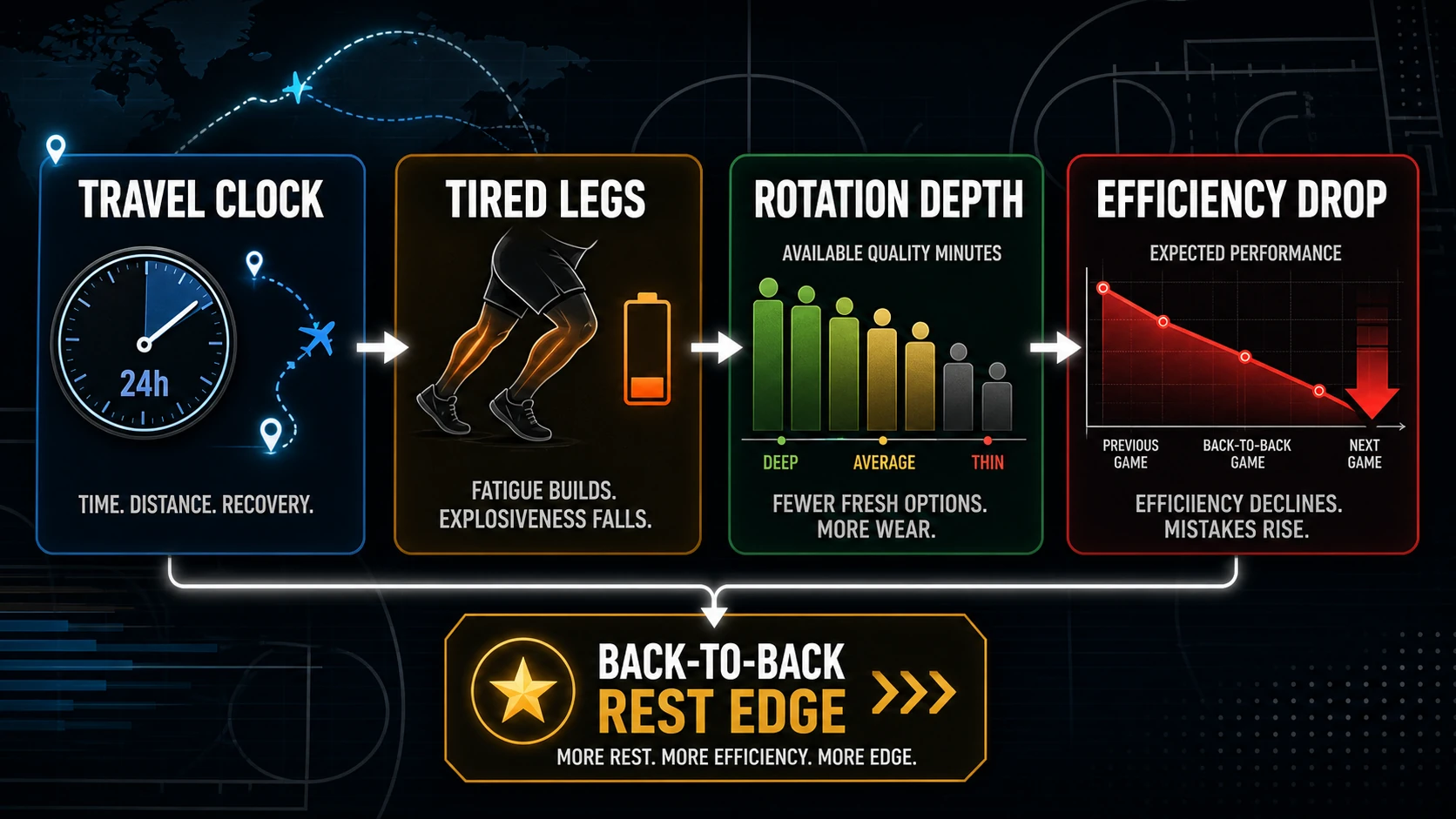
A back-to-back is a schedule label, not a bet. It tells you that a team played the previous day. It does not tell you how far the team traveled, who carried the workload, whether the prior game was competitive, who is resting tonight, or how much of that information the market already priced.
The useful version of NBA back to back betting starts by replacing the label with a workload profile. Home or road. Travel or no travel. Time-zone change or none. Heavy starter minutes or a quiet night. Opponent rested or equally compressed. Once those pieces are visible, the schedule can enter a projection without pretending every second night is the same.
Classify the spot before assigning an effect
Separate home-to-home, home-to-road, road-to-home, and road-to-road sequences. Add travel distance, direction, arrival timing when available, and the opponent's rest. The same calendar pattern can mean sleeping at home after an easy win or landing late after an exhausting road game. Those are not comparable observations.
Keep the prior game state too. Overtime, foul trouble, a short bench, or a late comeback can concentrate workload. A blowout can spare starters even though the schedule still says back-to-back. The fatigue input should describe what happened, not merely that a game existed.
Minutes and availability carry the signal
Rest effects often reach the betting board through coaching decisions. A veteran may sit. A starter may lose part of the closing rotation. A reserve may gain minutes but inherit a lower-usage role. Those changes move props and team projections more directly than a generic fatigue tax.
Use the latest official status and expected lineup, each with a timestamp. If several players remain uncertain, widen the range or decline the bet. A schedule model that assumes full availability while the coach is managing workloads is solving the wrong game.
Spreads need an interaction, not a flat deduction
A tired team is not automatically worse by the same amount in every matchup. Depth, style, travel, opponent pressure, and expected pace decide how fatigue can show up. A deep roster may absorb a compressed night. A thin rotation facing aggressive ball pressure may have fewer places to hide.
Apply rest after the base team-strength projection, then test interactions instead of hard-coding a universal adjustment. The model should be allowed to learn that some schedule combinations matter and others vanish into noise. If the effect does not hold in later games, remove it.
Totals can move in either direction
Fatigue can lower offensive execution, but it can also damage transition defense, closeouts, and rebounding. A slow opponent may turn the game into a half-court grind. A fast opponent may force the tired team to defend more possessions than it wants. The total depends on which mechanism dominates.
Project possessions and efficiency separately. Let schedule context affect each component where evidence supports it. Do not start with the desired over or under and backfill a fatigue story. The same workload profile can point toward fewer possessions and worse defense at once.
Props reveal where the workload is concentrated
Player props are often the cleaner place to express a rest view because the assumptions are specific. Expected minutes, shot volume, rebounding position, and initiation duty can all change on the second night. A broad team adjustment may hide those shifts.
Still, do not turn fatigue into a blanket under. A starter resting can create more opportunity for a reserve. A shortened rotation can raise another player's minutes. The question is who gets the work and whether the posted line reflects it.
Live markets do not prove the pregame story
A tired team starting well does not mean fatigue is fake, and a poor stretch does not prove it. Live betting adds new information about pace, rotation, foul trouble, and shot quality, but early scoring is noisy. Reprice from observed possessions and actual rotations rather than narrating every run as tired legs.
Preserve the pregame projection when making a live update. That makes it possible to see which assumptions changed and which merely had a volatile outcome. Without that record, live analysis becomes hindsight with a scoreboard.
Validate by schedule state and market time
Train on earlier seasons and test forward. Group results by the workload features actually used, not by a broad back-to-back label after the fact. A published ATS record must show wins, losses, percentage, window, and sample. Thin subdivisions need an uncertainty label, not a stronger headline.
Compare the model with and without the rest features. If the rest layer fails to improve later-game calibration or error, it has not earned its complexity. A plausible mechanism is a hypothesis until the holdout agrees.
The pregame card
- Classify the travel and venue sequence.
- Record prior-game workload and rotation depth.
- Confirm current availability from timestamped sources.
- Project spread, total, and props through separate mechanisms.
- Capture the market after the relevant news was public.
- Pass when the lineup or workload evidence is too uncertain.
The schedule can matter without becoming a system. Treat rest as context, not prophecy. The market already sees the calendar. Your job is to describe the night more accurately than the label does.
Expected value from graded outcomes
Expected-value cells render only when a verified source binds observed win outcomes to the price paid for the same bets.
Breakeven win rate at recorded American prices
Breakeven probability is calculated only from American prices that were actually captured in the odds-history table.